




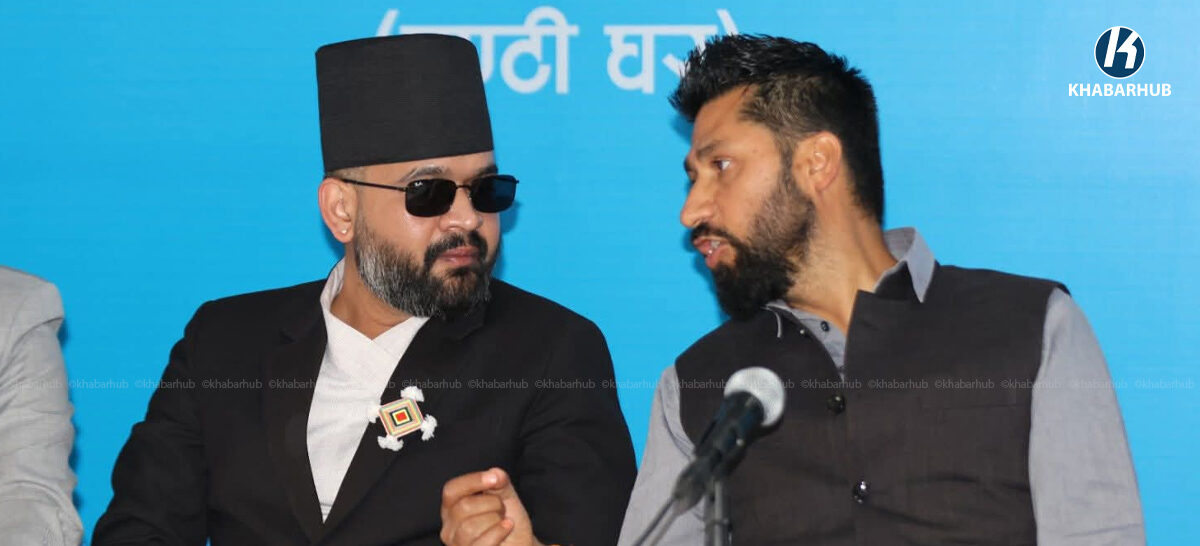
KATHMANDU: Discussion has intensified over the Rastriya Swatantra Party’s (RSP) statute, which was amended for the fourth time during the party’s first general convention held in Chitwan on June 21-26, 2026.
A provision included in the revised statute has sparked debate over whether the party could seek an alternative to current Prime Minister Balendra Shah in the future.
Following the publication of the statute, some political observers have speculated that party Chair Rabi Lamichhane could eventually challenge Prime Minister Balen’s leadership. Although Lamichhane is not currently in a position to exercise such authority immediately, the new provisions have led to questions about the future balance of power within the party.
Analysts argue that the statute could place not only Balen but any future parliamentary party leader under greater pressure, while significantly strengthening the authority of the party president.
One of the key reasons cited is the expanded authority granted to the party Chair under the revised statute. The Chairperson is empowered to nominate 51 members to the central committee, appoint 20 additional members to the secretariat, and nominate 10 office bearers. Critics argue that these provisions considerably enhance the president’s influence over the party’s organisational structure.
The party president shall be the supreme executive head of the organisation, its ideological guide and the symbol of party unity. Within the framework of the Constitution, the law and the party statute, the president shall provide strong and dynamic leadership. The president’s functions, duties and powers shall include:
Some commentators have also pointed to the recent withdrawal of cooperative fraud cases against Lamichhane from various district courts as another development that could strengthen his political position.
How Balen became prime minister
The political developments leading to Balendra Shah’s rise to the premiership began with the protest movement of September 8-9, 2025. Following the movement and the collapse of the then Nepali Congress–CPN-UML coalition government, an interim administration led by former chief justice Sushila Karki was formed on September 12, 2025.
At the time, Balen, who was serving as Mayor of Kathmandu Metropolitan City, appeared to support Karki’s leadership. Lamichhane was also viewed as being indirectly associated with the broader political developments. During the movement, Lamichhane was in Nakkhu Prison but was later released before the election process moved forward.
The Karki-led government announced the election date for March 5. The Rastriya Swatantra Party, led by Lamichhane, contested the election, with Balen also joining the campaign.
Following the Gen-Z protests, political groups advocating alternative politics sought to unite ahead of the elections. As part of that effort, Balen and Lamichhane signed a seven-point agreement after Balen resigned as mayor of Kathmandu Metropolitan City to pursue national politics alongside the RSP.
Under Clause 4 of the agreement, Lamichhane would continue as the party’s central president, while Balen Shah would serve as the parliamentary party leader and the party’s candidate for prime minister following the House of Representatives election.
The RSP subsequently contested the March 5 election under that arrangement and secured an unexpectedly strong mandate, coming close to a two-thirds majority.
Having campaigned extensively across the country, Balen achieved his political objective. Following the election results, the party’s central committee elected him parliamentary party leader. He was sworn in as prime minister on March 27, coinciding with the festival of Ram Nawami festival.
When Balendra Shah became the parliamentary party leader after the party amended its statute, President Rabi Lamichhane did not object. Even though Balen had joined the party only a few months earlier, there was little internal resistance to his appointment as both parliamentary party leader and the party’s prime ministerial candidate. While some leaders privately expressed dissatisfaction, there was no significant public opposition.
Following Balen’s appointment, he and Lamichhane jointly decided on the party’s ministerial nominees, reflecting what appeared to be a power-sharing arrangement between the two leaders.
A similar understanding was evident during the party’s first general convention in Chitwan. In line with their earlier agreement, Prime Minister Balendra Shah did not contest the party presidency, allowing Lamichhane to be elected unopposed.
However, controversy emerged after the party’s revised statute was made public. The version circulated on the third day of the general convention did not appear to contain a provision allowing the party president to remove the parliamentary party leader.
But the statute released later on Monday grants the party president the authority to replace the parliamentary party leader under certain circumstances.
The development has drawn widespread attention within the party. Several leaders claim there are differences between the statute endorsed during the convention’s closed session on and the version later published. Although leaders considered close to Balendra Shah have expressed reservations, none has publicly detailed the specific changes.
A comparison between the statute presented during the convention and the version now in force suggests significant differences. Some political observers have even speculated that the revised provisions could eventually trigger tensions between Balendra Shah and Rabi Lamichhane, although party sources insist no such conflict currently exists.
According to party insiders, the new provisions are intended to ensure that the prime minister, who also serves as the parliamentary party leader, remains accountable to the party’s policies, principles and directives. Leaders close to Lamichhane argue that the prime minister has increasingly pursued his own political course.
The opposition has also questioned Prime Minister Balendra Shah’s role in recent developments. Attention has particularly focused on Bipin Acharya, coordinator of the party’s statute amendment task force, who is widely regarded as being close to Lamichhane.
What does the revised statute say?
The statute amendment task force was coordinated by then Joint General Secretary Bipin Acharya. According to several party leaders, the report presented during the general convention differs from the statute that was later officially published.
Leaders say delegates had little opportunity to debate the proposed amendments during the convention because the statute was tabled and endorsed unanimously without detailed discussion.
Article 68 of the statute published on Monday sets out provisions for the removal or recall of the parliamentary party leader. Under the statute, the position of parliamentary party leader automatically becomes vacant in the following circumstances:
(a) If the leader resigns in writing or passes away.
(b) If the leader ceases to be a member of the Federal Parliament or the Provincial Assembly, either because the membership is revoked or the term expires.
(c) If the leader resigns from the party or is expelled.
(d) If the leader loses a vote of confidence in the legislature while heading the government.
(e) If the leader fails to comply with policy directives issued by the party president under Article 11(a)(3) of the party statute.
(f) If the parliamentary party passes a motion of recall or no confidence against the leader.
Article 11(a) of the Rastriya Swatantra Party’s statute defines the functions, duties and powers of the party president. Among those powers is the authority to coordinate with the parliamentary party.
“If these provisions were inserted later without the approval of the convention, it would certainly require investigation,” the leader said. “The prime minister has not yet made any public comment on the matter.”
The relevant provision states that the party president is responsible for maintaining coordination between the party organisation and its parliamentary wing and may issue policy directives to the parliamentary party. The statute further makes it mandatory for the parliamentary party, its leader and its members to comply with such directives.
Article 11(a) states:
Article 11: Functions, duties and powers of party office-bearers
(a) Functions, duties and powers of the party president
The party president shall be the supreme executive head of the organisation, its ideological guide and the symbol of party unity. Within the framework of the Constitution, the law and the party statute, the president shall provide strong and dynamic leadership. The president’s functions, duties and powers shall include:
(1) Ideological and political leadership: To provide overall political, organisational and ideological leadership to the party and strengthen the organisation while upholding its ideals, principles and democratic values, ensuring that it remains transparent and accountable to the people.
(2) Official representation: To present and represent the party’s official position in national and international forums, before state institutions and with other political parties as the party’s chief leader and official representative.
(3) Coordination with the parliamentary party: To maintain ideological, policy and political coordination between the party and its parliamentary party. If the party president is not serving as the parliamentary party leader, the president may issue policy directives to ensure the effective representation and implementation of the party’s official policies, principles, decisions and positions in Parliament. The parliamentary party, its leader and all of its members shall be obliged to comply with such directives.
Article 68(1)(e) of the statute states that the position of parliamentary party leader becomes vacant if the leader fails to comply with the policy directives issued by the party president under Article 11(a)(3).
Similarly, Article 68(1)(f) provides that the parliamentary party leader may be removed if a motion of recall or no confidence is passed against him or her within the parliamentary party.
Taken together, these provisions have led some political observers to argue that party Chair Rabi Lamichhane could, under certain circumstances, initiate a process that results in Prime Minister Balendra Shah losing his position as parliamentary party leader.
Since the prime minister’s position is tied to the leadership of the parliamentary party, such a development could also affect his tenure as head of government. Observers say that if Lamichhane enjoys stronger backing within the party than Balen, the revised statute could significantly strengthen the party president’s position.
Some party insiders also believe the amendments reflect the influence of Bipin Acharya, who coordinated the statute amendment task force and is regarded as being close to Lamichhane. However, when asked about the issue, a senior party source declined to comment directly.
“The prime minister is also a party member and must follow the party’s policies and rules,” the source said. “The party’s policies should apply equally to everyone.”
Meanwhile, some RSP leaders argue that the amendments were introduced to ensure the prime minister remains accountable to the party organisation. Several delegates who attended the general convention, however, have said they were unaware of the revised provisions at the time the statute was endorsed.
The party statute also provides for two general secretaries. However, the general secretary reportedly associated with the Balendra Shah faction has yet to be appointed by party president Lamichhane. As a result, some leaders believe the statute amendments were largely driven by the party president and those involved in the amendment task force.
What does the Balen faction say?
Prime Minister Balendra Shah has not publicly stated whether he supports or opposes the revised statute. Despite frequently responding to political controversies through social media, he has remained silent on the issue.
A leader considered close to Balen said the faction is still reviewing the new statute.
“The version released on Monday contains provisions that were not included in the document presented during the convention,” the leader said. “Clauses (e) and (f) have been added. We are trying to understand how that happened.”
Leaders including Ganesh Karki, Sagar Dhakal, Bhupdev Shah and Sunil Lamsal have not publicly criticised the amendments but are said to have expressed concerns privately. The issue has fuelled speculation within sections of the party.
The leader further claimed that the earlier draft contained only Clauses (a), (b), (c) and (d).
“If these provisions were inserted later without the approval of the convention, it would certainly require investigation,” the leader said. “The prime minister has not yet made any public comment on the matter.”
Has the alarm bell rung for Balen?
Asked whether the revised statute could affect Prime Minister Balendra Shah’s position, several party leaders said the amendments were intended to strengthen internal accountability rather than target any individual.
One senior leader said the RSP was committed to ensuring that the promises it made to the public would not be compromised.
When asked about the issue, Minister Biraj Bhakta Shrestha dismissed speculation that the statute could destabilise the government.
“The party has the authority to frame its own statute,” Shrestha said. “The government has been formed on the basis of the people’s mandate, and there should be confidence that the Prime Minister will serve the full five-year term. The adoption of a party statute does not automatically mean the Prime Minister will be replaced.”
He added that the party’s internal rules were designed to govern the organisation and said there was close coordination among party President Rabi Lamichhane, senior leaders and Prime Minister Balendra Shah.
“There is no reason to doubt the relationship between the party leadership and the Prime Minister,” he said.
Earlier, party leader Samiksha Baskota had also maintained that the party would honour the public mandate, noting that voters had supported Balendra Shah as the party’s prime ministerial candidate for a five-year term. At the same time, she said party leaders should remain accountable to the organisation.
Party leader Ganesh Parajuli also downplayed concerns over the revised statute. He said the party operates according to its own rules and policies and argued that the amendments should not be interpreted in different ways.
While leaders considered close to Lamichhane have generally expressed satisfaction with the revised statute, those viewed as being closer to Balendra Shah have reportedly voiced reservations.
At the same time, several party leaders point out that Balendra Shah was given a five-year mandate to lead the government under the party’s earlier political agreement, making any immediate intervention by the party president unlikely.
Leaders including Ganesh Karki, Sagar Dhakal, Bhupdev Shah and Sunil Lamsal have not publicly criticised the amendments but are said to have expressed concerns privately. The issue has fuelled speculation within sections of the party.
Some leaders believe the revised provisions theoretically create a mechanism through which the parliamentary party leader could be removed under specified circumstances, potentially affecting the prime minister’s position. Others argue that the amendments reflect an effort by the party leadership to ensure greater organisational discipline and accountability.
Political analysts say it is natural for a party to establish internal rules governing the conduct of its leaders and that the statute should not necessarily be interpreted as evidence of an immediate power struggle.
Nevertheless, some observers believe the inclusion of the new provisions suggests that Lamichhane sought to strengthen the party president’s institutional authority. Although the statute does not automatically place Balendra Shah’s position at immediate risk, analysts say it provides a framework that could become politically significant in the future if internal disputes emerge.
At the same time, several party leaders point out that Balendra Shah was given a five-year mandate to lead the government under the party’s earlier political agreement, making any immediate intervention by the party president unlikely.
Even so, the revised statute has reinforced perceptions that Lamichhane now holds greater organisational authority within the RSP.





Comment