




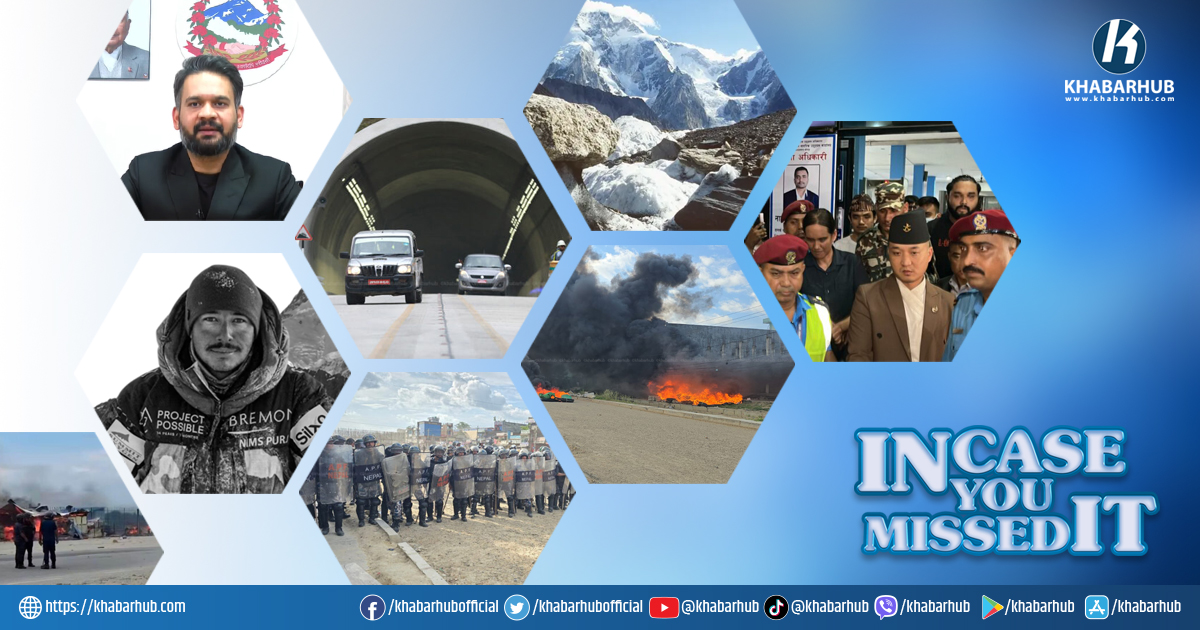
KATHMANDU: The past week in Nepal unfolded as one of the most consequential in recent months, marked by a profound national tragedy, communal unrest in the eastern Tarai, significant political realignments, and a major infrastructure milestone.
The death of internationally celebrated mountaineer Nirmal Purja, popularly known as Nimsdai, in an avalanche on Pakistan’s Broad Peak brought the country together in grief. At the same time, the violence that began in Dewanganj, Sunsari, and later spread to Siraha exposed deep social fragilities and raised urgent questions about policing, federalism, and state accountability.
Parallel to these crises, Prime Minister Balendra Shah sought to position himself as both a conciliator and a reformist, while developments in provincial politics, the Nagdhunga tunnel inauguration, and the end of Dr. Govinda KC’s hunger strike added further layers to an unusually eventful week.
The loss of Nirmal Purja: A national and global moment
Nirmal Purja’s death was not merely the loss of a mountaineer; it was the loss of a symbol. His journey from a village in Myagdi to the British Gurkha Regiment, the United Kingdom Special Forces, and eventually to the summit of all 14 eight-thousanders in a record six months and six days represented one of the most extraordinary stories in modern mountaineering.
The most important lesson of the week is that national unity cannot be sustained by rhetoric alone. It requires credible institutions, impartial investigations, responsive local governance, and political leadership that can prevent crises rather than merely manage them after lives have been lost.
Purja helped redefine the global image of Nepali climbers. For decades, Nepal produced elite high-altitude climbers whose achievements were often overshadowed by foreign expedition leaders. Purja changed that narrative by becoming the face of a record-breaking project, a Netflix documentary, and an international expedition business.
His death also highlighted the enduring risks of high-altitude climbing, even for the world’s most accomplished mountaineers. The tragedy reminded Nepal that mountaineering remains both a source of national pride and a profession of extreme danger. The widespread emotional response across the country showed how deeply Purja had entered Nepal’s national consciousness.
Dewanganj: When a local dispute became a national warning
The most politically significant development of the week was the violence in Dewanganj, Sunsari. What reportedly began as a dispute over loud music during a Bolbom pilgrimage procession escalated into deadly clashes, arson, vandalism, and police firing. The deaths of Om Prakash Mehta and Jay Prakash Mehta, followed by the later death of Ganesh Yadav in Siraha, transformed a local conflict into a broader crisis.
The spread of unrest to other parts of Sunsari and then to Siraha revealed how quickly communal tensions can travel across district boundaries in the age of instant communication and emotional mobilization. The deployment of the Nepal Army underscored the seriousness of the situation.
Beyond the immediate violence, the incident exposed three structural weaknesses: fragile inter-community trust, limited local conflict-management mechanisms, and public distrust in the impartiality of state institutions.
The events showed that Nepal’s social harmony cannot be taken for granted and that localized grievances can rapidly acquire wider political and communal meanings.
The government’s response: Compensation, inquiry, and symbolism
The seven-point agreement between the government and the victims’ families was an attempt to de-escalate tensions through a combination of relief, recognition, and accountability. The decision to begin the process of declaring the deceased as martyrs, provide Rs 1 million to each family, offer employment to one family member, and promise a fair investigation carried both practical and symbolic weight.
However, compensation alone cannot restore public confidence. The credibility of the promised investigation will depend on whether it is seen as genuinely independent and whether any findings lead to meaningful legal action. In many past crises, governments have announced inquiries that failed to produce accountability. This history makes implementation more important than announcement.
The agreement to examine the legal status of the local madrasa also reflected the political sensitivity of the issue. While legal scrutiny of institutions is legitimate, such measures must be handled carefully to avoid reinforcing perceptions of collective suspicion against a community.
Prime Minister Balen Shah: Balancing empathy and authority
Prime Minister Balendra Shah delivered two public messages that revealed the delicate balancing act facing his government. In his televised address, he emphasized national unity, social harmony, constitutional rights, and the need for a transparent investigation. In his later Facebook post, he adopted a more emotional tone, acknowledging that society had become divided and that citizens were afraid to face one another.
This dual messaging was politically significant. The formal address sought to reassure institutions; the social media message sought to connect with public sentiment. Shah’s acknowledgment that deaths caused by security personnel cannot be treated as normal was particularly notable, as it suggested a willingness to recognize the gravity of state violence rather than dismiss it as an operational necessity.
Yet the government also faces a credibility challenge. Shah himself admitted that the state’s presence “was not enough.” That admission may be honest, but it also raises expectations that the government must now demonstrate stronger preventive capacity, not merely post-crisis management.
Federalism returns to the center of debate
The meeting between Prime Minister Shah and Madhesi leaders turned the Sunsari crisis into a debate about federalism. Leaders argued that stronger provincial authority and provincial police might have enabled a more culturally informed and locally trusted response.
Shah’s emphatic rejection of the anti-federalist label was politically important. By insisting that his government seeks to strengthen rather than weaken federalism, he attempted to reassure Madhesi parties whose support may be crucial for political stability.
This debate goes beyond the immediate crisis. Seven years after federalism was implemented, questions remain about the real distribution of power between the federal center and the provinces. The Sunsari violence may become another example used by federalist forces to argue that constitutional decentralization remains incomplete.
RSP consolidation and shifting political alignments
The appointment of Prime Minister Shah as senior leader of the ruling Rastriya Swatantra Party signaled further institutional consolidation of the relatively new political force. Although he was not made a central committee member, the move formally elevated his status within the party structure.
At the same time, the resignations of all Nepali Congress ministers from the Lumbini Provincial Government reflected a broader coalition shift following the UML-NCP understanding. This suggests that provincial politics is entering a new phase of realignment, with Congress preparing to move into opposition in a province where it had previously shared power.
These developments indicate that Nepal’s coalition landscape remains highly fluid and that provincial governments continue to be vulnerable to changes in national-level political equations.
Nagdhunga tunnel: A rare infrastructure success
Amid the week’s political and social turbulence, the inauguration of the Nagdhunga-Sisnekhola Tunnel offered a rare development success story. As Nepal’s first road tunnel, the project carries significance beyond transportation. It represents technological advancement, institutional learning, and the long-term value of Nepal-Japan cooperation.
The tunnel is expected to reduce travel time, ease chronic congestion at the Kathmandu gateway, and improve road safety. Equally important is the associated technical assistance for future tunnel planning and maintenance, which could help Nepal build domestic capacity for more complex infrastructure projects.
The years of delay caused by COVID-19, contractor issues, and local disruptions also serve as a reminder that completing major infrastructure projects in Nepal remains a difficult institutional challenge. The fact that the tunnel was eventually completed gives the government a tangible achievement at a time when public attention has been dominated by crisis.
Governance beyond crisis: Dr. KC, India, and business accountability
The end of Dr. Govinda KC’s hunger strike after a seven-point agreement showed that negotiation remains possible even in highly contentious policy disputes. However, as with previous agreements involving Dr. KC, the real test will be implementation.
India’s invitation to Prime Minister Shah for an official visit is diplomatically significant. It suggests that New Delhi is prepared to engage the new leadership directly despite recent political transitions in Kathmandu.
The court’s decision to release businessman Shekhar Golchha on Rs 10 million bail highlighted ongoing tensions between business interests, regulatory enforcement, and judicial processes. Such cases continue to shape public perceptions of economic accountability.
Conclusion: A week that revealed Nepal’s fault lines and possibilities
The past week revealed two Nepals simultaneously. One was a Nepal capable of producing global icons such as Nirmal Purja and completing landmark infrastructure projects such as the Nagdhunga tunnel. The other was a Nepal where communal tensions can escalate rapidly, where trust in state institutions remains fragile, and where federalism is still an unfinished political project.
The most important lesson of the week is that national unity cannot be sustained by rhetoric alone. It requires credible institutions, impartial investigations, responsive local governance, and political leadership that can prevent crises rather than merely manage them after lives have been lost.
If the government delivers a transparent inquiry into the Sunsari and Siraha violence, follows through on its agreements, and strengthens mechanisms for local conflict prevention, this painful week may become a turning point. If not, it risks becoming another entry in Nepal’s long history of tragedies that produced sympathy, compensation, and promises, but too little structural change.



Comment