




The World Trade Organization (WTO) stands at what is now undeniably an existential juncture. The recent failure of the 14th Ministerial Conference (MC14) in Yaoundé, which concluded on March 29, serves as a deafening alarm.
Dubbed the “Turning Point Ministerial,” the conference ended without a final ministerial declaration or even a chair’s summary capturing a conference-wide consensus. Since its creation in 1995 as the successor to the GATT 1947, the WTO has served as the definitive framework for global economic governance, seeking to replace power-based trade relations with a multilateral legal order grounded in fairness, predictability, and cooperation.
Today, however, the organization faces a “reform or die” moment, as the pillars of the rules-based system—binding rules, impartial dispute settlement, and the principle of non-discrimination—suffer from systemic paralysis.
This system is currently being challenged by what has been termed the “Great Trade Hack”—a frontal attack on multilateralism characterized by unilateral tariffs and the disregard of WTO rulings. The rise of unilateralism and nationalism is currently one of the biggest problems the WTO faces.
We are witnessing a resurgence of trade barriers implemented under the banner of “national security,” while the imposition of reciprocal tariffs ranging from 10% to 50% dynamites the twin pillars of tariff bindings and the Most-Favored-Nation principle. Equally troubling is the emergence of bilateral “napkin deals” and asymmetric arrangements where market access is used as a “carrot” to extract one-sided concessions. These deals prioritize coercion over fairness and threaten the stability of global trade, leaving smaller economies particularly vulnerable.
Perhaps the most visible symptom of this decline is the paralysis of the Dispute Settlement Understanding (DSU), widely regarded as the structured and binding process of conflict resolution. Today, this “crown jewel” is broken. Why? Because new members have not been appointed to the Appellate Body (the WTO’s final court), it has lacked the quorum to issue rulings since late 2019.
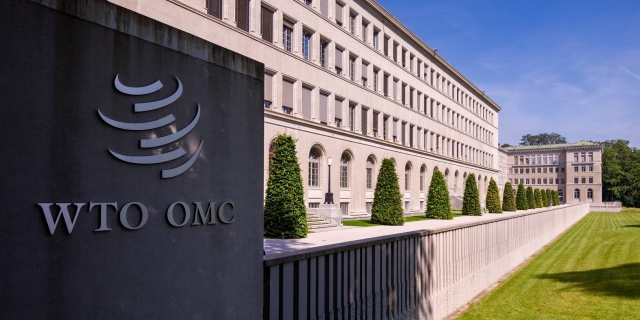
On September 26, 2025, the selection process was vetoed for the 90th time—a persistent deadlock fueled by long-standing U.S. concerns regarding judicial overreach and the need for fundamental systemic reform. This has left over 30 cases appealed since the paralysis began, creating a legal vacuum where losing parties can block the acceptance of panel reports by “appealing into the void.”
This practice allows members to circumvent WTO rules, as court decisions can no longer be finalized or enforced. The de facto suspension of the dispute-settlement mechanism has stripped the organization of its ability to enforce its own rules, making global trade rules increasingly unpredictable.
The inability of the WTO to make even modest progress at MC14 demonstrates the pressing need for change. For the first time in 25 years, the e-commerce moratorium was allowed to expire on March 31 after Brazil and Türkiye blocked a draft text that provided for a five-year extension. Similarly, consensus could not be reached on implementing the Investment Facilitation for Development Agreement (IFDA), despite 129 co-sponsors and around 60 delegations urging its incorporation.
These failures reflect a systemic weakness: the practice of equating consensus with absolute unanimity. When individual members can “take a hostage” to advance a pet policy, the organization’s ability to function is paralyzed, and its institutional authority is cumulatively eroded.
Despite this institutional inertia, a more hopeful reality exists: medium-sized countries and middle powers have renewed agency. In a direct rebuke to the stalemate, 66 members covering 70% of global trade—including Australia, Japan, and Singapore—announced they would independently forge ahead with a plurilateral Agreement on Electronic Commerce.
These “coalitions of the willing” show that when the central decision-making process is blocked, like-minded groups can still shape the future of trade. This “world minus one” model—where multilateralism is not contingent upon the participation of any single major power—may be the only way to preserve rule-based trade while circumventing institutional deadlock.
A deep and comprehensive reform is now an institutional necessity. The status quo is not an available option, as it will merely contribute to a continuous “downward trajectory”.
The European Union and other members have identified three pillars for a transformed WTO: Predictability, underpinned by a fully functioning and effective dispute settlement mechanism with a depoliticized appellate process; Fairness, ensuring a level playing field by strengthening disciplines on subsidies and State interventions while placing development at the heart of the mandate; and Flexibility, which requires moving past the practice of equating consensus with absolute unanimity in favor of “responsible consensus,” allowing “open plurilateralism”.
Today, the WTO stands at a critical crossroads. The disintegration of the rules-based order would most severely penalize the developing world, those who had the least voice in shaping the rules. To save the organization from irrelevance, members must reconcile efficiency with equity and cooperation with legitimacy. The goal is a fair, stable, and predictable global trading system where trade serves all, not just the beneficiaries of “Green Room Politics.” The question is no longer whether the WTO can survive, but whether its members are willing to make it worth saving.
The author is a BA LLB student at Kathmandu School of Law.





Comment