




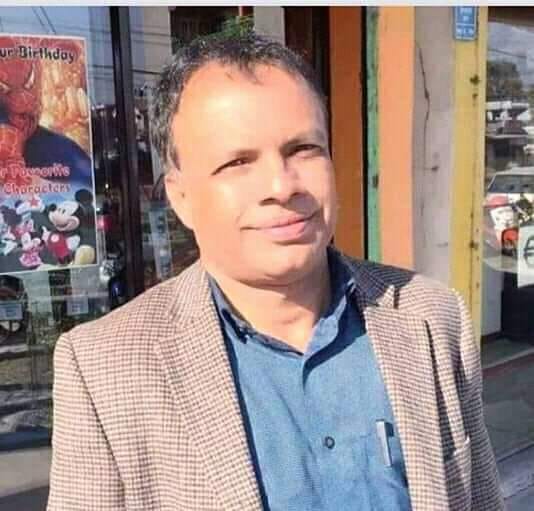
KATHMANDU: Gururaj Ghimire, who became General Secretary following the special general convention of the Nepali Congress (NC), is widely regarded as an intellectual leader. He is a candidate for the House of Representatives from Morang-4, a constituency neighboring that of party President Gagan Thapa.
In the 2022 election, Aman Lal Modi won this constituency with the support of the Nepali Congress under the Democratic Left Alliance. At present, the candidates in Morang-4 include Aman Lal Modi from the Maoist Centre, Jiwan Ghimire from the CPN-UML, and former journalist Santosh Rajbanshi from the Rastriya Swatantra Party (RSP).
Generally, it appears that the Nepali Communist Party (NCP) and CPN-UML are jointly challenging Nepali Congress General Secretary Ghimire. However, Ghimire claims he is confident of victory, citing a strong base of voters within his own party.
Wards 1, 2, 3, 8, 10, and 19 of Biratnagar Metropolitan City fall under Constituency No. 4. As the core urban area lies within this constituency, the Koirala residence is also located here. This urban belt alone accounts for nearly 50,000 voters.
As a heavyweight leader, General Secretary Ghimire faces a significant electoral challenge. Nonetheless, he asserts that he will defeat candidates from older parties, arguing that voters in his constituency are politically conscious and discerning.
We spoke with Ghimire about the Nepali Congress’s upcoming plans, its election manifesto, possible alliances, the party’s strength after the elections, the role of former office bearers and President Thapa, and the broader political situation in Morang-4. Presented below is an edited excerpt from our conversation with Ghimire:
You are the candidate from Morang–4. What is the situation there?
Morang-4 is a constituency with politically conscious voters. I am a completely new candidate in this election, but I represent an old and trusted party. Because of that, people here have strong confidence in me. I have worked in Morang-4 for a long time, and the public response has been very encouraging. As we begin internal preparations for the election campaign, there is visible enthusiasm among the people. After the Gen-G rebellion, we transformed the party–something others failed to do.
Who do you see as your main competitor? Where do you place yourself in the contest?
Everyone who has entered the electoral race is a competitor. I do not categorize candidates as primary or secondary, strong or weak. Anyone contesting the election is a competitor, and I see them all equally.
Does that mean you feel insecure?
Not at all. In the previous election, Amanlal won with the support of the Nepali Congress. The UML, as a traditional party, is naturally our competitor, and the newer parties are also active in their own ways. That is why I consider everyone equally, everyone is my competitor.
Given that, are you confident of winning?
I am very confident. I can see victory ahead. As a new and young candidate, I have not yet had sufficient opportunity to fully demonstrate my capabilities. I previously contested at the provincial level; this time, I am contesting for the House of Representatives, which brings a sense of newness. Most importantly, the trust of the people is with me.
Let’s talk about the party. Is there an internal challenge within the party this time?
The most important development is that the Nepali Congress has fielded candidates in all 165 constituencies. We are taking the party back to its original footing. In the 2022 election, we contested in only 91 constituencies and won 89 seats. The results of contesting elections in alliance with five parties and contesting alone are very different.
This time, we are confident of achieving better results than in 2022. The internal disputes within the party have been resolved through the general convention, and there is no need to further escalate them. There is no logical basis for linking changes in party leadership to election outcomes. We have gone into this election independently. Our candidates have already been finalized, and we have opened our account by securing one seat in Parliament.
It is being said that the Nepali Congress has become stronger after the change in leadership. However, there has been no nationwide wave in your favor. Critics also say that you and the party president have failed to run the country, while new faces are emerging with ambitions to become prime minister.
Elections are not about being flashy, fashionable, or entertaining. That may seem appealing to those who want to project themselves as leaders of new parties, but they are yet to be tested, and their credibility has not been established. They appear eager to abandon the responsibilities they have already been given in order to seek new positions.
Who can say they will not abandon those responsibilities again tomorrow? Politics does not operate according to personal wishes or ambitions; it runs on public sentiment. Instead of focusing on what people want and how to bring them happiness and prosperity, their priority seems to be popularity. An objective review of their activities so far is underway. Governance is not about showmanship—we need a clear roadmap for where the country is headed and how to take it there.
Will the Nepali Congress president and general secretaries also begin public programs after February 16?
Yes, we are preparing to roll out activities in phases. This was discussed in the party’s central work execution committee meeting as well. The party president will visit Biratnagar for a Koshi Province-level gathering. A large meeting is being organized in Janakpur on February 19, and programs across the country are being prepared. Leaders, including the general secretaries, are personally receiving invitations, and candidates from various constituencies are also calling us. We will participate as our schedules allow. Our full-scale activities will begin after February 16.
Will your first major meeting be held in Janakpur?
Yes. This decision was not made by following where others have held their programs. Janakpur had already been planned as the venue for our first major meeting. Since the party president is also a candidate from Sarlahi, we want to send a strong message by prioritizing Madhesh and addressing the long-standing issues there. That is why our first large election meeting is being held in Janakpur.
What is the status of the party manifesto? When will it be made public?
Work on the manifesto is ongoing. It was also discussed in today’s meeting of the execution committee. The broad framework has already been prepared, and we plan to make it public soon, before February 16.
What are the key priorities included in the manifesto?
The manifesto will be presented in a concise, bullet-point format. Voters should be able to read it within 15 minutes and form a clear and reliable understanding. It will not be a long, literary document, but a focused and practical one.
Education, health, and employment are our top priorities. We have placed strong emphasis on addressing the compulsion that forces young people to seek employment abroad and on promoting self-employment within Nepal. The manifesto includes only those commitments that are realistic and achievable, things that can be accomplished if our party forms a government independently.
There is a history of promises being made in manifestos but not fulfilled. How confident are you that this will not happen again?
We are fully aware of those criticisms. It is true that in the past, some commitments remained limited to paper. However, this time we have deliberately included only those promises that can realistically be fulfilled. We will not make empty promises or commit to actions beyond our capacity.
We have limited resources, and we must use them wisely. Without strengthening the economy, we cannot advance either national development or physical infrastructure. Keeping this reality in mind, we have presented a clear and practical list of commitments. I believe voters will find this manifesto credible and satisfactory.
Former NC President Sher Bahadur Deuba and other senior leaders have not been very visible in the election campaign. Doesn’t this confuse voters?
They are leaders who have carried great responsibility, and their contribution to the party is immense. We, including the new generation, are grateful for that. Senior leaders understand their roles and are fulfilling their responsibilities accordingly. Even though we may not always be in close dialogue with them for various reasons, we remain in contact and are aware of their activities.
They are working with voters in their respective constituencies. Since we have candidates in all 165 constituencies, it is incorrect to suggest that former presidents and senior leaders are not supporting the Nepali Congress. The party needs their support, and we have continuously urged them to contribute. There is no serious problem in this regard.
There are claims that they will not support or actively help the Nepali Congress win. What do you say to that?
We should not rely on rumors. We should speak based on facts and ground realities. They are working, and I believe they are contributing in their own areas and capacities.
What are the chances of former presidents and office bearers attending the Janakpur assembly?
The central office formally invites everyone to participate. Responsibilities are assigned, and coordination is done accordingly. We believe that senior leaders will participate and contribute as their schedules permit.
There is dissatisfaction that former office bearers and senior leaders, such as Purna Bahadur Khadka, Krishna Sitaula, Ramesh Lekhak, Prakash Man Singh, and others, were not given tickets. Is that true?
There is no dynastic politics in the Nepali Congress. Tickets are not distributed based on personal convenience. They are given by assessing the ground situation and understanding the sentiments of party workers. Winning the election is essential, it is not enough just to contest.
If there had been discrimination, those individuals would not have received opportunities in the past either. It is not reasonable to argue for candidacy purely based on personal preference. Purna Bahadur Khadka’s brother, Bishnu Khadka, is contesting the election, and Purna Bahadur Khadka himself did not seek candidacy. Dissatisfaction is natural when preferred candidates are not selected, but we are actively working to keep the party united. From our assessment, the party remains united.
What is your assessment; will the Nepali Congress secure a respectable number of seats after the election?
We will emerge as the largest party. We are confident of winning more than 100 seats directly. Additionally, we expect strong results in proportional representation, where our vote share is also increasing significantly. Voters have shown the greatest trust in us.
What is the basis of this confidence?
We have transformed the party and changed the leadership. We have produced leadership that the people want and need. This leadership change has sent a positive message. The Nepali Congress has clearly prioritized the nation and the Nepali people, and we are transparent and firm in our positions.
There is also discussion about electoral coordination and alliances. What is the Nepali Congress’s position?
This time, we will not form any alliance, neither from above nor below. The issue of coordination and alliance is closed. Had we intended to coordinate, candidate selection would already have reflected that. The Congress will contest the election on its own strength. We have no greed for power.
There are rumors that coordination might happen if UML Chair KP Sharma Oli offers Gagan Thapa the prime ministership. Is that possible?
Speculation will always exist. But we clearly stated before the election that we would not form any alliance, and that position remains unchanged. We will move forward independently.
So, no alliance even if the prime ministership is offered?
We aim to form a government on our own strength. If we are unable to do so, we will sit in the opposition. That is our principled position. We do not engage in opportunistic politics. If democracy or the nation faces a serious crisis, unity may be necessary, but that situation does not exist now. At present, we are competing in a healthy and democratic manner.
We will accept the people’s verdict with respect. Even if UML Chair Oli or others propose Gagan Thapa as prime minister, we are not in favor of forming any pre-election alliance.
Is it possible to make Gagan Thapa prime minister without coordination?
Yes, absolutely. We are confident of securing a majority. Public opinion is in our favor, and the Nepali people support us. There will be no pre-election coordination or alliance.
Is there a possibility of forming a post-election alliance with UML or other parties?
That is a separate matter. Right now, our focus is on securing a majority and forming a single-party government, one with unity of purpose. If that is not possible, decisions will be made based on the parliamentary situation and seat distribution at that time. We are not considering that scenario now.
So, who will be the next prime minister, Gagan Thapa, Balen Shah, KP Oli, or Pushpa Kamal Dahal Prachanda?
Two of those names have already served as prime minister. The possibility of Balen Shah becoming prime minister is low. Gagan Thapa, who has led multiple movements and represents the leadership the people are searching for, is the most credible choice. You will see: after the election, the Nepali people will make Gagan Thapa the prime minister.



Comment