




This year’s World Economic Forum was framed around dialogue in a contested world. From Geneva to Jakarta, Nairobi to New Delhi, that framing landed with a familiar mix of recognition and resignation. Yes, the world is contested. Yes, dialogue matters.
But for countries grappling daily with debt pressures, climate shocks, capital scarcity, and demographic urgency, Davos still feels like a conversation conducted at a comfortable distance from consequence.
The central message emerging markets heard from Davos 2026 was not one of renewed partnership, but of managed imbalance: a global system stabilised to protect what already works, while the costs of adjustment continue to fall elsewhere.
One thing Davos did clarify is that fragmentation is no longer a theoretical risk. It is now policy. Trade is being re-routed. Technology is being fenced. Capital is becoming more selective and more political. For advanced economies, this is framed as “de-risking.” For emerging markets, it often looks like higher costs with fewer choices.
Many developing countries are now expected to align, on supply chains, standards, security, or technology, without the fiscal buffers or bargaining power to make those choices safely. They are asked to absorb volatility they did not create, while being told this is the price of global stability.
The irony is difficult to miss. The same system that once urged openness and integration now rewards insulation and scale. Davos acknowledged the shift but largely accepted it as inevitable. What it did not confront is how destabilising that inevitability may be for countries still trying to climb the development ladder.
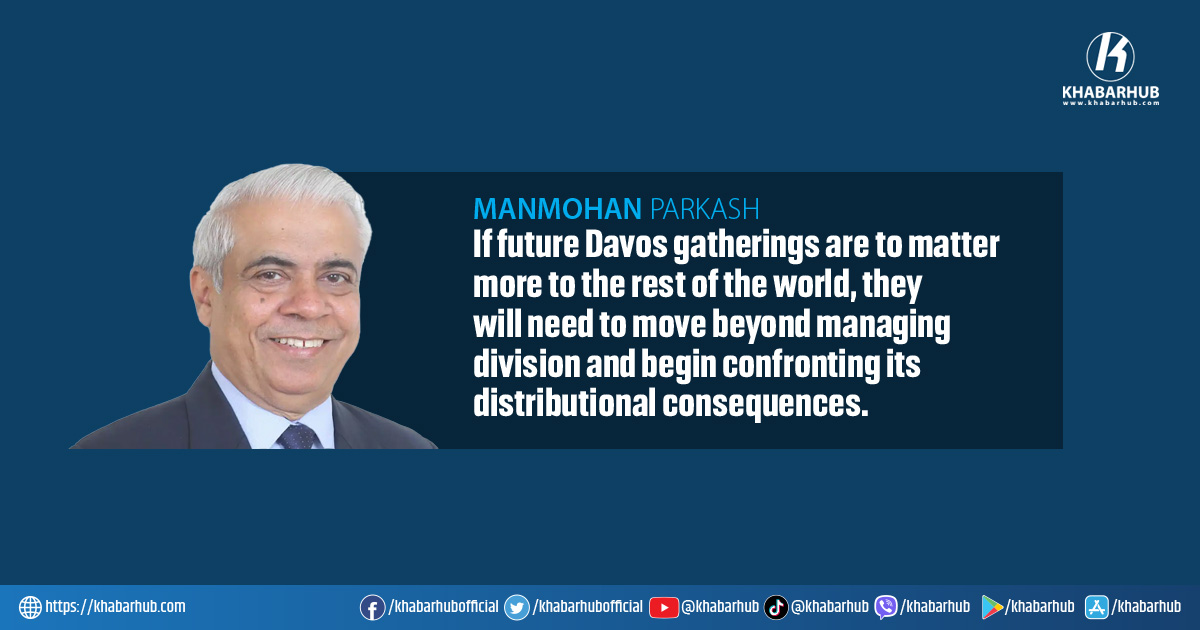
If future Davos gatherings are to matter more to the rest of the world, they will need to move beyond managing division and begin confronting its distributional consequences. The question is no longer whether the Global South will be heard—but whether it will be accounted for in how the global system is redesigned.
By Davos standards, the macroeconomic news was relatively good. Growth has held up. Inflation has eased. Financial markets remain orderly. These are not small achievements.
But from the perspective of emerging economies, this stability comes with a caveat: it has been purchased by tightening the margins for development.
Higher interest rates have made debt more expensive just as climate adaptation, infrastructure, and social investment needs are rising. Fiscal space has narrowed. Concessional finance is scarce and slow. Meanwhile, advanced economies retain the ability to subsidise strategic industries, underwrite transitions, and absorb shocks through their balance sheets.
For many emerging economies, this tension is already visible in rising debt-service ratios, delayed infrastructure projects, and increasingly difficult trade-offs between climate resilience and social spending.
The policy advice offered to emerging markets remains familiar: reform, discipline, credibility. None of this is wrong. But it is incomplete. What Davos still struggles to acknowledge is that the global environment itself has become less forgiving, even for well-run economies.
Stability without investment is not progress. It is endurance. Artificial intelligence dominated Davos conversations as a promise of future growth. For emerging markets, the promise is real—but so is the risk of being left behind again.
AI is not just software. It requires energy, data, capital, and infrastructure. Many developing countries lack all four at scale. Without deliberate efforts to widen access—through shared infrastructure, skills investment, and financing—AI could entrench technological dependence rather than enable leapfrogging.
Davos spoke often about ethical AI. It spoke less about economic participation. Who will own the platforms? Where will the rents accrue? How can domestic firms compete when entry costs are rising and standards are set elsewhere?
If AI becomes another growth story written primarily in advanced economies, its political backlash will not be confined to them.
Climate discussions at Davos were more grounded than in previous years. Adaptation, resilience, and insurance featured prominently. This reflects reality: climate change is already shaping growth paths and public finances across the Global South.
Yet the core problem remains unresolved. The countries most exposed to climate damage face the highest cost of capital. Private finance, while essential, will not flow at scale without public risk absorption. Blended finance structures remain too small, too slow, and too cautious.
What is still missing is a willingness to name climate adaptation a global public good that requires redistribution of risk, not just clever financial engineering. Without that shift, climate shocks will continue to undermine development and spill across borders in ways no amount of dialogue can contain.
Davos repeatedly returned to the importance of institutions and trust. This is true. Credible governance lowers costs and attracts investment. But institution-building is measured in decades. Development pressures are immediate.
For many emerging economies, the message feels circular: improve institutions to access capital, but do so while capital is scarce, shocks are frequent, and patience is thin. The cost of waiting is borne not in abstract indicators, but in delayed infrastructure, underfunded schools, and foregone growth.
Davos acknowledged the trust gap. It did not meaningfully close it.
Davos 2026 did what it could. It clarified that fragmentation is here to stay, that cooperation will be selective, and that risk-sharing remains politically constrained.
For emerging markets, that clarity matters. It reinforces the need to build resilience domestically, deepen regional ties, and mobilise local capital. But it also underscores that without deliberate reform of global incentives, convergence will slow and instability will rise.
Dialogue remains necessary. But dialogue without redistribution, without risk-sharing, and without recognition of asymmetry is no longer enough.
The danger is not that Davos is insincere. It is that the world it describes—one of shared challenges and collective responses—no longer matches the world it is helping to shape.
From the Global South, the message after Davos is clear: the costs of fragmentation are real, the patience for imbalance is thinning, and the demand is no longer just to be heard—but to be accounted for.
If future Davos gatherings are to matter more to the rest of the world, they will need to move beyond managing division and begin confronting its distributional consequences. The question is no longer whether the Global South will be heard—but whether it will be accounted for in how the global system is redesigned.
(Former Senior Advisor, Office of the President and Deputy Director General, South Asia, Asian Development Bank. He writes on economic policy, infrastructure, and development finance, with a focus on inclusive growth and reimagining global institutions. The views expressed are personal.)






Comment