




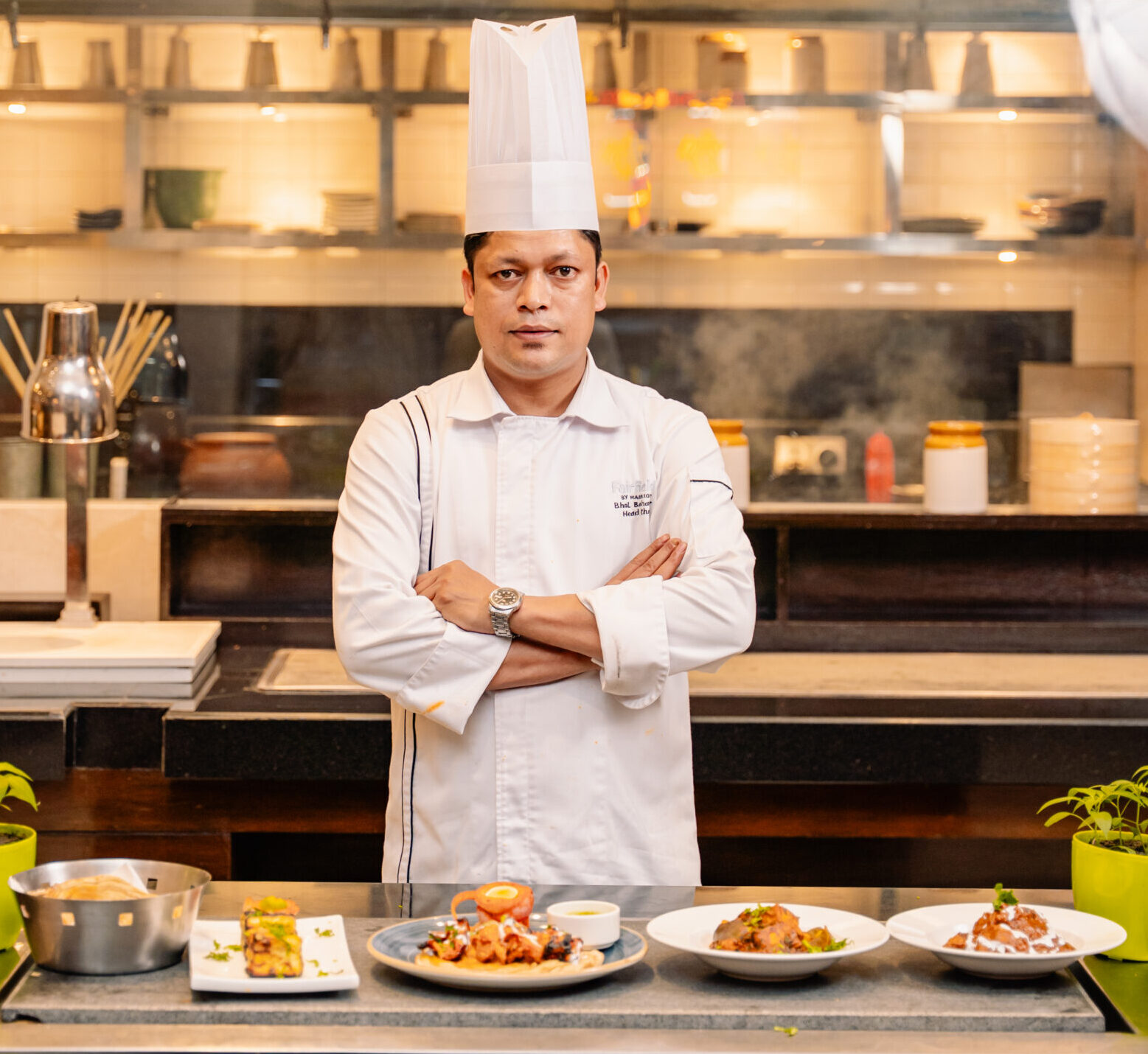
KATHMANDU: Long before Chef Bhol Bahadur Bishwakarma was leading a professional kitchen in Kathmandu, he was a young man from Khotang learning to read the heat of a tandoor.
He had gone to India without a clear career plan. He did not know what job he would find or where the work would take him. He only knew that he wanted to earn, learn and build a better future.
About 10 days after arriving in India, he found work at a club. He stayed for around two months, but the kitchen caught his attention. He began watching how chefs prepared food, organised their work and moved as a team.
That curiosity took him to the tandoori section of a catering company, where he worked casually for nearly two years. It was there that he began building the foundation of his career.
The tandoor became his classroom.
He learned to prepare kebabs, make marinades, balance spices and judge temperature, texture and timing. Much of the learning came through repetition: preparing the same food, making mistakes, correcting them and doing it again.
The experience taught him something that would remain central to his career: consistency matters as much as skill.
In 2009, Bishwakarma joined Keeya Kainosh, a restaurant in Vasant Kunj, Delhi, as a Commis II in the Indian tandoori section.
For nearly a year and seven months, he worked on marinades, spice combinations, portion control, consistency and presentation. His employer recognised him as an Indian tandoor specialist and noted his punctuality and dedication.
His next opportunity came at The Westin Gurgaon after a senior colleague who had worked with him recommended him for a position. He was invited to a food test.
Rather than attempting unfamiliar dishes, Bishwakarma prepared the Indian and tandoori food he had spent years practising.
He impressed the chefs with the quality and presentation of his dishes and joined the hotel as Commis II.
The move into a five-star kitchen brought a new set of demands. Good food alone was not enough. He had to work to strict standards of hygiene, recipes, mise en place, portion control, teamwork and communication.
Over three years and seven months at the Westin, he progressed to Commis I.
He was also given responsibility for the tandoor section during two large banquets, serving 350 and 400 guests. The pressure was different from cooking for a few diners. Hundreds of plates had to leave the kitchen at the same standard.
His team also achieved a 96.75% score in a food safety audit.
By then, the tandoor was no longer the limit of his expertise. It had become the starting point.
Bishwakarma went on to develop expertise in several regional cuisines of India, including North Indian, Mughlai, Awadhi, Rajasthani, South Indian and Bengali cooking.
North Indian cuisine strengthened his command of tandoor cooking, breads, kebabs, curries and aromatic spice blends. He developed expertise in dishes such as tandoori chicken, paneer tikka, butter chicken, dal makhani, rogan josh, naan and a range of kebabs.
Mughlai and Awadhi cuisines introduced him to the slower, more delicate side of Indian cooking, including dishes such as shahi korma, nihari, biryani, galouti kebab, kakori kebab and shami kebab.
Rajasthani cuisine brought another set of techniques and ingredients, including dal baati churma, laal maas, gatte ki sabzi, ker sangri and bajre ki roti.
At Sheraton Hyderabad, he moved into South Indian cuisine, learning dishes such as dosa, idli, sambar, rasam, appam, Kerala fish curry and biryani. He was promoted to Chef de Partie and later held the same position at The Den in Bengaluru.
He also gained experience in Bengali cuisine, known for its careful balance of sweet, sour, bitter and spicy flavours. His repertoire expanded to dishes including machher jhol, shorshe ilish, kosha mangsho, chingri malai curry and mishti doi.
The experience across different regions gave him a broader understanding of Indian cooking. Each cuisine had its own ingredients, techniques and balance, and he learned to preserve those characteristics rather than treat them as variations of the same food.
In 2019, Bishwakarma decided to bring that experience back to Nepal.
When he learned that Marriott was opening a hotel in Kathmandu, he applied and joined the pre-opening team of Kathmandu Marriott Hotel as Chef de Partie.
Over the next five years, he progressed to Demi Sous Chef and Sous Chef. He later worked as Chef de Cuisine at Hyatt before taking up his current role as Head Chef at Fairfield by Marriott Kathmandu Thamel.
His cooking now brings together the techniques he developed in India and the flavours of Nepal.
His menus include Indian favourites such as butter chicken, seekh kebab and dal makhani alongside Nepali-inspired dishes such as momo, timur chicken and Mustang aloo. Seasonal and locally available ingredients also have a place in his kitchen.
For Bishwakarma, understanding food goes beyond following a recipe. A marinade needs balance. A spice should complement rather than overpower. Heat needs to be controlled. And a dish that succeeds once must be repeatable every time.
Those lessons have also been reflected in the recognition he has received throughout his career.
At The Westin Gurgaon, he received a “You Created a WOW” award in 2013 for his leadership of the tandoor section during the two large banquets. He received another in 2014 for his contribution to the 96.75% food safety audit.
At Kathmandu Marriott, he received a Certificate of Appreciation in 2021 for his service during the COVID-19 period. He was also named Cleanliness Champion that year and received the Brilliant Executive of the Month award in May 2022 for his initiative and contribution.
There is no dramatic shortcut in Bishwakarma’s story. There is a young man who left Khotang without knowing where his career would lead, a tandoor that became his first real teacher, and years spent learning one kitchen after another.
The title of head chef came much later. The foundation was built one kebab, one mistake and one service at a time.






Comment