




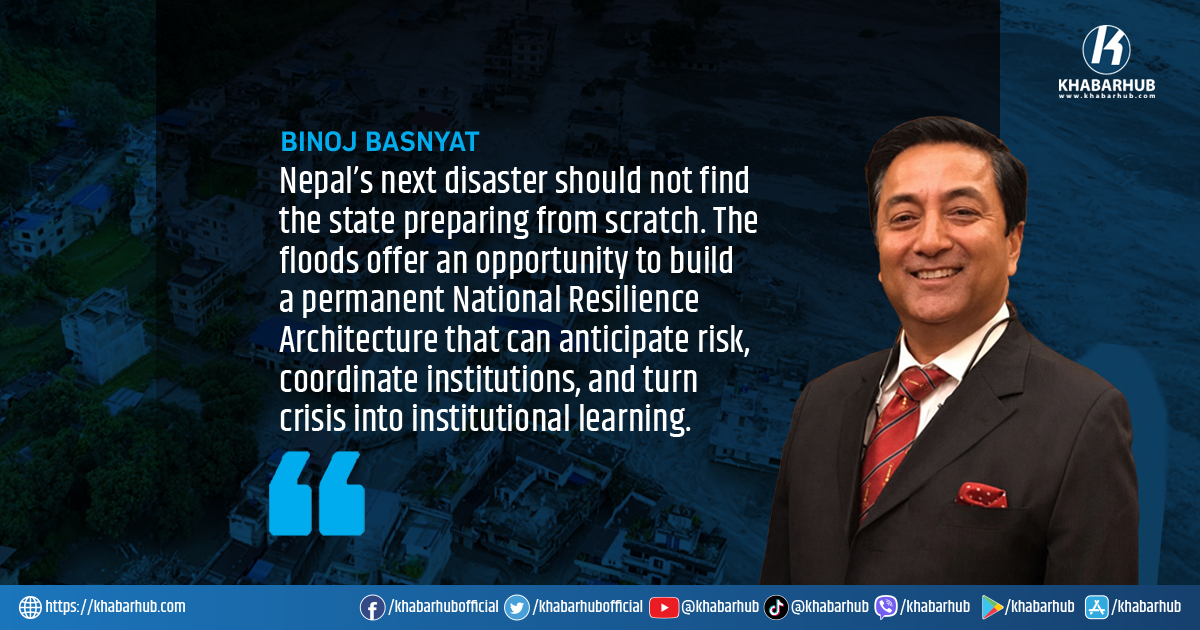
A disaster reveals the state in ways that ordinary politics often conceals.
When a crisis strikes, institutions are suddenly expected to work together, information must move rapidly, decisions must be made under pressure, and resources must reach people before the window for action closes. The recent August 26 flash floods in Rasuwa, Nuwakot, and Dhading districts have demonstrated that Nepal can mobilize significant operational capacity when circumstances demand it.
But the question arises: What happens when every disaster, every response, and every outcome is politicized, negotiated away through political compromise, and ultimately absorbed into a culture of institutional comfort? The first challenge is therefore political—the tendency to turn disasters into contests of blame rather than opportunities for institutional learning. The second is institutional: whether Nepal has the capacity, coordination, and preparedness to anticipate risks, respond effectively, and recover quickly.
The third is regional, along the climate boundaries, and global: Nepal is among the countries least responsible for global greenhouse-gas emissions, yet it is highly exposed to the consequences of climate change. It is therefore neither fair nor strategically sound to treat every climate-induced disaster simply as a failure of the Nepali state.
Kathmandu cannot be the only operational center of every disaster. In many emergencies, communities and local governments will have to act before national institutions can reach them.
Therefore, the real challenge lies in distinguishing what Nepal must take responsibility for—preparedness, governance, land-use planning, early warning, resilient infrastructure, and institutional coordination—from what requires international responsibility, particularly climate finance, technology transfer, and regional cooperation.
Why should extraordinary coordination require an extraordinary crisis?
The real challenge for Nepal is to make the capabilities demonstrated during emergencies part of the normal functioning of the state.
This requires a shift from disaster management to national resilience.
The Problem Is Not Only Capacity. It Is Fragmentation
Nepal does not necessarily lack institutions. It has security agencies, civil administration, local governments, technical agencies, meteorological and hydrological institutions, health services, and development authorities.
What is often missing is the mechanism that enables these institutions to see risk as a whole-of-state responsibility.
Risk information remains dispersed. Responsibilities can overlap. Early warnings do not always translate into early action. Development decisions can be made without sufficiently incorporating disaster risk. Local governments may be expected to respond without possessing adequate resources or preparedness. Recovery mechanisms are frequently designed after the disaster rather than before it.
The result is a familiar cycle: institutions become highly visible during a crisis and gradually retreat into their respective silos once the crisis passes.
That is not resilience. Resilience is the ability to anticipate, absorb, adapt, recover, and learn—before the next crisis arrives. Nepal therefore needs a permanent architecture that connects these functions.
A National Resilience Architecture
The current architecture for post-disaster management also exposes a deeper institutional weakness. The system of unified command among the security agencies, alongside the all-party political mechanism, has proved inadequate to deliver a coherent, accountable, and effective response. Both mechanisms tend to prioritize coordination after a crisis rather than building the institutional capacity needed to anticipate, manage, and learn from it. What Nepal needs is not another ad hoc command structure or political consensus mechanism, but a permanent, professional, and accountable national disaster-resilience architecture capable of integrating early warning, civilian administration, security forces, local governments, scientific expertise, and international cooperation.
Nepal should establish a National Resilience Architecture as a permanent framework for managing the country’s most consequential risks. This should not become another committee or another strategy document. Its purpose should be to connect institutions that already exist, identify gaps between them, and establish clear responsibility for national risks. At the center could be a high-level National Resilience Council, supported by a professional permanent secretariat.
Its mandate should extend beyond conventional disaster management to include climate risks, critical infrastructure, food and water security, public health emergencies, technological vulnerabilities, and other threats to national resilience.
The Council should maintain a National Risk Register identifying the risks that could cause the greatest human, economic, infrastructural, or strategic disruption.
The essential change would be conceptual: risk would no longer be treated as the responsibility of one ministry or agency. It would become a responsibility of the state as a whole.
From Risk Information to Risk Intelligence
Nepal cannot manage risks it does not adequately see.
The country already generates large amounts of information about weather, rivers, geology, glaciers, settlements, infrastructure, and environmental change. The challenge is to turn dispersed information into usable intelligence.
Nepal should develop an integrated National Risk Intelligence System that brings together meteorological, hydrological, geological, glacial, demographic, environmental, and infrastructure data.
The purpose should not be to produce another database. It should be to answer practical questions: Where is the risk greatest? What infrastructure is most exposed? Which communities are most vulnerable? What could happen if several systems fail simultaneously? And, most importantly, what should the state do before the hazard becomes a disaster?
Risk maps should therefore become mandatory inputs into infrastructure planning, settlement decisions, development budgets, and major public investments.
This would mark a fundamental transition—from responding to events to anticipating consequences.
Early Warning Must Become Early Action
An early warning that does not trigger action is little more than information.
Nepal needs an early-warning-to-early-action system in which defined thresholds automatically activate predefined responses.
A credible warning of dangerous rainfall, river levels, or other hazards should trigger operational measures: mobilization of responders, movement of emergency supplies, evacuation where necessary, closure of vulnerable infrastructure, and activation of local emergency centers.
This requires something more difficult than technology. It requires institutional clarity.
Someone must know who receives the warning, who has the authority to act, what action follows, and who is accountable if nothing happens.
The warning must reach the last kilometer. And the response must begin before the disaster arrives.
Resilience Begins Where the Disaster Happens
Nepal’s geography makes excessive centralization particularly dangerous in disaster response. The 2015 earthquake and recent flash-flood events demonstrate two fundamentally different operational realities. The earthquake affected a broad and diverse terrain, creating multiple points of damage but also allowing relatively greater spatial flexibility for national and international search, rescue, and relief operations. Its rehabilitation phase could subsequently be decentralized and undertaken across a wider geographic area.
Flash floods, by contrast, can create a high-intensity, highly concentrated emergency along narrow corridors such as the Bhotekoshi and Trishuli, sometimes extending for 40 kilometers but only one to five kilometers in width. Roads, bridges, communications, and access routes can be simultaneously destroyed, while communities can be trapped under debris and mud reaching depths of up to 30 meters. In such circumstances, a heavily centralized command structure can become a liability. Decisions made far from the affected area may arrive too slowly, while local authorities may themselves be overwhelmed, absent, or lack the resources and delegated authority to act immediately.
Nepal will also need international cooperation. India, China, and other partners can contribute expertise, technology, and resources in areas such as hydrology, early warning, glacial monitoring, emergency communications, search and rescue, and disaster medicine.
Nepal therefore needs a disaster-response architecture designed around geographic realities: strong local command, pre-delegated authority, interoperable civilian and security agencies, and the capacity to scale rapidly from local response to national coordination and, when necessary, international assistance.
Kathmandu cannot be the only operational center of every disaster. In many emergencies, communities and local governments will have to act before national institutions can reach them.
Every high-risk municipality should therefore possess a basic resilience package: trained emergency teams, evacuation maps, designated shelters, emergency communication systems, pre-positioned supplies, community drills, and direct coordination mechanisms with security agencies.
This is not simply a local-government responsibility. It is a national investment.
A community that can evacuate itself, communicate during a network failure, and provide basic emergency assistance is not merely better prepared. It is reducing the burden on the entire state. National resilience begins locally.
Build Once, Build Resiliently
Nepal should also change the way it thinks about infrastructure. The country cannot afford to repeatedly build, repair, and rebuild the same vulnerable assets.
A national Resilient Critical Infrastructure Standard should require major roads, bridges, airports, hydropower facilities, telecommunications systems, hospitals, and other critical infrastructure to undergo disaster-risk assessments before construction and periodic resilience assessments thereafter.
The objective should not simply be stronger concrete. It should be better decisions about where infrastructure is located, how it is designed, and what risks it must withstand. Where evidence shows that an existing location is fundamentally unsafe, rebuilding in the same place should not automatically be regarded as the cheapest or fastest option. The cheaper reconstruction today can become the more expensive disaster tomorrow. Nepal cannot build resilience by rebuilding yesterday.
Institutionalize Joint Capability
The recent response has also highlighted the importance of coordination among the Nepali Army, Armed Police Force, Nepal Police, civilian authorities, and local governments. That capability should be institutionalized rather than improvised.
Nepal needs regular joint exercises, interoperable communications, common operating procedures, and clearly defined logistics arrangements. Specialist capabilities in engineering, aviation, communications, medicine, search and rescue, and emergency logistics should be maintained as national assets.
This does not mean militarizing disaster management. It means ensuring that institutions with different mandates can contribute their specialized capabilities to a common national mission. The objective is simple: When a crisis occurs, institutions should already know how to work together.
Prepare the Recovery Before the Disaster
One of the weaknesses exposed by disasters is that recovery often begins administratively from zero. Nepal should establish a permanent National Recovery and Reconstruction Facility with pre-approved procedures for damage assessment, compensation, financing, procurement, and project prioritization.
This would allow the state to move rapidly from emergency response to recovery without waiting for every procedural mechanism to be created after the event. It should also establish a standardized national system for post-disaster damage and needs assessment. Preparedness is not only about storing rescue equipment. It is also about preparing the machinery of recovery.
Resilience Needs Its Own Financial Logic
No resilience architecture will survive without resources. Preparedness is often politically difficult because its success is invisible: money is spent to prevent an event whose absence produces no obvious political reward. Yet prevention is usually cheaper than repeated reconstruction.
Nepal should therefore integrate resilience into national and subnational budgeting. Major development programs should undergo resilience assessments, while public investment should increasingly favor projects that reduce rather than amplify exposure to risk.
A portion of development expenditure could progressively be linked to disaster-risk reduction, climate adaptation, resilient infrastructure, and preparedness. This would change disaster management from an emergency expenditure category into something more important: an investment in future national stability.
The Strategic Dimension
For Nepal, resilience is no longer only an environmental or humanitarian issue. The Himalayas are becoming a shared risk environment in which climate change, extreme weather, glacial instability, infrastructure vulnerability, water security, and human security increasingly intersect.
A damaged bridge can disrupt a local community. It can also interrupt trade, tourism, connectivity, and access to strategically important areas.
A resilient state should not need a disaster to discover that its institutions can cooperate. It should already have mapped the risks, trained the personnel, established communication systems, pre-positioned resources, and defined responsibilities.
A telecommunications failure can become an emergency-management problem. A water crisis can become a public-health problem. A major infrastructure disruption can become an economic-security problem.
This is why disaster resilience should increasingly form part of Nepal’s broader conception of national resilience and national security. The distinction between human security and national security is becoming less clear in a rapidly changing Himalayan environment.
International Cooperation Without Strategic Dependence
Nepal will also need international cooperation. India, China, and other partners can contribute expertise, technology, and resources in areas such as hydrology, early warning, glacial monitoring, emergency communications, search and rescue, and disaster medicine.
But Nepal should enter such cooperation from a position of strategic clarity. External support should strengthen national institutions rather than create parallel systems. Projects should align with nationally identified priorities and contribute to capabilities that Nepal can maintain after external funding ends. The principle should remain: Nepal should coordinate assistance; it should not be coordinated by assistance.
A resilient Nepal should be internationally connected without becoming institutionally dependent.
The Four Measures of a Resilient State
Ultimately, Nepal should judge its resilience architecture against four measurable questions. Speed: How quickly can the state act? Coordination: Can institutions act together? Accountability: Can citizens see how decisions and resources are being used? Learning: Does every disaster make the next response better?
These measures are more important than the number of committees created, strategies published, or conferences held.
A resilient state is not one with the most plans. It is one whose plans change outcomes.
Making Emergency Capacity Permanent
The flash floods have exposed a paradox. Nepal can mobilize extraordinary capacity during an extraordinary emergency. The greater challenge is to make that capacity ordinary.
It should integrate scientific monitoring, early warning, risk mapping, preparedness, civilian administration, security agencies, and international assistance. Institutional capacity is not merely a domestic requirement; it is the credibility that gives Nepal leverage in disaster diplomacy.
A resilient state should not need a disaster to discover that its institutions can cooperate. It should already have mapped the risks, trained the personnel, established communication systems, pre-positioned resources, and defined responsibilities.
That is the difference between emergency capacity and state capacity. Emergency capacity responds to a crisis. State capacity prepares for it. Nepal now has an opportunity to make that transition. The National Resilience Architecture should therefore be treated not as another bureaucratic reform but as a program of state-building—with responsible institutions, dedicated resources, measurable targets, timelines, and public reporting.
Every major disaster should leave Nepal with something more valuable than repaired infrastructure. It should leave behind better institutions.
The Opportunity After the Crisis
The most important legacy of the recent floods will not be determined by how quickly the headlines disappear or the debris is cleared. It will be determined by what Nepal changes after public attention moves elsewhere. If the country merely restores what was lost, it will have recovered from a disaster. If it changes how it identifies risk, plans development, prepares communities, coordinates institutions, finances resilience, and learns from crisis, it will have learned from one. And if that learning becomes permanent national capability, Nepal will have achieved something far more consequential: it will have converted disaster experience into state capacity.
The strategic objective should therefore be clear: anticipate before reacting; coordinate before improvising; build for tomorrow, not yesterday; prepare locally, act nationally; and learn from every crisis. Resilience should no longer be an emergency program activated when disaster strikes. It should become a permanent responsibility of the state.
That requires Nepal to act on four fronts.
First, take climate justice to the global level. At the 81st United Nations General Assembly, Nepal should push for a dedicated Loss and Damage window for mountain and cryosphere states, alongside existing mechanisms that have historically focused more heavily on small island developing states. For Nepal, GLOF and other high-altitude early-warning systems should be framed not simply as national adaptation measures but as a global public good, given their implications for downstream populations, water security, and regional stability.
Nepal’s floods must therefore become policy, not pathos. Geography is fixed. Preparedness is not. The country cannot prevent every disaster, but it can decide whether each disaster leaves behind only destruction—or a more capable state.
Second, build a regional resilience mechanism through BIMSTEC. Nepal should propose a Himalaya–Bay of Bengal Resilience Framework that connects upstream glacial and hydrological risks with downstream water security, disaster preparedness, and climate adaptation. Such a framework should go beyond declarations, with dedicated financing, technical cooperation, and an appropriate mandate within the BIMSTEC institutional structure.
Third, begin a focused Nepal–India–China resilience mechanism. Strategic competition among the three countries should not prevent cooperation where their interests converge. Nepal could initiate a narrowly defined Himalayan Resilience Mechanism focused on glacial and hydrological monitoring, early warning, information-sharing, and joint humanitarian assistance and disaster relief exercises. Its deliberately limited scope would make it more practical and potentially more durable, even amid wider geopolitical differences.
Fourth, build institutional capacity at home. Nepal needs a permanent National Disaster and Glacial Monitoring Authority, established through a clear statutory mandate, professional structure, and predictable budget—not another ad hoc institution created after the next catastrophe. It should integrate scientific monitoring, early warning, risk mapping, preparedness, civilian administration, security agencies, and international assistance. Institutional capacity is not merely a domestic requirement; it is the credibility that gives Nepal leverage in disaster diplomacy.
These four tracks—global climate justice, regional cooperation, trilateral resilience, and national institutional capacity—should reinforce one another. A stronger domestic capability gives Nepal greater credibility internationally; regional cooperation provides information and operational depth; and global climate diplomacy can help finance the resilience that Nepal cannot build alone.
Nepal’s floods must therefore become policy, not pathos. Geography is fixed. Preparedness is not. The country cannot prevent every disaster, but it can decide whether each disaster leaves behind only destruction—or a more capable state.
The ultimate test of resilience is not whether Nepal can respond to the next crisis. It is whether the next crisis finds Nepal better prepared than the last.
(Basnyat is a Maj. Gen. (Retd.) of the Nepali Army and writes on international affairs and geopolitical strategy. He is also a researcher affiliated with Rangsit University in Thailand.)





Comment