




South Asia—home to nearly two billion people, three nuclear powers, major maritime chokepoints, and several fragile economies—has historically been a theater of great-power competition.
During the Cold War, the region was shaped by the strategic rivalry between the U.S. and the Soviet Union. Today, many analysts describe the current geopolitical environment as an emerging “Cold War 2.0,” driven primarily by intensifying U.S.–China competition.
As the strategic focus of global politics is temporarily in the Western Hemisphere and the Gulf, the unquestionable shift is toward the Indo-Pacific. South Asia has become increasingly central to geopolitical competition.
Washington and Beijing seek to expand influence, shape regional norms, secure trade routes, and establish strategic access points. Unlike the earlier Cold War, however, competition today extends beyond military alliances into infrastructure investment, digital networks, economic statecraft, maritime strategy, and ideological influence.
China and the U.S. are therefore pursuing sharply contrasting yet increasingly overlapping strategies to project influence in South Asia. China relies heavily on economic statecraft through infrastructure financing, political leverage, and selective security engagement under the Belt and Road Initiative (BRI). The U.S. emphasizes maritime security, defense cooperation, democratic partnerships, and strategic balancing through India and Indo-Pacific frameworks.
At the diplomatic level, both states continue to cooperate within multilateral frameworks such as BRICS, the SCO, the G20, and the AIIB. Yet these platforms mask deeper strategic disagreements regarding sovereignty, regional leadership, and Indo-Pacific security architecture.
The question now is how U.S.–China rivalry may evolve in South Asia over the next two decades, particularly across the continental nations of Afghanistan, Bhutan, and Nepal, in addition to Maldives and Sri Lanka in the maritime domain. Bangladesh, India, Myanmar, and Pakistan are located along the Himalayas and the sea. The question is how regional actors attempt to preserve strategic autonomy amid intensifying external pressure.
Alignments and Regional Rivalries During the Cold War
The strategic architecture of South Asia during the Cold War was shaped by ideological competition, alliance politics, and the Non-Aligned Movement (NAM). India and Pakistan emerged as principal regional actors, each pursuing external alignments to balance security threats and secure economic and military assistance.
Pakistan aligned closely with the U.S.-led Western bloc through alliances such as the Southeast Asia Treaty Organization (SEATO) and the Central Treaty Organization (CENTO), motivated largely by concerns regarding India and Soviet influence. Washington viewed Pakistan as strategically valuable due to its geographic location bordering Afghanistan, China, and the Soviet Union.
India, while officially non-aligned, developed close strategic ties with the Soviet Union, culminating in the Indo-Soviet Treaty of Peace, Friendship, and Cooperation in 1971. This alignment significantly shaped South Asia’s strategic equilibrium.
Smaller South Asian states attempted to maintain neutrality while preserving sovereignty. Nepal adopted a “small-state realism” approach through non-alignment and proposed the “Zone of Peace” initiative under King Birendra to insulate the country from Cold War rivalry and military competition. Bhutan strengthened its strategic ties with India, while Myanmar pursued isolationist neutrality under military rule. Afghanistan ultimately became the site of a major proxy conflict following the Soviet invasion of 1979.
These Cold War patterns continue to shape present-day geopolitical alignments, especially the India–Pakistan contention and the strategic calculations of external powers.
China’s Expanding Strategic Footprint in South Asia
China’s strategy in South Asia is primarily anchored in economic statecraft, infrastructure financing, political influence, and selective security engagement. Through the Belt and Road Initiative (BRI), Beijing has emerged as one of the largest providers of infrastructure financing across the region.
A central pillar of China’s regional strategy is the China–Pakistan Economic Corridor (CPEC), valued at approximately USD 60 billion. CPEC strengthens China’s access to the Arabian Sea through Gwadar Port while deepening Pakistan’s economic and strategic dependence on Beijing. The project also provides China with an alternative trade and energy route that bypasses the Strait of Malacca.
China’s influence has expanded further into Afghanistan following the U.S. withdrawal in 2021. Beijing’s objectives include preventing militant activity linked to Uyghur separatism, securing mineral resources, and integrating Afghanistan into broader BRI connectivity.
At the central Himalayan level, China has significantly increased engagement with Nepal through BRI-related projects and the Trans-Himalayan Multi-Dimensional Connectivity Network (THMCN). Bhutan also faces increasing Chinese pressure through border negotiations and territorial claims.
In the maritime domain, China’s influence extends through investments in Bangladesh, Maldives, Myanmar, and Sri Lanka. The Hambantota Port lease in Sri Lanka and infrastructure projects in the Maldives have generated concerns regarding debt dependency and strategic encirclement. Similarly, the China–Myanmar Economic Corridor (CMEC) provides Beijing with direct access to the Indian Ocean through Kyaukpyu Port, reducing dependence on maritime chokepoints vulnerable to U.S. naval power.
China’s broader strategic approach is therefore characterized by long-term infrastructure penetration, economic leverage, and selective security partnerships designed to gradually reshape the regional balance of power.
The U.S. Strategy: India First and Maritime Primacy
The U.S. has traditionally prioritized maritime dominance, counterterrorism cooperation, and strategic partnerships in South Asia. Since the early 2000s, Washington’s regional focus has increasingly shifted toward strengthening India as a strategic counterweight to China.
This shift has produced significant defense and intelligence cooperation between Washington and New Delhi. Agreements such as the Logistics Exchange Memorandum of Agreement (LEMOA), Communications Compatibility and Security Agreement (COMCASA), and Basic Exchange and Cooperation Agreement (BECA) have institutionalized military interoperability and information-sharing between the two countries.
India’s growing participation in the Quadrilateral Security Dialogue (Quad) alongside Australia, Japan, and the U.S. further reflects the consolidation of Indo-Pacific strategic balancing. Washington views India as indispensable to maintaining a “free and open Indo-Pacific” capable of constraining Chinese expansionism.
At the same time, India continues to pursue strategic autonomy by maintaining relations with Russia while managing a competitive relationship with China. India’s close engagement with Brazil-Russia-India-China-South Africa Plus (BRICS+), the Shanghai Cooperation Organization (SCO), and the Asian Infrastructure Investment Bank (AIIB) provides important platforms through which it expands its economic, diplomatic, and strategic influence.
These institutions offer alternatives to Western-led frameworks while promoting greater cooperation among emerging economies. The AIIB, in particular, has evolved into a significant multilateral development bank with more than 100 member countries, including major economies such as India, Russia, the United Kingdom, Germany, and Australia, underscoring its broad international legitimacy and reach.
This balancing strategy reflects India’s historical resistance to formal alliances and desire to preserve independent foreign-policy decision-making.
The U.S. also engages smaller South Asian states through development assistance, democratic governance support, maritime cooperation, and selective economic investment. However, Washington has struggled to match the scale and speed of Chinese infrastructure financing.
Nevertheless, these frameworks provide important diplomatic platforms through which emerging powers signal strategic autonomy and resist excessive dependence on Western institutions.
Following the withdrawal from Afghanistan, U.S. influence in Pakistan and Afghanistan has weakened considerably, though diplomatic engagement with Pakistan has risen significantly. China’s growing role in these countries has created a strategic vacuum increasingly difficult for Washington to counter without sustained diplomatic and economic reinvestment.
India–China Rivalry and Strategic Competition
India and China represent two rising Asian powers with deeply intertwined economic relations and unresolved strategic competition. Bilateral trade exceeded USD 136 billion in 2023, making China India’s largest trading partner despite growing tensions. However, economic interdependence coexists alongside military rivalry and geopolitical distrust.
The 2017 Doklam standoff, the 2020 Galwan Valley clash, and continuing tensions along the Line of Actual Control (LAC) have significantly deteriorated bilateral trust.31 India has consequently accelerated military modernization, infrastructure development along disputed borders, and maritime cooperation with Indo-Pacific partners.
At the diplomatic level, both states continue to cooperate within multilateral frameworks such as BRICS, the SCO, the G20, and the AIIB. Yet these platforms mask deeper strategic disagreements regarding sovereignty, regional leadership, and Indo-Pacific security architecture.
China perceives India’s growing engagement with the U.S. and the Quad as part of a broader containment strategy. India, in turn, views China’s support for Pakistan and U.S. engagement with Pakistan, as well as China’s expansion into the Indian Ocean, as direct strategic challenges.
The future trajectory of India–China relations will significantly shape South Asia’s strategic environment over the coming decades.
Strategic Hedging by Smaller States
Smaller South Asian states increasingly pursue hedging strategies designed to maximize economic gains while avoiding excessive dependence on any single external power.
Nepal continues to balance relations among China, India, and the U.S. through selective engagement, infrastructure cooperation, and diplomatic diversification. Bhutan remains closely aligned with India but has cautiously explored limited engagement with China through border negotiations.
Myanmar occupies a strategically critical position linking South and Southeast Asia. China remains the military junta’s principal economic and diplomatic backer, while the U.S. emphasizes democracy and human rights. This divergence limits Washington’s ability to compete directly with Beijing in Myanmar.
Maldives and Sri Lanka have become key nodes in maritime competition within the Indian Ocean. Chinese investments in ports, airports, and infrastructure have generated both economic opportunities and concerns regarding sovereignty and debt dependency. India and the U.S. have responded by intensifying maritime security cooperation and development engagement.
These states demonstrate that South Asian actors are not merely passive recipients of great-power competition but active participants attempting to leverage rivalry for national advantage.
Multipolarity, BRICS, SCO, and the Revival of RIC
The emergence of BRICS Plus, the SCO, and renewed discussions surrounding the Russia–India–China (RIC) trilateral format reflect broader trends toward multipolarity and contestation of Western dominance. However, these institutions lack the cohesion, institutional depth, and unified strategic purpose necessary to directly replace the U.S.-led international system.
Internal contradictions remain substantial. India and China remain strategic competitors, while Russia’s increasing dependence on China after 2022 has created asymmetries within the grouping. India simultaneously deepens cooperation with the U.S. while preserving defense and energy ties with Moscow.
At the same time, the U.S. and China must avoid coercive behavior and support regional stability through economic cooperation rather than military escalation.
Nevertheless, these frameworks provide important diplomatic platforms through which emerging powers signal strategic autonomy and resist excessive dependence on Western institutions.
The potential revival of the RIC mechanism has significant implications for global geopolitics. Although unlikely to evolve into a formal alliance, closer coordination among Russia, India, and China could accelerate the transition toward a fragmented multipolar order and complicate Western strategic calculations.
Risks of Destabilization and New Cold War Dynamics
If U.S.–China competition intensifies into a zero-sum geopolitical confrontation, South Asia risks becoming a frontline arena for proxy conflicts, economic coercion, and military competition.
Several destabilizing trends are already visible. First, the India–Pakistan rivalry remains unresolved and deeply intertwined with external alignments. China’s strategic partnership with Pakistan and India’s expanding partnership with the U.S. risk reinforcing regional polarization.
Second, debt dependency and opaque infrastructure financing may weaken governance and sovereignty in smaller states.
Third, increasing militarization of the Indian Ocean could heighten risks of maritime incidents and strategic confrontation around critical chokepoints such as the Strait of Malacca and the Bay of Bengal.
Internal conflicts in Afghanistan, Myanmar, and Pakistan further exacerbate regional instability and create opportunities for external intervention. Climate change, demographic pressures, and governance weaknesses compound these vulnerabilities.
The possible return of more transactional and nationalist approaches by major powers—including a future “Trump 2.0” administration in the U.S.—could further complicate regional alignments and policy consistency.
Regional Autonomy and Strategic Resilience
Despite these risks, South Asia retains opportunities to leverage great-power competition for development, modernization, and strategic diversification. The most optimistic trajectory involves South Asian states strengthening institutions, enhancing regional cooperation, and preserving strategic autonomy while engaging all major powers pragmatically.
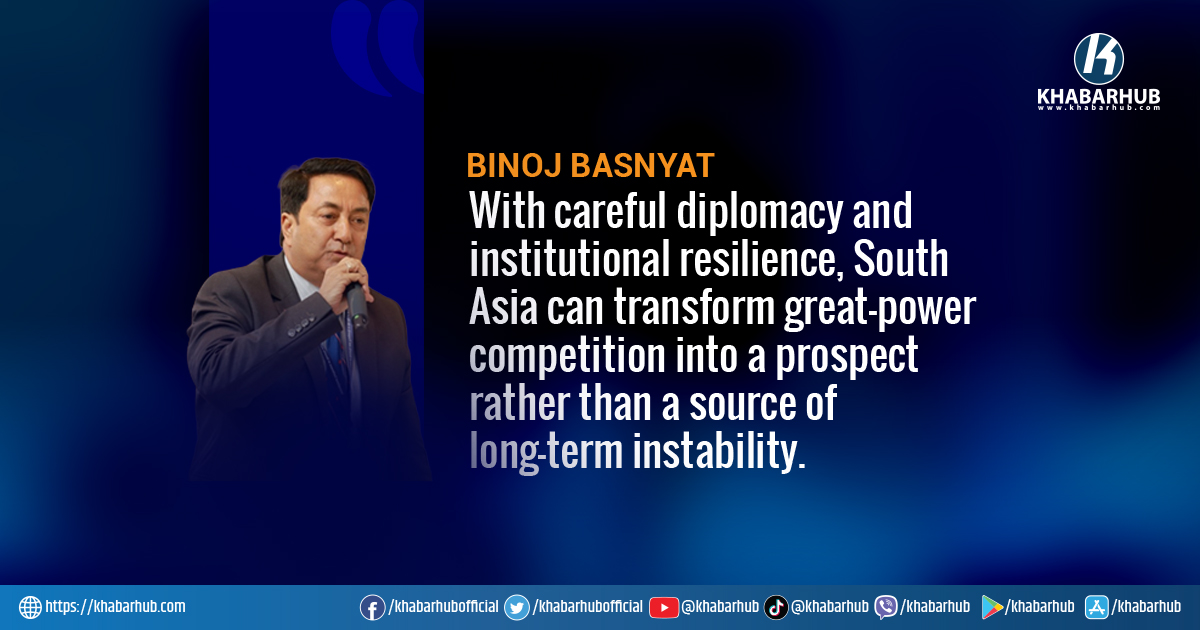
With careful diplomacy and institutional resilience, South Asia can transform great-power competition into a prospect rather than a source of long-term instability.
India and Pakistan could gradually reduce tensions, regional organizations such as the South Asian Association for Regional Cooperation (SAARC) and the Bay of Bengal Initiative for Multi-Sectoral Technical and Economic Cooperation (BIMSTEC) could regain relevance, and smaller states could diversify economic partnerships while maintaining sovereignty.
For this outcome to materialize, governance reforms, transparency, and institutional resilience will be critical. Smaller states must negotiate external investments carefully, avoid unsustainable debt obligations, and preserve decision-making autonomy.
At the same time, the U.S. and China must avoid coercive behavior and support regional stability through economic cooperation rather than military escalation.
South Asia’s future will ultimately depend less on the ambitions of external powers and more on the strategic choices made by regional actors themselves.
Conclusion
Over the next two decades, U.S.–China rivalry in South Asia is likely to intensify economically, politically, technologically, and militarily. China’s influence will continue expanding through infrastructure financing, connectivity corridors, and strategic maritime access, while the U.S. will remain a critical actor through maritime power, support for India, and Indo-Pacific partnerships.
For South Asia, this rivalry presents both opportunities and strategic risks. The region could emerge either as a fragmented geopolitical battleground vulnerable to external manipulation or as a strategically autonomous and resilient regional center capable of balancing competing powers.
Ultimately, the decisive factor will not be the ambitions of Washington or Beijing alone, but the ability of South Asian states to strengthen governance, maintain strategic flexibility, and pursue cooperative regional development. With careful diplomacy and institutional resilience, South Asia can transform great-power competition into a prospect rather than a source of long-term instability.
(Basnyat is a Maj. Gen. (Retd.) of the Nepali Army and writes on international affairs and geopolitical strategy. He is also a researcher affiliated with Rangsit University in Thailand.)






Comment