




The global economy is no longer punctuated by crises. It is defined by them. Over the past two decades, the Iraq war reshaped energy markets; the global financial crisis disrupted capital flows; the Covid-19 pandemic fractured supply chains; the Russia–Ukraine war destabilised food and fuel systems; and now the Middle East conflict is adding persistent risk to critical trade corridors.
These are not isolated shocks. They are cumulative signals of a structural shift. Volatility is no longer an interruption to globalisation—it is a feature of it.
For South Asia, this has profound implications. The region’s growth model remains deeply dependent on imported energy, external financing, global trade routes, and remittance flows. When these systems are disrupted, the impact is immediate—higher inflation, weaker currencies, strained public finances, and slower industrial growth.
The lesson is not that globalisation is reversing. It is that its risks are becoming more concentrated.
Consider energy. Countries such as India import more than 80 per cent of their crude oil, much of it moving through the Strait of Hormuz—a narrow corridor that carries roughly a fifth of global oil supply. When geopolitical tensions threaten this route, the consequences ripple quickly through manufacturing costs, transport systems, and food prices. For smaller economies in the region, such as Nepal or Sri Lanka, the transmission is even more direct.
The world economy is entering a phase where disruption is persistent, and interdependence is more tightly coupled. In such a system, the question is no longer whether shocks will occur, but how far they will spread.
Trade flows are equally exposed. A handful of chokepoints—including the Suez Canal and key Middle Eastern shipping lanes—handle a disproportionate share of global commerce. When disruptions occur, freight costs surge, delivery times lengthen, and export competitiveness erodes. The 2021 Suez blockage, which affected nearly 12 per cent of global trade, offered a brief glimpse of how fragile these systems are.
Financial channels amplify these pressures. Energy shocks often trigger capital outflows from emerging markets, putting downward pressure on currencies and increasing the cost of imports. For economies already managing fiscal constraints, this can quickly become destabilising.
The cumulative effect is that South Asia is increasingly exposed to what might be called “stacked risk”: disruptions in energy, trade, and finance reinforcing one another.
Yet policy responses across the region remain largely reactive. Governments continue to treat shocks as temporary disruptions rather than structural conditions. The result is a cycle of crisis management—subsidies during price spikes, emergency borrowing during financial stress, and delayed reform once stability returns.
This approach is no longer tenable.
What is required is a shift from efficiency-driven integration to resilience-driven integration.
Energy policy offers the clearest starting point. Reducing exposure to external shocks will require sustained investment in domestic renewable capacity, greater regional energy integration, and more systematic use of strategic reserves. The objective is not energy independence, but reduced vulnerability to concentrated supply routes.
Supply chains require similar rethinking. The logic of just-in-time production—optimised for cost and speed—has left industries exposed to disruption. Building resilience will mean accepting higher costs in exchange for diversification, redundancy, and buffer capacity. For South Asian economies seeking to expand manufacturing, this trade-off will become increasingly unavoidable.
Trade strategy must also evolve. Rather than relying heavily on a narrow set of routes and markets, countries need to diversify both geography and logistics. This includes investing in regional connectivity within Asia, as well as expanding access to alternative corridors.
Financial resilience is equally critical. Stronger foreign exchange buffers, more flexible exchange rate regimes, and deeper local currency capital markets can help absorb external shocks rather than amplify them.
Underlying all of this is a less visible but more important requirement: institutional capacity. Countries that have managed recent crises more effectively have done so not because they avoided shocks, but because they responded faster, coordinated better, and communicated more clearly.
The broader lesson is conceptual. South Asia must move from reacting to shocks to designing systems that anticipate them.
This does not imply retreating from global markets. On the contrary, deeper integration remains essential for growth. But integration without resilience is increasingly risky.
The world economy is entering a phase where disruption is persistent, and interdependence is more tightly coupled. In such a system, the question is no longer whether shocks will occur, but how far they will spread.
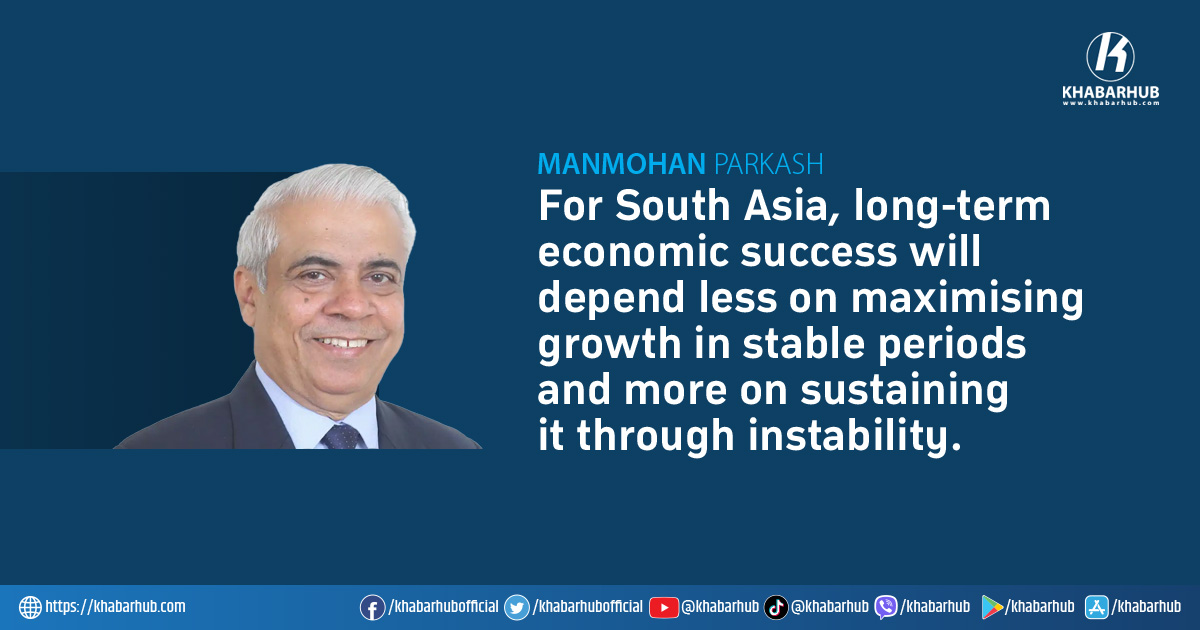
For South Asia, long-term economic success will depend less on maximising growth in stable periods and more on sustaining it through instability.
Resilience, in that sense, is the foundation of competitiveness.
(Manmohan Parkash is a former Senior Advisor in the Office of the President and former Deputy Director General for South Asia at the Asian Development Bank (ADB). Views expressed are personal.)






Comment