




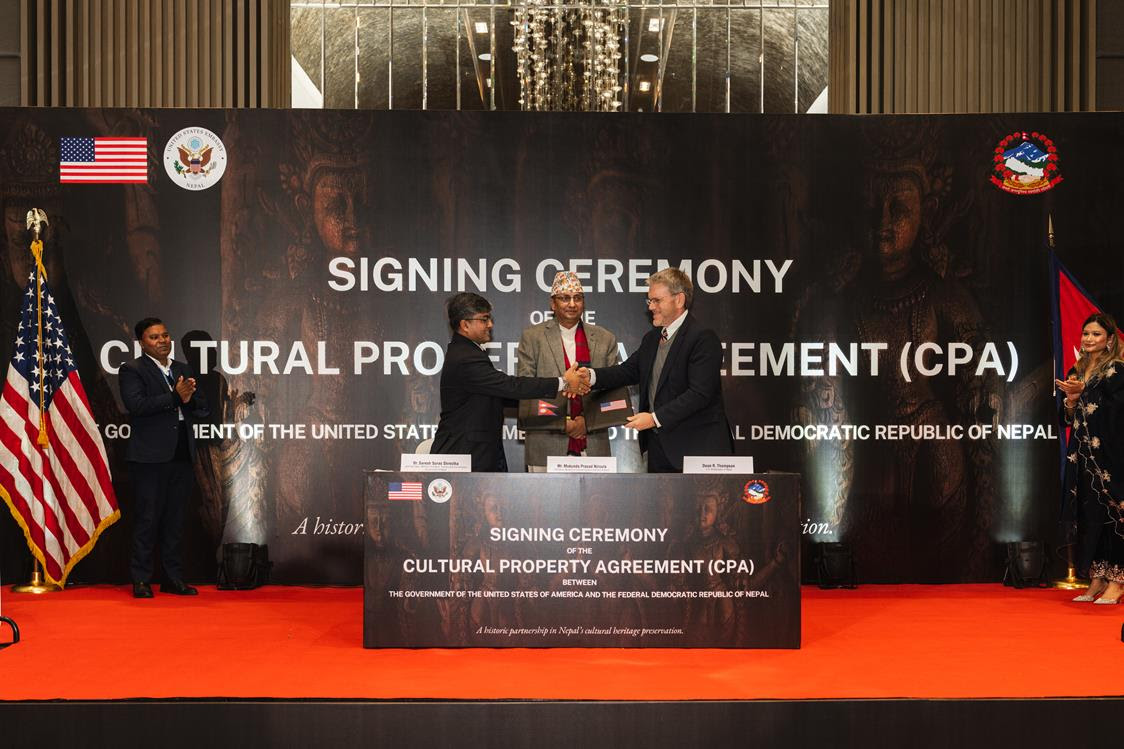
KATHMANDU: U.S. Ambassador to Nepal Dean R. Thompson and Dr. Suresh Suras Shrestha, Joint Secretary, Ministry of Culture, Tourism, and Civil Aviation (MOCTA) signed a landmark bilateral Cultural Property Agreement (CPA) to safeguard Nepal’s rich cultural heritage and prevent the illicit trafficking of cultural property on Thursday.
Under this agreement, the United States, in accordance with its legislation, will restrict the importation into the United States of certain archaeological and ethnological material from Nepal unless accompanied by a valid export certificate issued by the Government of Nepal.
The agreement covers archaeological material ranging in date from the Paleolithic period (approximately 32,000 BCE) through 1770 CE, and ethnological material ranging from the 13th century through 1950 CE, including religious architectural materials, religious and ceremonial objects, and manuscripts identified in a designated list to be published by the U.S. Government.
This agreement strengthens bilateral cooperation to combat looting and illegal trade of artifacts, ensuring Nepal’s cultural treasures remain preserved for future generations.
The agreement delivers important benefits to Nepal by curbing the loss of priceless heritage to the illicit market, reducing incentives for looting, and promoting responsible stewardship of cultural property. It enhances Nepal’s global profile by recognizing the nation’s unique contributions to world civilization, while also facilitating collaboration with American institutions, universities, and researchers who can study and share Nepal’s cultural history with international audiences. The agreement also supports Nepal’s cultural tourism industry, which is vital to the country’s economy, by ensuring that sacred and historic artifacts remain in their original context to be experienced by Nepali citizens and visitors alike.
Ambassador Thompson stated at the signing ceremony, “the CPA underscores the deep respect the United States holds for Nepal’s cultural heritage. It strengthens cooperation to prevent illicit trafficking, supports lawful cultural exchange, and reinforces our shared responsibility to protect Nepal’s cultural heritage for future generations.”
Secretary for Culture, Tourism, and Civil Aviation Mukunda Prasad Niroula said, “The Government of Nepal would like to thank the Government of the United States for its continued partnership in protecting Nepal’s cultural heritage. Over the past two decades, this partnership through the Ambassadors Fund for Cultural Preservation and now the Cultural Property Agreement (CPA) reflects the strong Nepal–U.S. collaboration and our shared commitment to preventing illicit trafficking of cultural property and preserving cultural heritage for the for future generations.”
The U.S. Department of State’s Cultural Heritage Center leads the United States’ efforts to combat the illicit trafficking of cultural property and preserve cultural heritage through the negotiation and implementation of cultural property agreements. These agreements disrupt illegal trafficking networks, protect American collectors and museums from inadvertently purchasing looted objects, and cut off financial flows to terrorists and transnational criminals.
They also enhance diplomacy by providing tools for U.S. embassies to strengthen relations with partner countries while ensuring that American citizens can responsibly access and study global heritage. With 30 such agreements in force worldwide, the United States is a global leader in cultural heritage preservation.
The Cultural Property Agreement with Nepal builds on the United States’ longstanding commitment to protecting Nepal’s sovereignty and heritage, which includes support through the Ambassadors Fund for Cultural Preservation (AFCP) for 28 projects over the past two decades.
These projects have restored historic monuments and manuscripts, safeguarded cultural heritage sites, and recently established Nepal’s first modern conservation laboratory in Lumbini.






Comment