




When I reached the flood-affected areas of Rasuwa and Nuwakot, I did not see only homes destroyed by floods, roads washed away, and infrastructure reduced to ruins. I saw the future of an entire generation sitting beneath tarpaulins, looking toward the state for answers.
The devastating floods of Bhadra 10, 2083, caused unimaginable destruction across Rasuwa, Nuwakot and Dhading. The raging waters of the Lhende Khola and Bhotekoshi swept away homes, roads, bridges, schools, farmland and vital hydropower infrastructure. Families who had been living safely in their homes just days earlier are now searching for shelter under open skies.
Some have lost their homes, some their farms and businesses, some their livelihoods, and many have lost loved ones. There is fear and uncertainty in the eyes of children. Elderly people are mourning the homes and life savings they built over decades, now reduced to debris. Such scenes do not merely shock the eyes; they challenge the conscience of the state. Who will take responsibility for the future of these citizens after the immediate disaster is over?
The scale of the destruction is also reflected in the available figures. According to the figures provided for this disaster, 1,341 people have been confirmed dead (as of Sunday), while more than 5,600 remain missing. Thousands of families have been affected, with many losing their homes, property, livelihoods and loved ones all at once. In Rasuwa and Nuwakot alone, more than 7,500 private homes have reportedly been completely destroyed.
Our diplomatic missions, climate negotiators, researchers and political leadership must speak with one voice: Nepal is willing to build a greener and more resilient future, but the world must also recognize its responsibility to countries on the front line of a crisis they did not create.
Eighteen school buildings have been washed away, around 41 kilometres of roads have suffered major damage, and eight hydropower projects have sustained serious damage. These are not merely numbers in a government report. Behind every number is a family, a story, a dream and, in many cases, a life shattered by the loss of someone they loved.
Every confirmed death represents a family living with grief; every missing person represents a family trapped in uncertainty; every destroyed home represents years of hard work wiped away within hours; and every school swept away represents not only the loss of a building but also a serious threat to the education and future of children.
Today, relief has reached the affected areas. Security personnel are working around the clock, rescue teams are deployed, and individuals, organizations and volunteers are contributing whatever they can. The efforts of the Nepal Army, Nepal Police, Armed Police Force, local governments, health workers, volunteers and ordinary citizens deserve recognition. But we must also confront a difficult truth: relief does not last forever, while displacement does.
For a few days, cameras remain focused on the affected areas. Social media fills with sympathy and solidarity. Relief trucks arrive. But after a few weeks, the headlines change. Cameras move elsewhere, social media finds another subject, and the flow of relief gradually declines. The families living under tarpaulins, however, remain there.
The children who have lost their parents remain there. The families who have lost both their homes and livelihoods remain there. That is why we must ask the government now, before the attention fades: What happens to their lives when the relief phase is over?
We still tend to understand disaster management in the narrow terms of rescue and immediate relief. But the real challenge of a major disaster begins after the rescue operation ends. Pulling a person out of floodwaters is the first responsibility. Bringing that person back into a safe home, returning children to school, restoring lost livelihoods, helping survivors recover from psychological trauma and enabling families to become self-reliant again are equally important responsibilities of the state.
The government must therefore immediately shift its focus from relief distribution toward rehabilitation and reconstruction. Keeping affected citizens dependent on tarpaulins, food packages and emergency assistance for months cannot be considered a successful response.
The future of children who have lost their parents or guardians must receive extraordinary attention. In a disaster where thousands remain missing, the government must immediately identify how many children have been left orphaned, separated from their families or otherwise placed in vulnerable situations. A child does not merely lose a house in such circumstances; they lose their sense of security, family and emotional foundation.
Relief materials alone cannot address that loss. The state must take long-term responsibility for their education, healthcare, nutrition, protection and psychological well-being. With 18 school buildings destroyed, alternative learning centres must be established immediately.
Teachers, psychosocial counsellors and child-protection mechanisms must be mobilized. If a child’s education is permanently disrupted because of this disaster, the consequences may follow them for the rest of their lives. The first brick of reconstruction, therefore, must be laid around protecting the future of our children.
The destruction of more than 7,500 private homes in Rasuwa and Nuwakot also makes safe housing not a future concern but an immediate national priority. A tarpaulin is not a permanent home. The government cannot consider its responsibility fulfilled by keeping people for months inside schools, public buildings or temporary camps.
A scientific and technical assessment of the affected geography must begin immediately to determine which areas remain safe for habitation and which are at high risk. The damage to around 41 kilometres of roads, along with the destruction of bridges and other infrastructure, will also have long-term consequences for transportation and economic activity. Therefore, roads and other infrastructure must not simply be rebuilt in their old form.
Reconstruction must take into account future risks from floods, landslides and climate change and create stronger, safer infrastructure. We must not rebuild homes in dangerous locations only to create the foundation for another disaster tomorrow. Where necessary, communities must be relocated to safer areas through planned and integrated settlement development.
But rebuilding houses alone will not restore lives. Without livelihoods, recovery remains incomplete. The floods have taken away not only homes but also farmland, livestock, shops, businesses and sources of income. The damage to hydropower projects will also affect local economies, employment and critical national energy infrastructure. The government must therefore immediately introduce collateral-free recovery loans, interest support, agricultural rehabilitation, assistance for small businesses and local employment programmes.
When roads, bridges, schools, health facilities and hydropower projects are rebuilt, young people from the affected communities should receive priority for employment. Reconstruction should not merely be a programme to rebuild physical infrastructure; it should also become a pathway to restore the economic independence and dignity of affected citizens. Relief may help people survive for a while, but livelihoods help them stand on their own feet again.
But there is another question we can no longer avoid: Who pays for a disaster that Nepal did little to create?
Nepal must take its case for climate justice to the international community with greater confidence and urgency. Nepal is among the countries most vulnerable to climate change, yet its contribution to global greenhouse gas emissions is negligible. The World Bank estimates Nepal’s share at around 0.1 percent of global greenhouse gas emissions, while Nepal’s earlier national reporting put its share at approximately 0.027 percent.
Yet Nepal is experiencing increasingly severe climate-related risks, from floods and landslides to glacier and water-related hazards. The World Bank has warned that unchecked climate impacts could reduce Nepal’s GDP by at least 7 percent by 2050.
This is the heart of the climate-justice argument: those who have contributed least to global warming should not be left to bear its greatest costs alone. Nepal must not approach the world merely as a recipient asking for charity. It must approach the international community as a country demanding fairness, responsibility and climate finance.
The international climate regime recognizes differentiated responsibilities, and Nepal’s vulnerability must be translated into concrete international support for adaptation, loss and damage, resilient infrastructure, early-warning systems, disaster preparedness, climate-resilient agriculture and the protection of mountain ecosystems.
Nepal’s mountains, glaciers, rivers and forests are not only national assets; they are part of a global ecological system. The Himalayas are often described as the water towers of Asia, and changes in the cryosphere have consequences far beyond Nepal’s borders. Yet the communities living closest to these fragile ecosystems are being asked to carry an enormous share of the cost of a warming world. Climate justice therefore cannot remain a slogan at international conferences. It must mean predictable finance, technology transfer, capacity-building and meaningful support for communities already facing climate-related loss and damage.
Nepal should therefore develop a clear international climate-justice strategy. Every major climate-related disaster should be properly documented. Losses to homes, agriculture, infrastructure, ecosystems, hydropower, education and livelihoods should be systematically quantified. Nepal should use this evidence in international climate negotiations and demand greater access to adaptation finance and loss-and-damage mechanisms.
If we rebuild homes in the same vulnerable places, construct infrastructure in the same fragile ways and forget everything a few months after the relief operations end, then we will have learned nothing from this catastrophe.
Our diplomatic missions, climate negotiators, researchers and political leadership must speak with one voice: Nepal is willing to build a greener and more resilient future, but the world must also recognize its responsibility to countries on the front line of a crisis they did not create.
At home, however, climate justice must begin with climate responsibility. Nepal cannot demand accountability from the world while failing to build accountable institutions domestically. Climate finance must never become another avenue for corruption, political patronage or opaque procurement. Every rupee received for climate adaptation and every rupee invested in reconstruction must be publicly traceable.
Scientific evidence, geological studies and climate projections must guide where we build homes, roads, bridges, schools and cities. Development cannot continue to mean rebuilding the same vulnerable infrastructure in the same dangerous locations after every disaster.
The fundamental question raised by the Gen Z generation is also relevant here: How responsible is the state toward the lives of its citizens? We took to the streets demanding accountability, transparency and good governance. Today, the disaster in Rasuwa, Nuwakot and Dhading is putting those principles to a real test. Rescuing citizens during a disaster is a duty of the state; rebuilding their lives afterward is an equally important responsibility.
The government must now abandon the old culture of passing responsibility between ministries, moving files from one desk to another and holding endless meetings without visible results. Under the direct leadership of the Prime Minister, a dedicated rehabilitation and reconstruction programme should be launched for the affected areas, with clear deadlines, adequate funding, responsible agencies and transparent public monitoring.
As members of the Gen Z generation, we do not want merely to criticize the government. We want to work alongside the state, volunteer, collect facts, contribute to reconstruction and monitor how public resources are used. But we also want to make one thing absolutely clear: we will not allow this disaster to become yesterday’s headline within a few months.
The child sitting beneath a tarpaulin today is the future of Nepal. The family sitting beside the ruins of its home is also a citizen of this country. Their future cannot be reduced to a relief package, temporary sympathy or a few government announcements.
Therefore, our message to the government is not merely a request; it is a responsible demand from a generation that refuses to remain silent. Connect the relief phase immediately with a concrete rehabilitation plan. Record the condition of every affected family. Document what each family has lost, what they need immediately and how they can be sustainably restored. Develop safe housing plans. Guarantee children’s education.
Prioritize mental health and social protection. Launch employment and economic recovery programmes without delay. Make every rupee spent on reconstruction transparent and ensure that affected citizens are included at the centre of decision-making. The suffering caused by the disaster must never become an opportunity for corruption, political patronage or institutional negligence.
And it is a question of whether the world will continue to ask vulnerable countries to adapt alone, or finally accept that climate justice requires responsibility, solidarity and action.
What we are witnessing in Rasuwa and Nuwakot is not merely a story of a natural disaster. It is a test of the capacity and conscience of the Nepali state. It is also a question about what kind of Nepal we want to build. If we rebuild homes in the same vulnerable places, construct infrastructure in the same fragile ways and forget everything a few months after the relief operations end, then we will have learned nothing from this catastrophe.
But if we transform today’s pain into an opportunity to build safer settlements, stronger infrastructure, better disaster-management systems, resilient livelihoods and a safer future for our children, then this tragedy can also become the beginning of something new.
The future of citizens living beneath tarpaulins must not be as temporary as the tarpaulins themselves. They do not need pity; they need rights. They do not need relief alone; they need rehabilitation. They do not need promises alone; they need results. And they deserve something more: a future protected by a state that plans ahead and an international system that recognizes climate justice.
The Gen Z generation raised its voice for change in the streets. Today, that voice must also be heard from the riverbanks, the ruins and the temporary shelters of Rasuwa and Nuwakot. We must continue to question the government, continue to demand accountability and, where necessary, stand shoulder to shoulder with affected citizens in the long journey of reconstruction.
At the same time, Nepal must take the story of these communities beyond its borders—to the global climate negotiations, to international institutions and to the governments whose historical emissions have helped shape the climate crisis we now face.
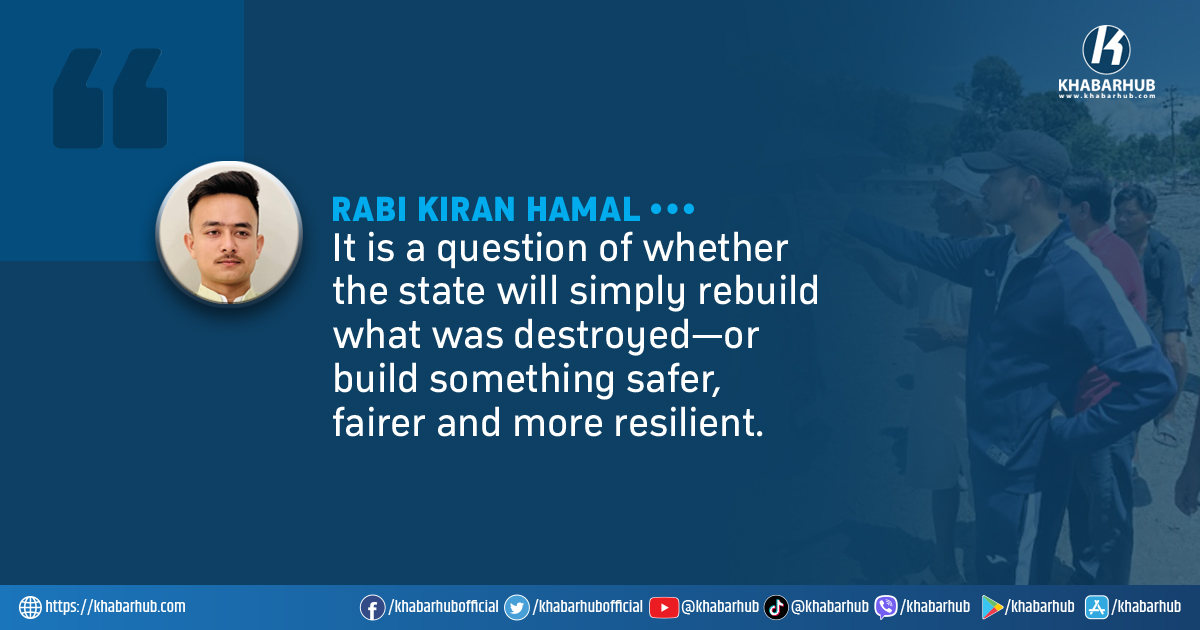
Because this is not merely a question of rehabilitating disaster victims. It is a question of whether Nepal will allow today’s catastrophe to determine tomorrow’s future. It is a question of whether the state will simply rebuild what was destroyed—or build something safer, fairer and more resilient. And it is a question of whether the world will continue to ask vulnerable countries to adapt alone, or finally accept that climate justice requires responsibility, solidarity and action.
Nepal must rebuild its future. But Nepal should not have to rebuild that future alone.





Comment