




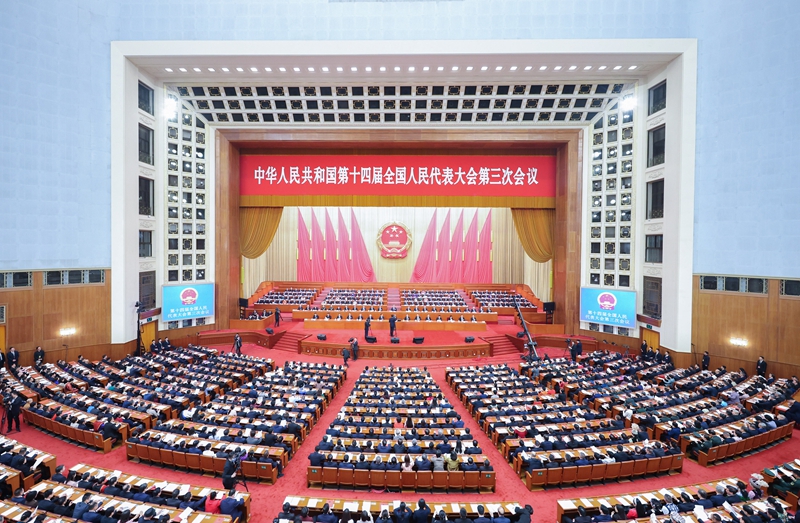
As Beijing hosts its most significant annual political gatherings, a parallel story has emerged beyond the carefully choreographed proceedings—one of suppression, surveillance, and systemic obstruction.
While China’s leadership convenes for the “Two Sessions,” a period that projects unity and policy direction, petitioners from across the country report being detained, intercepted, or silenced before they can present their grievances.
Petitioning system under strain
China’s administrative petitioning system, designed as a channel for citizens to raise complaints against local authorities, has long been portrayed as a mechanism for redress.
Citizens frequently travel to Beijing in the hope that higher authorities will intervene in disputes ranging from land seizures to allegations of corruption or judicial injustice.
However, accounts from petitioners and rights observers suggest that the system remains deeply constrained in practice. During politically sensitive periods such as the Two Sessions, local governments intensify “stability maintenance” operations.
These efforts are aimed at preventing petitioners from reaching the capital, where their presence could disrupt the image of political order.
Reports indicate that the petitioning mechanism is not only ineffective for many but may also expose complainants to heightened risks, including surveillance, harassment, and detention.
Heightened controls during the two sessions
This year’s political meetings, which began on March 4, have seen a renewed tightening of controls.
Petitioners attempting to travel to Beijing have encountered increased restrictions at multiple levels. Some have been intercepted en route, while others have been detained upon arrival.
In several documented cases, individuals were reportedly confined in hotels under guard, forcibly returned to their home provinces, or placed in informal detention facilities often referred to by activists as “black jails.”
These facilities, which operate outside formal judicial oversight, have long been criticised by human rights organisations.
The pattern reflects a broader approach in which local authorities seek to pre-empt complaints by preventing petitioners from accessing central institutions altogether.
Detentions and disappearances in Beijing
Multiple incidents reported during the current political meetings highlight the extent of enforcement measures in the capital.
Petitioners from Shanghai were among those detained or forcibly repatriated after attempting to lodge complaints.
One individual, who had managed to evade local surveillance, was reportedly stopped by police near a central leadership compound and transferred to a holding facility used for petitioners awaiting return to their home regions.
In another case, siblings seeking medical treatment in Beijing were intercepted by police shortly after arriving at a hospital and taken into custody. Their whereabouts have since remained unclear, raising concerns about enforced disappearances.
Other petitioners described being stopped within the premises of the national complaints office itself.
According to their accounts, unidentified personnel checked their identification against what was described as a blacklist before escorting them to holding rooms.
There, multiple individuals from different provinces were confined without access to mobile phones or external communication.
Such incidents suggest that restrictions extend beyond travel controls, reaching into the very institutions meant to process grievances.
Allegations of abuse and coercion
Some of the most serious allegations involve physical abuse and inhumane treatment.
A petitioner from Fujian Province reportedly suffered severe distress after being held for nearly two days without access to water or restroom facilities.
According to accounts from other petitioners, her repeated requests for medical assistance were denied. She was eventually left on a public sidewalk, where passersby called for emergency help.
Another individual from the same province, who had pursued a land dispute for more than two decades, was reportedly stopped by personnel from her home region before she could present her case.
Her efforts to seek legal review had previously resulted in repeated referrals between courts and administrative bodies, without resolution.
These cases illustrate a pattern in which prolonged grievances remain unaddressed, while attempts to escalate them are met with coercive measures.
Targeting of vulnerable petitioners
Among those detained were individuals with disabilities and those who had previously alleged corruption by local officials.
In one reported case, petitioners were confined by security personnel in a building in Beijing shortly after arriving in the city. Two of them were described as disabled, raising further concerns about the treatment of vulnerable individuals within the petitioning system.
One of the detainees had previously accused local authorities of corruption and had reported retaliation in earlier years. Before losing contact, she issued a statement suggesting that any disappearance would likely be linked to reprisals.
Such accounts underscore the risks faced by petitioners who persist in challenging official actions, particularly when their claims involve allegations against local power structures.
Nationwide surveillance and pre-emptive restrictions
The restrictions are not limited to Beijing. Reports from multiple provinces indicate that monitoring and control measures have been intensified nationwide, often before petitioners attempt to travel.
In northeastern China, a petitioner described being subjected to physical assault by police officers who entered his hotel room. He reported being under continuous surveillance for several years and being barred from leaving his city.
In another province, a petitioner said she had been confined to a hotel room for over a week, with modifications made to prevent her from exiting independently.
She described being placed under constant guard after being stopped by police while visiting a friend.
These measures reflect a strategy of pre-emptive containment, aimed at neutralising potential petitioners before they can act.
A system caught between image and reality
The developments during this year’s Two Sessions highlight the tension between the official portrayal of governance and the experiences reported by citizens seeking redress.
While the political meetings emphasise stability, policy continuity, and national progress, the treatment of petitioners presents a contrasting narrative. The reliance on surveillance, detention, and coercion suggests a prioritisation of control over accountability.
The persistence of long-standing grievances—some spanning decades—further raises questions about the effectiveness of existing mechanisms for dispute resolution.
For many petitioners, the journey to Beijing represents a last resort after exhausting local channels. The obstacles they encounter at every stage point to systemic barriers that remain unresolved.
As China’s leadership concludes its annual political gatherings, the accounts emerging from petitioners offer a stark counterpoint to the official proceedings.
The reported detentions, disappearances, and restrictions underscore the challenges faced by individuals seeking to navigate the country’s petitioning system.
The pattern observed during the Two Sessions reflects a broader approach in which maintaining political order takes precedence over addressing citizen grievances.
In this environment, the promise of redress through administrative channels remains uncertain, and the risks associated with pursuing justice continue to grow.






Comment