




In 2024, a public health student at Pokhara University conducted a study on breastfeeding practices in rural Kaski as a partial requirement for the degree. She interviewed mothers about the breast-feeding practices, analyzed the data and wrote a 120-page thesis filled with the findings which indicate gaps in service delivery and maternal awareness.
She successfully defended her thesis and was praised by the external examiner for her thorough and rigorous statistical analysis. The document was then printed and placed on a dusty shelf in the university library. No further publications followed. Policymakers never learned about the study’s findings, and its recommendations were never considered in the policymaking process.
Her story is not unique. It is a story repeated thousands of times every semester across Nepal, as valuable student research remains confined to university archives instead of informing public policy and practice.
Every year, thousands of undergraduate, postgraduate, and PhD students conduct research across a wide range of fields, from business and economics to agriculture, education, and public health. They travel to different parts of the country to collect data through surveys, questionnaires, and interviews. They spend months analyzing information, applying statistical methods, drawing meaningful conclusions, and developing practical recommendations to address pressing national challenges such as financial literacy, youth unemployment, cooperative sector crises, healthcare access, and other socioeconomic issues.
Yet, once the thesis defense is completed and the degree is awarded, much of this research disappears from public view. Most theses are archived in university libraries or departmental shelves, rarely moving beyond campus walls. As a result, valuable insights and evidence-based recommendations that could contribute to policymaking, institutional reform and social development remain largely untapped.
This represents not just academic papers, but thousands of hours of survey, significant personal expenses, and a large amount of locally generated evidence that never becomes part of Nepal’s scientific evidence.
A key reason behind this publication recession is weak publication culture in Nepali Universities. Research is often treated merely as a graduation requirement rather than a contribution to national discourse. Supervisors are burdened with heavy workload and one supervisor handling almost 40 plus students research work in undergrad, may lack time to mentor students converting their thesis into journal papers.
Students have no experience in academic writing, journal process submission and responding to peer review. After graduation, students move on to jobs or further studies, and their research work inarticulately remains deferred in terms of dissemination.
A conversation that never happens
One of the issues with Nepal research ecosystem is the weak coordination between universities and policymakers. Student research findings are rarely translated into policy briefs or formally shared with ministries or regulatory authorities for policy implementation. There is no formal structure through which different government levels can systematically access research conducted within their own jurisdictions. As a result, valuable local evidence remains trapped inside university walls, invisible to those who shape public programs and policies.
The irony is striking. A municipality may be struggling with maternal health outreach or financial awareness campaigns while a detailed student study addressing the same issue sits just a few kilometers away on a campus shelf. The problem is not the absence of evidence; it is the absence of effective communication and institutional coordination. Without a functional bridge between academic research and public decision-making, policies continue to be formulated with limited data and evidence while research continues to be produced without real-world impact.
Consequences for national development
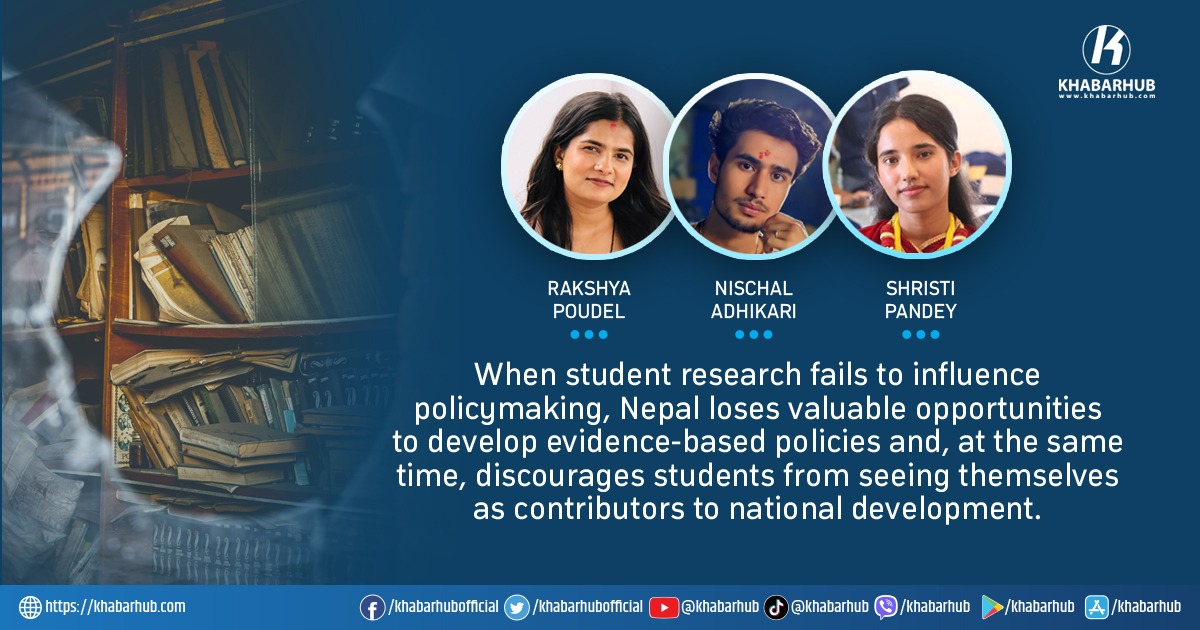
When student research fails to influence policymaking, Nepal loses valuable opportunities to develop evidence-based policies and, at the same time, discourages students from seeing themselves as contributors to national development. Research conducted by students often captures real community challenges through primary data collection, providing insights that large-scale national surveys may overlook or fail to examine in sufficient depth.
These studies generate localized and context-specific evidence on issues affecting communities across the country. Whether examining financial literacy, youth unemployment, agricultural productivity, public health, or local governance, student researchers frequently uncover practical findings and recommendations that could help policymakers design more effective interventions. If properly disseminated and utilized, such research could directly inform local-level decision-making and contribute to solving pressing social and economic problems.
When policymakers overlook existing student research, Nepal may incur financial loss more than any intellectual loss. Government agencies may allocate funds to conduct similar studies, this duplicates effort consumes public funds and delays policy action. If properly conducted and shared, student research could save time and reduce research expenditure of government significantly. Allowing these researches to remain unpublished and unused, Nepal is wasting academic effort, intellectual capital and public fund which can develop smarter and data-based policies.
What needs to change?
Universities must start to prioritize research as a knowledge product rather than a graduation requirement, which must not end with defense and should move toward publication. Departments should require at least a publishable paper or policy brief as part of the requirements, which may shift the paradigm.
At the same time, the lack of publication support must be addressed. Students are never taught how to turn a thesis into a journal article and navigate peer review. Universities need to institutionalize a dedicated support system for publication; expecting students to publish without proper guidance is unrealistic.
There must be a formal system to connect universities with policymakers, which can compile and disseminate annual research summaries with ministries, municipalities and regulatory agencies. Even a single-page policy brief from each thesis could create a flow of evidence into decision-making spaces. Incentives such as recognition, funding opportunities and institutional reward must be added for publication and policy contribution which help build a strong and serious research culture.
Policymakers cannot afford to remain passive, spending public funds on new studies while overlooking the vast body of research already being produced within universities. Government agencies at all levels should actively engage with academic institutions by providing research grants, identifying priority research areas, requesting research outputs, and incorporating academic findings into policy planning, implementation, and evaluation. Without demand from policymakers, the supply of research will continue to accumulate in archives rather than contribute to public decision-making.
Nepal does not suffer from a shortage of research; it suffers from a system that generates knowledge and then leaves it unused. Every unread thesis represents more than wasted academic effort—it is a missed opportunity to address real community challenges using evidence that already exists. A single policy brief derived from each thesis and systematically shared with the relevant ministry, municipality, or public institution could help bridge the gap between research and policymaking.
The country’s development challenges—from unemployment and financial inclusion to public health, agriculture, and local governance—have been extensively studied by students across universities. Yet the findings of these studies rarely reach those with the authority to act on them. Valuable insights remain buried in library archives while policymakers continue searching for solutions to problems that have already been examined in depth at the local level.
Nepal’s development challenges are well documented. What remains underdeveloped is the institutional commitment to using the evidence we already generate. Until a stronger bridge is built between academia and policymaking, many of the country’s brightest young researchers will continue writing for the shelf rather than for society, and Nepal will continue to miss opportunities for more informed, effective, and evidence-based governance.
Nischal Adhikari is a graduate of Bachelors of Business Administration; Rakshya Poudel, a graduate of Bachelors of Development Studies; and Shristi Pandey is a graduate of Bachelors of Business Administration from Pokhara University).





Comment