




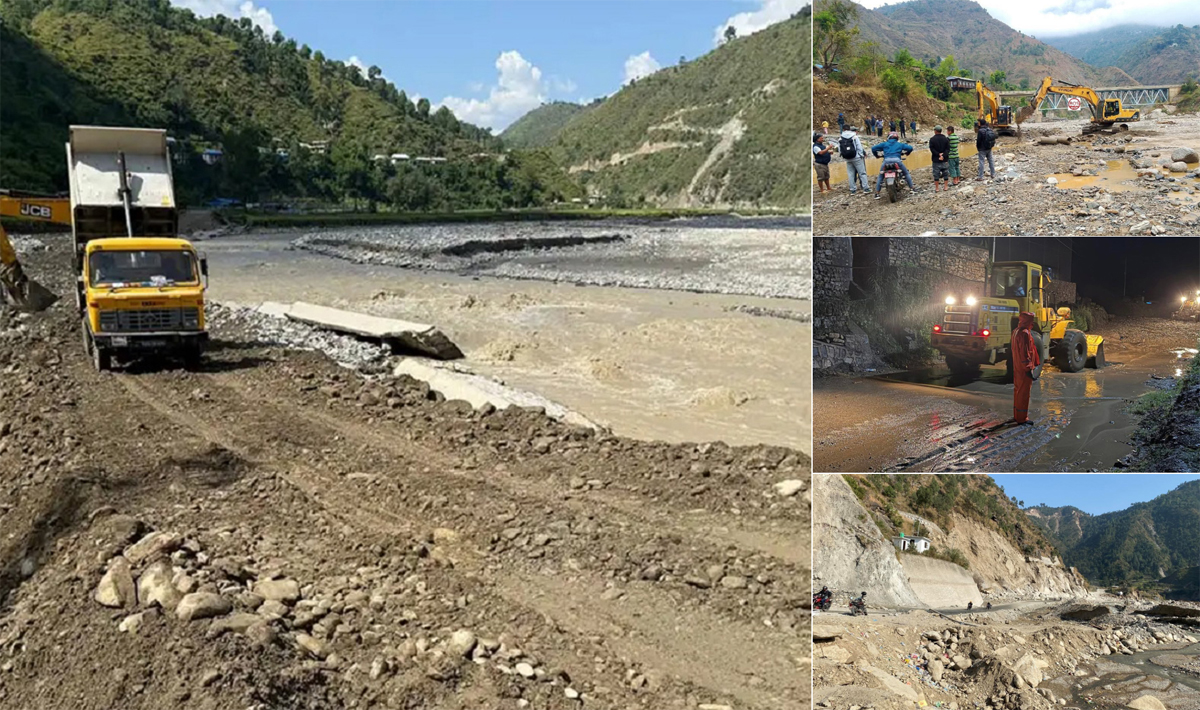
KATHMANDU: The BP Highway, a vital lifeline connecting eastern Nepal to the capital, is unlikely to reopen before July, with alternative routes also facing significant challenges.
Whether during the monsoon or even normal winter rains, the highway has been repeatedly obstructed in recent years.
Constructed over two decades, the BP Highway is the shortest and most convenient route linking eastern Nepal to Kathmandu. Its construction began in the fiscal year 1996/97 BS with support from the Japan International Cooperation Agency (JICA) and was completed in March 2015. The project cost included 26 billion Japanese yen from the Japanese government and 1.1 billion yen from the Government of Nepal.
However, within a month of its completion, the highway was damaged by the 2015 earthquake. With Japanese assistance, it was repaired and officially handed over to the Nepal government in January 2021.
Less than four years later, the highway suffered severe damage again due to floods and landslides triggered by heavy rainfall in September 2024. Currently, a 28-kilometre stretch from Bhakundebesi in Namobuddha Municipality (Kavre) to Nepalthok in Sunkoshi Rural Municipality (Sindhuli) is under reconstruction.
Approximately 8 kilometres of road, including sections at Chowkidanda, Boksekuna, Mamti, Charsayabesi, and Ghumaune, require complete rebuilding from the foundation.
Reconstruction responsibilities have been divided between the Road Division Office, Bhaktapur (covering three sections in Kavre), and the Road Division Office, Khurkot (Sindhuli section). The government has allocated a total resource agreement of Rs 8.5 billion for the project.
According to Department spokesperson Engineer Shyam Bahadur Khadka, Rs 7.5 billion has been allocated for the Kavre sections and Rs 1 billion for the Sindhuli section.
Information Officer Suman Raj Basnet of the Bhaktapur Division Office said contracts for the work were awarded before the end of the last fiscal year. “Work is being prioritised in areas where even the road base has been completely destroyed,” he said.
Dalabesi–Charsayabesi–Bhakundebesi Section
Khani–Avon–Kamaljit JV is currently reconstructing the 8.5 km Dalabesi–Charsayabesi section under a contract worth Rs 1.42 billion (including VAT).
Similarly, Lama–Nawakantipur JV has been awarded the 11.8 km Charsayabesi–Bhakundebesi section for Rs 1.33 billion. Around 25 percent of the work has been completed so far.
Barkhekhola–Piple section
The 3.2 km Barkhekhola–Piple section is set to be rebuilt in its original design with a grant from JICA. However, the contract for this portion has yet to be awarded.
Arjun Aryal, head of the Foreign Division at the Department of Roads, said a memorandum of understanding has been signed with the Japanese government for a grant worth Rs 2.63 billion. “The agreement verification process is currently underway and is expected to be completed within this week,” he said.
He added that construction work on this section will begin soon after the procurement process is finalized.
Nepalthok–Barkhekhola section
Reconstruction work on the 4.90 km Nepalthok–Barkhekhola road section in Sindhuli has begun. The project is being carried out by Kharidhunga–Ghising–Kshitij JV at a cost of Rs 610 million, including VAT.
This section was severely damaged by flooding in the Rosikhola in 2081 BS. Although it was temporarily reopened after constructing a diversion, the structure was washed away by floods last October, and even normal rainfall continues to disrupt traffic.
Engineer Sudarshan Upreti, Information Officer at the Road Division Office, Khurkot (Sindhuli), said that work is currently focused on building RCC retaining walls in areas where the road foundation has been completely eroded. “So far, around 30 percent progress has been achieved,” he said.
He added that there are plans to complete work in high-risk areas up to 65 percent before the onset of the monsoon.
What are the alternatives?
In the event of a complete blockage of the BP Highway, there is a lack of reliable alternative routes.
Although the Mid-Hill Highway is considered a potential option, vehicle movement becomes difficult during the rainy season due to the absence of major bridges at key points such as Sunkoshi and Khani Khola. If these bridges were constructed, it could serve as a dependable route connecting Sitkha and Jalghat.
In recent years, when floods blocked the BP Highway, vehicles traveling from districts such as Okhaldhunga, Udayapur, and Solukhumbu were forced to use the Mid-Hill Highway as an alternative.
Another option is a corridor via Sindhuretar Bridge leading to Bhakundebesi through Timal. However, this route is not suitable for smaller vehicles and two-wheelers.
Travelers can also reach Kathmandu via Khurkot–Manthali–Tamakoshi–Charikot–Khadichaur along the Araniko Highway, covering a distance of about 204 km.
From Sindhulimadi, Kathmandu can be accessed via the Madan Bhandari Highway through Hetauda and Phakhel, a route of approximately 209 km.
For larger vehicles, the Sindhulimadi–Hetauda–Palung–Naubise route stretches about 219 km. However, all these roads require further upgrades and improvements.
The longest but most reliable alternative remains the Bardibas–Hetauda–Narayangadh–Muglin–Kathmandu route, which spans approximately 357 km.
The BP Highway was originally designed to reduce travel time and hardship on such long routes. However, repeated disasters have once again forced travelers to rely on these extended alternatives.
Shubhraj Dahal, Information Officer at the Department of Roads, said that no long-term alternative route has yet been formally designated. “We have instructed officials to prioritise work in high-risk areas so that progress can be made before the monsoon,” he said.
Around 3,000 vehicles use the BP Highway daily.
What infrastructure expert says?
Former Secretary at the Ministry of Physical Infrastructure and Transport, Kishor Thapa, has urged the government to prioritise the upgrading of alternative routes such as the Mid-Hill Highway and Kanti Lokpath.
“The BP Highway was constructed over a long period under challenging geographical conditions. Now that it has been repeatedly damaged by natural disasters, reconstruction will take time,” Thapa said. “The government should immediately improve alternative routes like the Mid-Hill Highway and Kanti Lokpath, especially those passing through Dakshinkali, to ensure reliable connectivity.”
He added that while travel previously relied heavily on the Narayangadh–Muglin route due to the lack of alternatives, multiple route options now exist. The government, he stressed, should take immediate steps to upgrade and strengthen these alternatives.





Comment