




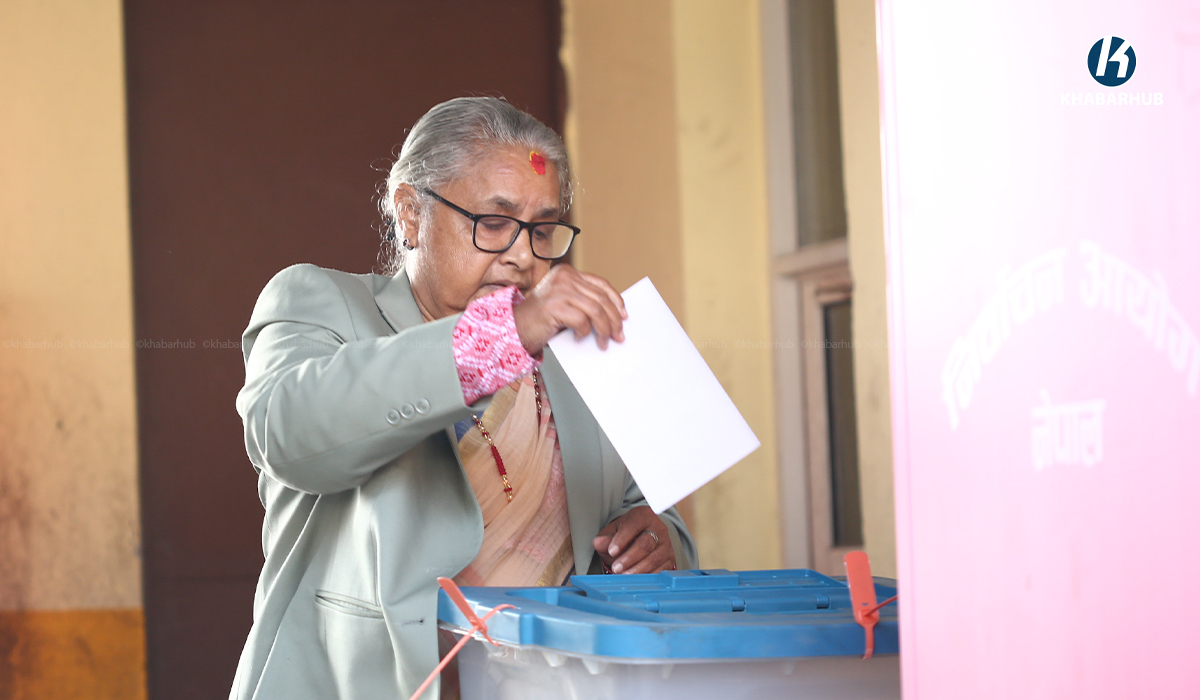
The election for transformation has successfully concluded from transition. The counting is now underway. 5 March may well mark a momentous day in Nepal’s democratic journey—a moment when the country paused, reflected, and chose once again the path of political legitimacy through the ballot. Yet the significance of this election cannot be understood without recalling the decisive events that preceded it.
On 9 September 2025, Nepal stood dangerously close to political breakdown. Escalating protests, deep public frustration, and mounting institutional paralysis had pushed the state toward a moment of potential anarchy. At that critical juncture, the intervention of the Nepali Army played a decisive stabilizing role. By preventing the situation from spiraling further, the institution helped facilitate the conditions necessary for the restoration of political order.
The security environment was stabilized, allowing the formation of a citizen-led government and ultimately paving the way for elections that many today celebrate. The peaceful exercise of democratic choice witnessed across the country stands, in many ways, on the foundation laid by the Nepali Army on the 9th of September 2025 in those uncertain days.
Credit is also due to Prime Minister Sushila Karki, whose leadership helped guide the transition from crisis to electoral legitimacy. Together, political leadership and institutional restraint ensured that the political-security crisis of 2025 did not evolve into a prolonged national rupture.
Today’s elections therefore represent more than a routine democratic event. They represent a recovery of legitimacy and the commencement of transformation. A win is election should be transferred to national victory.
A Peaceful Vote in a Fragile Moment
Under robust security arrangements, voters turned out steadily across the country. Turnout reached 61.63 percent—slightly lower than the previous election, but still reflecting meaningful civic participation in a country where democratic fatigue and political cynicism have often been visible.
Encouragingly, the polling process remained largely peaceful.
A few minor disputes were reported in the districts of Dolakha, Sarlahi, and Rautahat. These were resolved without major disruption. The far-western district of Darchula, however, presented a more complex situation, highlighting the uneven administrative and political realities that continue to characterize Nepal’s federal structure.
Still, the broader conclusion is clear: the system held.
In a region where electoral politics often generates intense friction, Nepal’s ability to conduct a largely peaceful vote during a period of institutional transition is itself noteworthy.
The Strategic Importance of Demography
Beyond the immediate electoral outcome lies a deeper structural factor shaping Nepal’s future—demography.
Much like its southern neighbor India, Nepal is a young nation. More than half of its population lies between the ages of 18 and 40. This demographic reality carries both opportunity and risk.
Young societies are inherently dynamic. They generate innovation, entrepreneurship, and social mobility. But they also produce intense expectations—particularly regarding employment, governance, and economic opportunity.
For Nepal’s younger generation, the demands placed upon the state are increasingly clear:
Job creation
Governance reform
Economic opportunity
Political accountability
These expectations differ sharply from those of previous generations. The youth of Nepal are digitally connected, regionally aware, and globally exposed. They compare their prospects not only with previous Nepali generations but also with peers across Asia.
This generational shift is quietly reshaping Nepal’s political landscape.
If the outcome of these elections reflects the aspirations of this younger demographic, it could begin to establish a blueprint for more responsive governance and institutional renewal.
The Economic Window
Encouragingly, there are signs—still tentative but increasingly visible—of economic recovery.
Nepal is beginning to see “green shoots” in its economic landscape. GDP growth is improving, and strategic sectors are witnessing renewed momentum. Among these, hydropower investment stands out as particularly significant.
Few countries possess the natural hydrological advantages that Nepal enjoys. Its Himalayan rivers provide the basis for potentially vast energy production. If developed prudently, hydropower could transform Nepal’s economic model.
The country has long struggled with energy shortages and infrastructure gaps. But with sustained investment, Nepal could shift from being an energy-deficit economy to a regional energy exporter.
Electricity exports to neighboring markets—particularly India and potentially beyond—could generate significant revenue, stabilize the current account, and stimulate industrial growth.
The foundations for such a transformation exist. What remains uncertain is whether political leadership can deliver the policy stability required to sustain long-term investment.
Legitimacy Is Not Delivery
The elections have restored political legitimacy. But legitimacy alone does not guarantee transformation.
Nepal’s modern political history is marked by repeated cycles of hope followed by disappointment. Political transitions have often produced new institutional arrangements without necessarily delivering improved governance.
The challenge today is therefore not simply to celebrate the election. It is to translate legitimacy into delivery.
Real change requires progress on several fronts simultaneously: Institutional reform; Administrative efficiency; Economic modernization; Anti-corruption efforts; Policy predictability; De-politicization of institutions; Revisit strategic structures for national security and Transparent Foreign policy.
Foreign Policy is considering adopting a more open foreign policy in order to strengthen its economic growth, diplomatic relations, and global presence. An open foreign policy means engaging actively with many countries rather than relying on only a few partners. For Nepal, this involves maintaining balanced relationships with immediate neighboring powers China and India while also expanding cooperation with other nations like the United States, Japan, and members of the European Union. By diversifying its international partnerships, Nepal can reduce overdependence on any single country and create more opportunities for trade, investment, and development.
One of the main advantages of an open foreign policy is the potential for economic growth. Increased diplomatic engagement can attract foreign investment, promote international trade, and support the development of key sectors such as tourism. Nepal is home to world-renowned destinations like Mount Everest and Lumbini, which already draw visitors from around the globe.
With stronger international cooperation and promotion, the tourism industry could expand even further and contribute significantly to the national economy. Additionally, collaboration with international organizations such as the World Bank and the Asian Development Bank can help Nepal improve infrastructure, energy development, and education, all of which are essential for long-term growth.
However, adopting an open foreign policy also requires careful management of potential challenges. Nepal’s geographic position between two major powers, India and China, makes its diplomacy particularly sensitive. Increased openness could lead to geopolitical competition between these countries within Nepal. Furthermore, successful foreign policy depends on political stability and consistent governance at home, which Nepal has sometimes struggled to maintain due to frequent changes in government. There is also a risk that excessive reliance on foreign aid or investment could create new forms of dependency if not handled wisely.
Overall, Nepal can benefit from a balanced and open foreign policy that prioritizes national interests with equi-centric, equi-valent, equi-distance principles while building friendly relations with multiple countries. By maintaining diplomatic balance, promoting economic cooperation, and strengthening its role in international affairs, Nepal can enhance its development and global standing while preserving its independence and stability.
Without these reforms, electoral participation risks becoming symbolic rather than transformative.
Nepal’s political leadership now faces a familiar but unavoidable test: whether it can convert democratic participation into tangible improvements in governance and economic performance.
The Institutional Backbone
In moments of uncertainty, societies often look toward institutions that retain public trust.
In Nepal, one such institution remains the Nepali Army.
Across decades of political change—from monarchy to republic, from insurgency to peace process—the army has largely maintained institutional cohesion and public credibility. Its role during the crisis of September 2025 reinforced this perception.
This does not imply a political role for the military in governance. Rather, it highlights the stabilizing function that credible national institutions can play when political systems face stress.
Stable democracies are rarely sustained by politics alone. They depend equally on trusted institutions capable of ensuring continuity during periods of turbulence.
The Strategic Shift Nepal Seeks
Despite the optimism surrounding the election, significant challenges remain.
Nepal is still searching for a strategic shift—a coherent national direction capable of aligning politics, economics, and governance. For years, the country’s political discourse has revolved around party’s benefits, corruption, and power-sharing arrangements. While important, these debates have often overshadowed the more pressing challenge of economic transformation.
The Nepali people increasingly expect a shift toward delivery-oriented governance.
Infrastructure, investment, industrialization, employment, and administrative efficiency now dominate public expectations. Elections may provide legitimacy, but citizens increasingly judge governments by outcomes rather than promises.
In this sense, the election represents a headway—but not yet a delivery.
A Moment of Possibility
Still, moments of possibility should not be dismissed lightly.
Nepal today stands at a potentially important inflection point. A peaceful election has restored democratic legitimacy. Economic indicators show early signs of recovery. A young population is eager for opportunity. Strategic sectors such as hydropower offer long-term potential.
If these elements align, Nepal could enter a more stable and prosperous phase of its modern history.
But the window will not remain open indefinitely.
The coming years will determine whether Nepal can transform political legitimacy into institutional performance and economic growth.
The Threshold of Change
For now, cautious optimism is warranted.
The events of 5 March demonstrate that Nepal’s democratic institutions remain resilient. The peaceful conduct of elections following a year of political turbulence shows that the country retains the capacity to recover from crisis.
If political leadership can harness the energy of its young population, sustain economic momentum, and strengthen institutional credibility, this election could indeed become a turning point.
Nepal may truly be standing at the threshold of change.
Whether that change leads to renewal—or simply another cycle of expectation—will depend on what happens after the ballots are counted.
(Basnyat is a Maj. General (retired) of the Nepali Army and a strategic affairs analyst. He is also a researcher and is affiliated with Rangsit University in Thailand)





Comment