




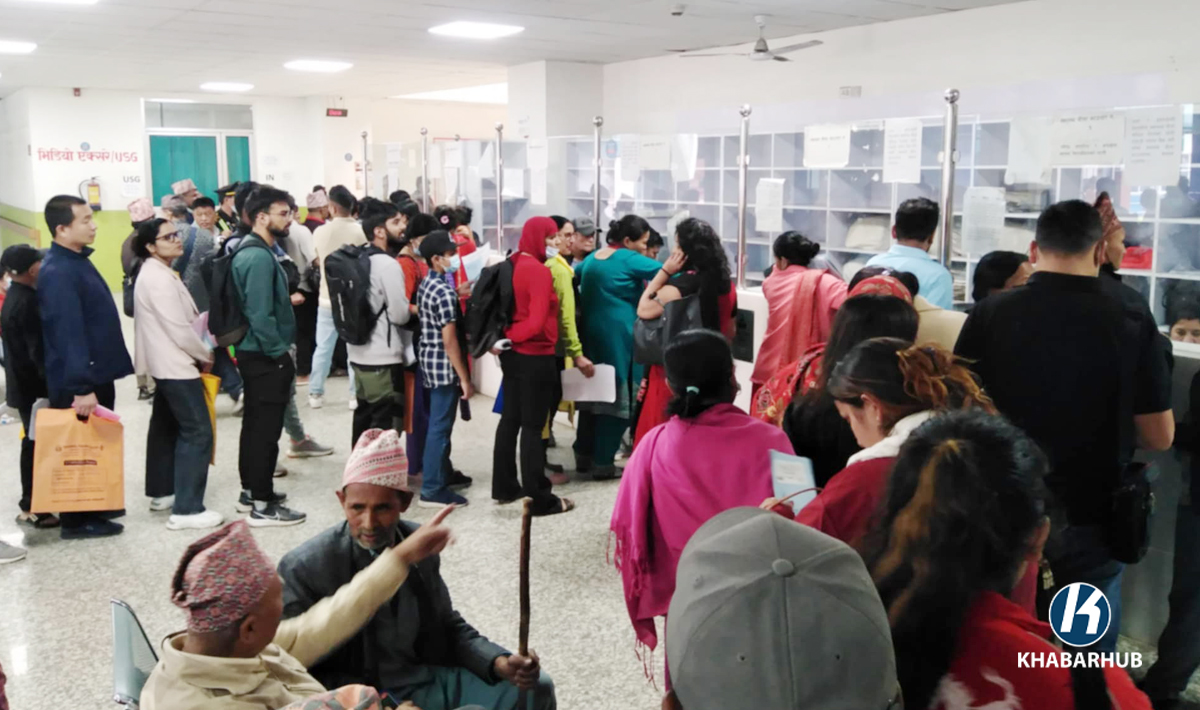
KATHMANDU: The government’s National Health Insurance Program, launched to provide accessible, affordable and quality healthcare to citizens, has plunged into a deep crisis, with more than three dozen private and community hospitals across the country suspending insurance-based services.
The suspension has directly affected millions of insured citizens, as service providers say prolonged delays in reimbursement have pushed them into severe financial distress.
The Health Insurance Board (HIB) has acknowledged that it owes service providers nearly Rs 11 billion in unpaid claims. Hospitals say they have been forced to halt services under the insurance scheme after failing to manage medicines, medical equipment and human resources due to non-payment.
Meanwhile, a blame game has intensified between the Health Insurance Board and the Ministry of Health and Population. While the Board claims that the government has failed to release the required budget on time, the Ministry argues that weak management and poor planning by the Board are at the heart of the crisis.
All-party meeting ends in finger-pointing
An all-party meeting convened by Prime Minister Sushila Karki on Wednesday to discuss the worsening insurance crisis failed to yield concrete solutions. Participants said the discussion was dominated by mutual accusations rather than a clear roadmap for reform.
Several attendees remarked that a program initiated with good intentions has been pushed to the brink by ineffective leadership and poor inter-ministerial coordination.
Disagreements between officials from the Ministry of Health and the Ministry of Finance over fund disbursement further underscored concerns that lack of coordination has driven the national health insurance policy towards failure.
‘Program cannot run without guaranteed funds’
Addressing the meeting, Health Insurance Board Executive Director Dr Krishna Prasad Paudel said the program could not continue unless the source of outstanding payments was immediately secured.
According to him, nearly 92 percent of those enrolled in the scheme are currently using services, creating pressure on limited financial resources. He stressed the need to revise premium rates and introduce an income-based premium payment system.
Dr Paudel said the program had been operated more like a social welfare scheme rather than a sustainable insurance system, which has led to structural problems. He warned that funds allocated for the current fiscal year had already been spent clearing previous dues, and arrears could reach Rs 26 billion by the end of the fiscal year if additional resources are not provided.
He noted that hospitals submitted claims worth Rs 23.81 billion in the last fiscal year. Of this, the Board collected Rs 3.73 billion from premiums, while the government allocated Rs 10.5 billion.
“After paying last year’s remaining Rs 11 billion from this year’s budget, the Board has no funds left to settle current claims,” Dr Paudel said, adding that the program cannot operate without immediate financial guarantees.
‘Program will collapse without Rs 15 billion’
Health and Population Minister Dr Sudha Gautam urged the Ministry of Finance to immediately arrange funds to address the crisis.
Speaking at the meeting, she warned that hospitals enrolled in the insurance program could shut down services altogether unless at least Rs 15 billion is managed immediately.
“How can a program function with zero budget while carrying liabilities worth Rs 24 billion?” Minister Gautam asked. “Either clearly instruct us to shut down health insurance, or ensure the required funding.”
Responding to the concerns, Finance Secretary Ghanashyam Upadhyay said the Finance Ministry was committed to mobilising resources but stressed the need for policy-level reforms.
He suggested reprioritising existing allocations within the Health Ministry and assured cooperation on budget transfers and resource reallocation. “Based on expenditure patterns, we are ready to shift funds from other ministries to the Health Ministry if needed,” he said.
However, Upadhyay warned that without placing reform at the centre of the agenda, merely searching for funds would not ensure the long-term sustainability of the insurance program.
Following the discussions, Prime Minister Karki pledged that the government would continue the health insurance program “by any means necessary,” though no immediate funding decision was announced.
Doctors’ Association cites three core problems
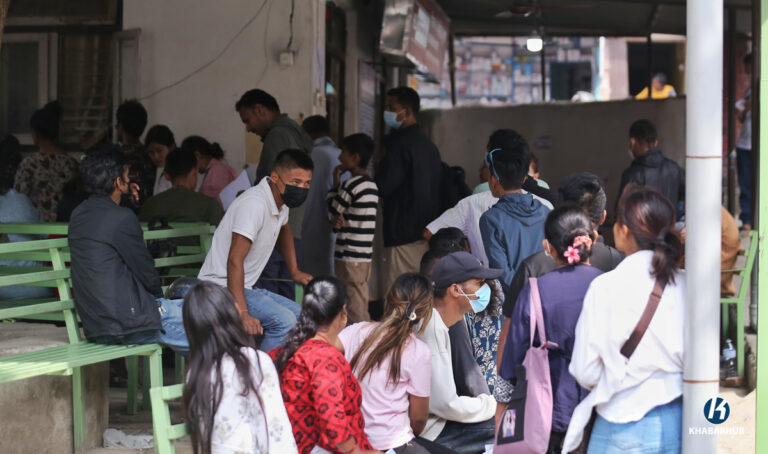
Nepal Medical Association President Dr Anil Bikram Karki identified three primary reasons behind the crisis: failure of the state to assume responsibility, lack of sustainable financial sources, and absence of policy clarity.
“The state has not taken the level of responsibility it should have,” Dr Karki said. “Decisions have been fragmented and short-term.”
He pointed out that the Finance Ministry’s approach of limiting expenditure strictly within the allocated insurance budget has created a situation where the program can neither be abandoned nor run properly.
Dr Karki said earlier arrangements that separated support for the poor and insurance schemes were merged, increasing confusion. He also criticised the lack of implementation of proposed reforms such as a ‘no-claim’ incentive system.
“There is talk of reducing OPD coverage to Rs 25,000. If that happens, people will start questioning why they should even enrol in insurance,” he said.
He also raised concerns over uniform OPD limits for all hospitals, arguing that the same amount may be insufficient at large urban or private hospitals but excessive for local facilities.
According to Dr Karki, health insurance is not solely a federal responsibility. “Where is the accountability of provincial and local governments when services are delivered through their hospitals?” he asked.
Although the Constitution guarantees health as a fundamental right, Dr Karki said insurance benefits are gradually being restricted in practice. He criticised the early narrative that paying Rs 3,500 annually guarantees treatment worth up to Rs 100,000, without clearly defining service packages.
“This created an expectation that people must fully utilise the Rs 100,000 every year,” he said. “Insurance should be for times of need, but that message was never properly communicated.”
As solutions, he proposed coordination among all three levels of government, a comprehensive review of the program, and the introduction of mechanisms such as no-claim benefits, reimbursement reform and reinsurance.
Dr Karki also suggested using taxes collected from tobacco and alcohol as permanent funding sources. “If someone uses only Rs 20,000 worth of services in a year, they should receive a discount on the next year’s premium,” he said.
“Either the government should integrate everyone into a robust social security system, or it should strengthen health insurance properly. Running it in the current form serves no real purpose.”




Comment