




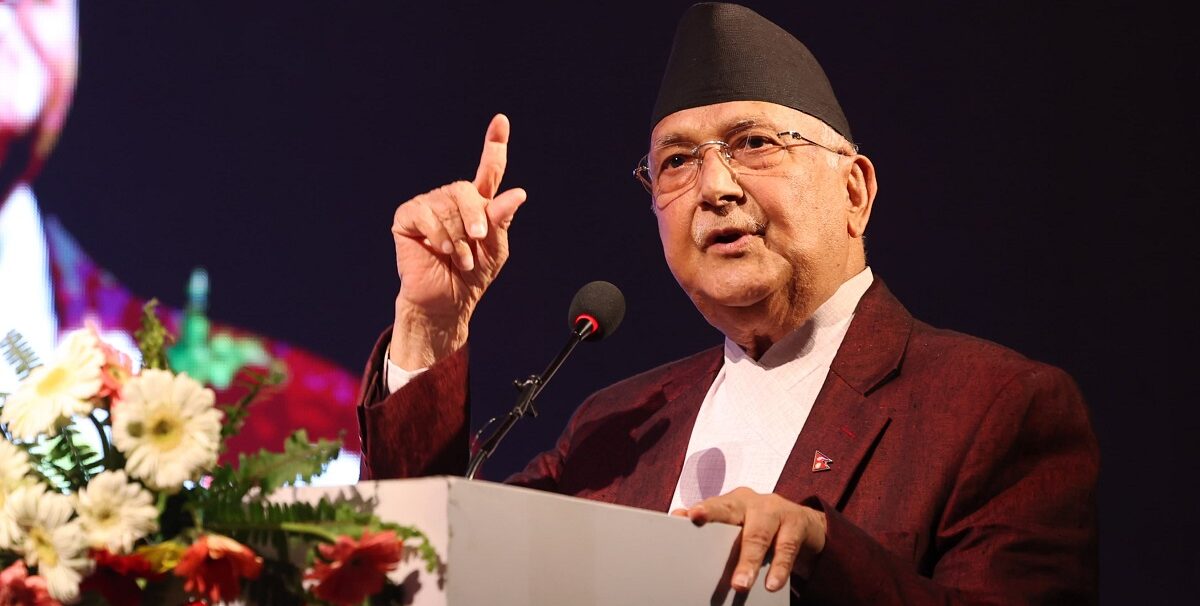
KATHMANDU: The statement submitted by CPN-UML Chairperson and former Prime Minister KP Sharma Oli to the commission formed to investigate the incidents of September 8 and 9 has become a subject of public debate.
Oli, who had earlier stated that he was ready to take bullets but would not give a statement to the commission, eventually appeared before the panel and recorded his statement on Sunday. Since then, reports and interpretations of his testimony have emerged from various angles.
On Tuesday morning, CPN-UML Secretary Mahesh Basnet made public five key points from Oli’s statement through social media, shedding light on the former prime minister’s position regarding the violence and the government’s response at the time.
According to Basnet, Oli stated that a meeting of the National Security Council held on the evening of September 7 had discussed ensuring that the protest would remain peaceful, avoiding the use of force, and extending cooperation to youth and students involved in the movement. However, Oli claimed that infiltration by disruptive and anarchic groups later took place, a fact that, he said, had been acknowledged by youths involved in the protest themselves.
Basnet further said Oli argued that most of those participating in the protest were not from the Gen-Z generation, as was widely claimed at the time. Oli reportedly cited photographs and videos from the period as evidence to support this assertion.
Regarding the escalation of violence on September 8, Oli stated that vandalism and sudden firing began unexpectedly. Following this, he said, discussions were held with the Home Minister and all security chiefs, leading to a decision to form an investigation committee.
Oli also maintained that although there was consideration of deploying the Nepal Army to bring the situation under control on September 9, it was ultimately not possible to do so.
In addition, Oli raised concerns about the impartiality of the investigation. According to Basnet, Oli expressed suspicion that a fair report might not emerge, noting that Gauri Bahadur Karki had already shared his views on social media on the day of the incident as well as before and after it.
“Since Gauri Bahadur Karki had already made his position public on social media on the very day of the incident and surrounding days, there is a risk that the report may not be impartial,” Basnet quoted Oli as saying in his Facebook post.
Five key points from Oli’s statement
- A National Security Council meeting on the evening of September 7 discussed keeping the protest peaceful, avoiding force, and supporting youth and students.
- Youths involved in the movement themselves acknowledged infiltration by disruptive and anarchic groups.
- Photos and videos from the time show that most protesters were not from the Gen-Z generation.
- After vandalism and sudden firing began on September 8, consultations with the Home Minister and security chiefs led to the decision to form an investigation committee.
- Although the deployment of the Nepal Army was considered on September 9, it could not be implemented.


Comment