




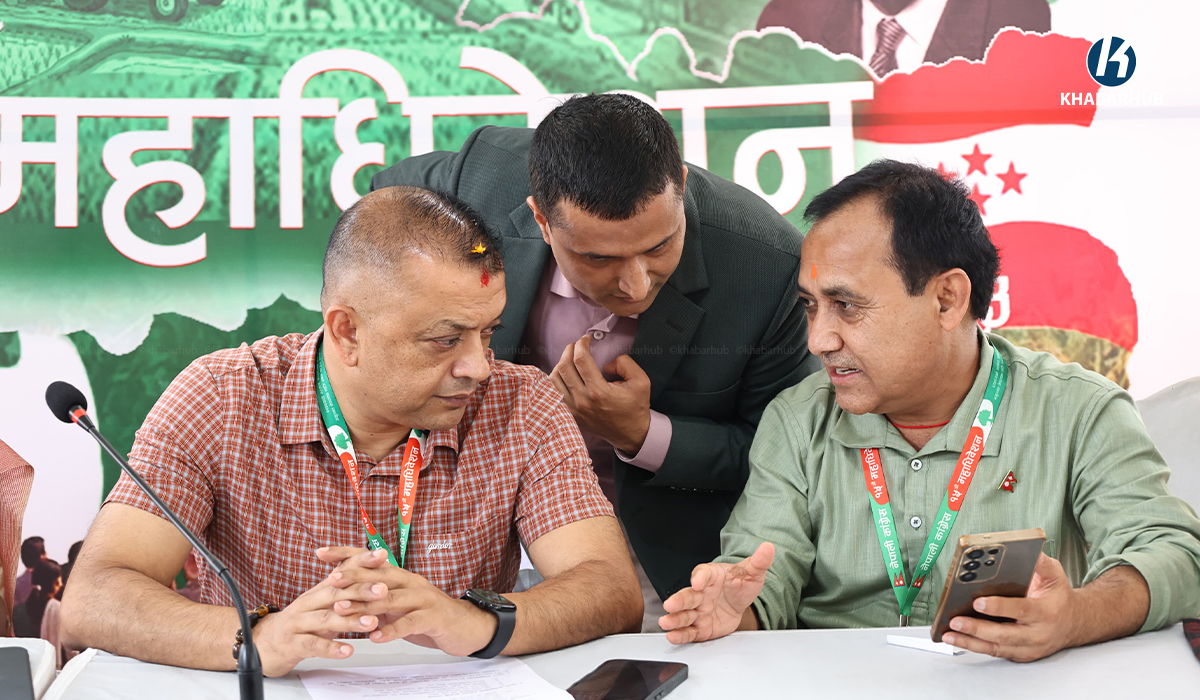
KATHMANDU: Nepali Congress Vice President Bishwo Prakash Sharma presented a detailed political report titled ‘The decline of political culture and the responsibility of transformation in line with the times’ at the closed session of the party’s 15th General Convention on Monday.
The report expressed deep sorrow over the Bhotekoshi disaster and highlighted issues including the current political culture, strengthening democracy, generational transition, a digital Congress and policy reforms.
Disaster, humanitarian sensitivity and the role of the opposition
At the outset, the report paid tribute to those who lost their lives in floods and disasters in Bhotekoshi, Manang and other areas a month ago.
It stated that the party had risen above all political interests and prejudices to support the government during the crisis and would continue to do so. It also stressed that the Nepali Congress should remain more responsible and constructive while in opposition, without giving space to impulsive or negative approaches.
Decline in political culture and internal self-criticism
The Nepali Congress has pledged to move forward by honestly acknowledging its own shortcomings. The report emphasised the need to make the democratic system and Constitution more inclusive and mature.
“Democracy is not merely a dull process of holding elections and choosing a government; it should be based on the way people experience it and on good governance,” the report said.
Putting people first and envisioning a digital Congress
The report stressed that the state must always place the individual dignity and human sensitivity of citizens at the centre. It said devaluing people, who are permanent, in favour of the power of temporary votes cannot be justified from any perspective of democratic culture.
It also proposed the concept of a ‘digital Congress’, using technology to ensure the participation and representation of the views of active party members in the party’s decision-making process. The report said this would help reflect the views of the majority of party members in decision-making.
15 pledges and 15 positive commitments
The report made public 15 things the Nepali Congress pledges not to do, including avoiding personality-centred politics, not promoting factionalism and ending the influence of access and connections in candidate selection.
It also outlined 15 positive commitments, including prioritising responsibility over positions, forming an ‘Election Bureau’ for candidate selection and linking party roles with income-generating activities.
The report also proposed legal initiatives to introduce fixed terms and age limits for leadership through amendments to the Constitution and party statute, with the aim of ensuring that leadership remains “like a flowing river, not a stagnant pond.”
Proposals for legal reforms
The report proposed bringing issues such as accountability in party switching, a requirement for candidates to have held membership in a particular party for a specified period before contesting elections, and protection of independent mandates into public debate.
The report made clear that the General Convention aims not only to select new leadership but also to transform the culture and style of doing politics.





Comment