




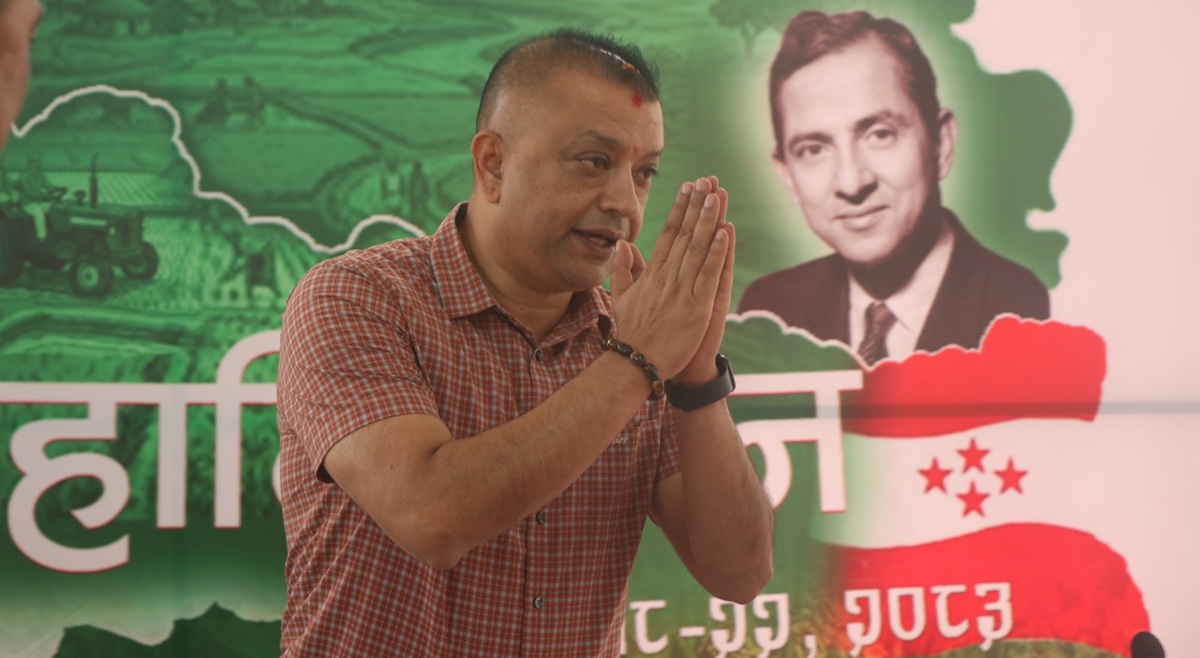
KATHMANDU: Nepali Congress (NC) President Gagan Kumar Thapa has presented a political report at the party’s Central Working Committee meeting, outlining the political, ideological, organizational and economic direction the party should take over the next four years.
The report, which is to be presented at the 15th General Convention, covers a wide range of issues, including a review of the party’s past performance, the government’s role and accountability, a policy of not forming pre-election alliances, party restructuring, cooperation with the private sector, greater youth participation and the vision of a “Prosperous Nepal, Respected Nepalis.”
Thapa’s report acknowledges that the Nepali Congress has prioritized positions and power over its core objectives over the past two decades. It states that the politics of alliance-building, division, factionalism and political transactions has weakened the party’s moral foundation. The report also says the tendency to protect people aligned with the party in cases of corruption and irregularities has undermined the autonomy of public institutions.
The report further states that the Congress has become increasingly disconnected from the younger generation and has failed to adequately understand changing public expectations. It proposes reforming the party through the second special general convention and seeking forgiveness from the people for its shortcomings.
The report primarily covers 29 issues, including:
Historical contribution and self-evaluation of the Nepali Congress
The report recognizes the Congress’s historical contributions to the political movements of 2007 BS, 2046 BS and 2062–63 BS, as well as the constitution-making process.
However, it concludes that the party has focused more on positions and power than its core objectives over the past two decades. It says alliance politics, internal divisions, factionalism and political transactions have weakened the moral foundation of the Congress.
The report also states that the tendency to protect party-aligned individuals involved in corruption and irregularities has weakened the autonomy of public institutions and contributed to the party’s growing distance from the younger generation.
The August 8-9, 2025 public uprising and the Nepali Congress’ defeat
The report states that the public uprising of August 8-9, 2025 should not be dismissed as a conspiracy. It recognizes demands for good governance, opportunities and fairness as legitimate expressions of public dissatisfaction.
At the same time, it argues that new political forces should not claim exclusive ownership of the movement. The report proposes an impartial investigation into the use of force, violence, loss of life and property, and alleged state repression during the uprising. It calls for those responsible to be brought to justice and for victims to receive truth, justice and reparations.
The Congress’s defeat in the last election on March 5 has been reviewed as the result of growing distance from citizens and political weaknesses accumulated over the past two decades. Accepting the electoral mandate, the party has expressed its commitment to play the responsible role of the main opposition.
A new role for the opposition
The report proposes that the Congress, with 38 seats, effectively monitor the government in Parliament. It calls for the party to scrutinize government activities on the basis of evidence and facts, speak out against corruption, rights violations and misgovernance, and present alternative policies and national priorities rather than merely criticizing the government.
It also proposes the practice of a “shadow government” to monitor ministries at both the federal and provincial levels, while giving priority to long-term national issues over day-to-day political disputes.
New policy on elections and alliances
Thapa has proposed that the Congress should not form an electoral alliance with any party before the upcoming elections. Instead, the party would seek votes under its own symbol, field its own candidates and go to the people with its own agenda.
The report proposes giving greater weight to competence, contribution and performance than to factional affiliation, access and patronage in candidate selection.
It also calls for greater use of primary elections, public opinion polls and direct voting by party members in selecting candidates. The report proposes that membership rules should not be changed at the last minute to influence the general convention or candidacy.
Ideological renewal of the Nepali Congress
The report proposes renewing the party’s ideology in line with the needs of the 21st century and changing socio-economic conditions, while retaining nationalism, democracy and democratic socialism as its core ideological foundations.
It proposes defining nationalism not merely in terms of geography and slogans, but also through national capacity in energy, food, technology and finance. Similarly, democracy should be linked not only to elections but also to citizens’ participation in decision-making and the exercise of public power.
The report proposes linking BP Koirala’s socialist vision with the modern social market economy and incorporating Pradeep Giri’s studies, debates, self-criticism and advocacy for excluded communities into the party’s ideological tradition.
“Prosperous Nepal, Respected Nepalis”
The report states that economic growth alone should not be considered the sole measure of progress. It proposes making education, health, nutrition, skills, capabilities and citizens’ substantive freedoms the foundations of development.
It also proposes making the development of citizens’ capabilities, access to opportunities and co-creation the principal approaches to national progress.
According to the report, development should not be driven by the government alone, but through collaboration among citizens, communities, the private sector, cooperatives, universities and experts. It also calls for greater clarity regarding the outcomes and responsibilities associated with major state decisions.
Five-question accountability system
The report proposes a five-question accountability system for every major government and public decision:
What decision was made?
Why was it made?
Who is responsible?
What results were achieved?
If the expected results were not achieved, what improvements were made?
It proposes making these five questions the basis of public accountability.
Open-source citizen dashboard
The report proposes developing a digital system through which citizens can directly access information on development projects, budget expenditures and responsible officials.
It calls for real-time monitoring and citizen oversight of government activities by publicly disclosing the status of projects, the amount of money spent and the officials responsible for implementation.
Economy and private sector
The report proposes recognizing the private sector not merely as a source of tax revenue, but as a key engine of wealth creation, production, innovation and employment.
It calls for creating a business-friendly environment while ensuring the security of private investment and policy stability. It also proposes shifting the government’s relationship with the private sector from one focused primarily on regulation and tax collection toward cooperation and partnership.
The report places production, entrepreneurship and employment generation at the center of economic policy. It proposes channeling remittances into productive investment in agriculture, industry, tourism and technology, while making water resources and clean energy the foundations of industrialization and green-energy exports.
Predistributive justice
The report introduces the concept of “predistributive justice,” which seeks to ensure equal opportunities from the outset rather than relying solely on taxes and subsidies to address inequality after it has emerged.
It proposes an economic policy aimed at creating a fair starting point for citizens by ensuring equitable access to education, healthcare, skills, finance and employment.
Employment and foreign employment
The report proposes making increased domestic production and access to decent employment a national priority. It also calls for foreign employment to be made safer, more systematic and rights-based, rather than being treated solely as an economic compulsion.
It proposes incorporating the rights and social security of Nepalis living abroad into national policy, creating an environment for channeling remittances into productive sectors, and expanding economic opportunities for young people to build their futures in Nepal.
Migration and population
The report states that different approaches are needed to address declining populations in the mountains, increasing migration in the Madhes and along major highway corridors, and growing population pressure in major cities.
It proposes formulating development plans based on actual patterns of settlement, mobility and demand for public services, rather than being constrained by administrative boundaries. It also calls for education, healthcare, housing, transportation and social security policies to reflect the changing lifestyles of Nepalis who are increasingly connected to villages, cities and overseas destinations.
In response to changing family structures, the report proposes incorporating the needs of children, senior citizens and caregiving into state policies.
Agriculture, industry and production
The report proposes shifting Nepal from an economy dependent on imports and remittances toward a production-oriented economy.
It identifies agriculture, water resources, energy, tourism, industry and digital technology as key foundations of economic growth and calls for linking agriculture with modern technology, markets and enterprise.
It also proposes channeling remittances into agricultural and industrial investment and providing policy support and facilitation to private-sector enterprises that generate production and employment.
Climate change and green development
The report proposes treating climate change not only as an environmental issue but also as an economic and national security concern.
It introduces the concept of intergenerational justice, calling for the sustainable use of natural resources and for disaster risks to be integrated into development planning, infrastructure and settlement development. It emphasizes that present-day development should not undermine the rights and opportunities of future generations.
The report also proposes linking green energy, water resources and environmental protection with economic opportunities and sustainable development.
Technology and artificial intelligence
The report notes that artificial intelligence and digital technology are transforming employment, education, knowledge and competition. It proposes that Nepal should not merely adopt new technologies but also prepare to capitalize on the opportunities they create.
It calls for making the education and skills-development systems compatible with emerging technologies and promoting media literacy and fact-based public discourse to counter misinformation and hate speech in the digital age.
Social sector
The report proposes maintaining the Congress’s engagement with social campaigns addressing issues such as caste discrimination, child marriage, gender-based violence, malnutrition, education, healthcare and environmental protection.
It calls for strengthening social security for senior citizens, children, women and vulnerable communities, while making public education and healthcare the foundation of equal opportunity. It also proposes incorporating mental health, loneliness and changing family structures into the state’s long-term policy framework.
Federalism and the Constitution
The report acknowledges that although Nepal’s federal structure has been established, its effective functioning remains weak and requires stronger coordination among the federal, provincial and local levels.
It proposes strengthening administrative capacity and fiscal federalism and linking federalism to local dignity, citizen participation and access to public services, rather than limiting it to administrative divisions.
The report states that any debate on constitutional amendment should be guided by national consensus rather than the prevailing balance of political power.
Transitional Justice
The report proposes completing the remaining tasks of the peace process and ensuring truth, justice and reparations for conflict victims.
It states that transitional justice should not be used as an instrument of political division or power bargaining, but should instead focus on restoring victims’ trust and strengthening the credibility of the institutions responsible for delivering justice.
National independence and the changing world
The report proposes strengthening Nepal’s national capacity in energy, food, finance, technology and knowledge, arguing that national independence should not be understood solely in terms of formal sovereignty.
It calls for expanding Nepal’s diplomatic options and pursuing a foreign policy based on national interests while maintaining the country’s independent decision-making capacity amid changing geopolitical competition.
The report emphasizes that Nepal’s internal economic capacity and external relations should be developed in mutually reinforcing ways.
A new concept of national reconciliation
The report proposes expanding BP Koirala’s concept of national reconciliation beyond a political agreement and developing it as a foundation for socio-cultural unity.
It calls for strengthening a common Nepali identity across the Himalayas, hills, Madhes and diaspora, as well as among people of different religions, cultures and communities. It proposes prioritizing coexistence, dialogue and democratic culture while embracing Nepal’s diversity.
Organizational reform and the journey of five generations
The report proposes transforming the Congress into an organization that remains continuously connected with citizens rather than becoming active only during elections.
It calls for combining the experience of older generations with the energy and knowledge of younger generations by making party membership, participation and internal democracy more transparent. It also proposes creating an institutional pathway for leadership transition across five generations.
The report proposes establishing a “Leadership Training Institute” for cadre and youth leadership development, a “Policy Foundation” for policy research, an “Election Bureau” to prepare for elections, and a “Governance Institute” to support elected representatives on policy, budgeting and good governance.
Corruption control and internal party discipline
The report proposes enforcing high ethical standards for party office-bearers and elected representatives and making financial transparency and public audits mandatory.
It calls for the party not to protect individuals accused of corruption, even when they are affiliated with the Congress. It also proposes a clear suspension process for those facing corruption allegations and the establishment of an independent internal “ombudsman” to investigate misconduct and corruption within the party.
Public commitment on “what we will not do”
The Nepali Congress proposes publicly committing not to divide the judiciary, constitutional bodies, universities or the civil service along party lines.
It also proposes pledging not to use public property or state powers for the benefit of the party, factions or individuals; not to provide opportunities based on money, access or proximity to party leaders; not to apply double standards when party members are accused of corruption; and not to change rules at the last minute to postpone conventions or influence candidacies.
Two-term limit for the prime minister
The report proposes initiating constitutional provisions to prevent any individual from serving as prime minister for more than two terms.
It argues that a term limit would help prevent the long-term concentration of power in the hands of a single individual and promote leadership renewal.
Electoral reform
The report proposes legal and constitutional initiatives to introduce primary elections for candidate selection, consider a “none of the above” option for voters, and grant voting rights to Nepalis living abroad.
It also proposes making elections more participatory, transparent and representative by considering various electoral-system reforms, including the possibility of mobile reserved constituencies.
Revolving fund for martyrs, injured and displaced people
The report proposes establishing a revolving fund of Rs. 100 million to provide educational and healthcare support to the families of martyrs, injured individuals and displaced people.
It also proposes long-term support and protection for families that have contributed to the party’s political movement.
Special arrangements for youth
The report proposes forming a special task force comprising independent youth experts to study the grievances and demands of the Gen-Z.
It proposes making implementation of the task force’s recommendations mandatory in the party’s policy-making process, placing youth participation and leadership development at the center of party renewal, and expanding young people’s participation in policy formulation and party decision-making through digital platforms.
Timeline for implementing “Samunnati” (prosperity)
The report proposes a timeline for implementing the concept of “Samunnati.”
During the first 100 days, it proposes conducting a political and organizational review covering the period from 2062–63 to 2082 BS, initiating review processes in all seven provinces, publishing the first “Samunnati Policy Paper” and preparing a record of community contributions.
In the first year, it proposes forming provincial-level task forces on education, nutrition, employment, good governance and green development. It also calls for launching citizen dialogues and public-service monitoring and implementing policies and programs at the provincial level.
Before the elections, the report proposes making clear candidate-selection criteria public, making community service, ethical conduct and performance the basis for candidacy, and advancing the primary-election process.
It also proposes conducting internal reviews every three months, publishing an annual public “progress report” and evaluating the four-year leadership term on the basis of policy and commitment implementation.
Main message of the report
Thapa’s political report does not limit the Congress’s renewal to leadership or organizational changes. Instead, it links party transformation to political culture, economic policy, the private sector, employment, social security, federalism, good governance, youth participation, technology, climate change and national independence.
The report’s overarching theme is “national renaissance and progress.” It seeks to acknowledge past shortcomings, reduce the party’s distance from citizens, strengthen democratic institutions, increase production and employment through collaboration with the private sector, and translate party policies and commitments into measurable results.
Thapa proposes developing a results-based system for evaluating leadership by regularly reviewing policies, organizational performance and programs throughout the four-year leadership term. The broader goal is to transform the Congress from an election-focused organization into a political organization that remains continuously connected with citizens.





Comment