




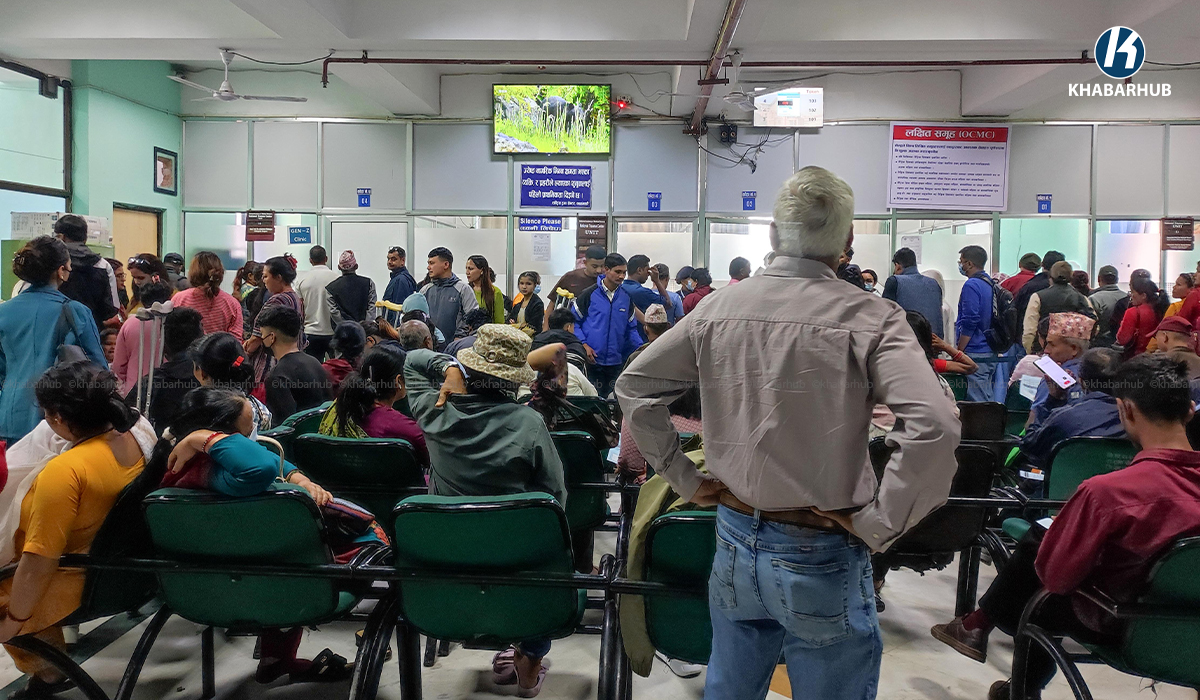
KATHMANDU: Nearly a month after the government led by the Rastriya Swatantra Party pledged to eliminate queues from public service offices, the promise remains largely unfulfilled.
The party had vowed to ensure that citizens would no longer have to stand in long lines at hospitals, transport offices, and land revenue offices. However, the reality on the ground tells a different story.
Scenes at government hospitals and transport offices show that the commitment has yet to translate into meaningful change. During its election campaign, the party had strongly promoted the slogan “not line, but online,” promising to digitize public services and ease citizen access.
Having criticized traditional parties like the Nepali Congress and CPN-UML for decades of inefficiency, the ruling party now faces scrutiny as similar problems persist under its leadership.
At Bir Hospital, one of the country’s oldest and busiest public hospitals, long queues continue to dominate daily operations. From ticket counters to payment desks, patients—including children, pregnant women, and elderly citizens—are still forced to wait for hours.
Many patients, already in fragile health, are compelled to stand in line just to register or make payments. Despite claims from Health Minister Nisha Mehta that improvements have begun following monitoring visits, visible changes remain limited.
The situation is so severe that even healthy individuals risk falling ill after standing for prolonged periods. Elderly patients, who require urgent care, are often seen waiting in the same long lines, highlighting the gap between policy and practice.
On Monday, the scale of the problem was evident at Bir Hospital. The premises were overcrowded, with patients and their relatives filling every available space. The emergency ward had no empty beds, and queues for outpatient department (OPD) tickets stretched far beyond the counters.
Patients reported difficulty even breathing while standing in tightly packed lines for extended periods. Despite the introduction of online ticketing, people still need to queue for tokens, payments, and medicine collection.
Inside the hospital, seating areas were fully occupied, forcing many patients to sit on the floor while waiting for their turn. Separate counters for elderly, disabled, and emergency cases exist, but even these are overwhelmed.
The problem is further compounded by weekend closures of government offices, which push more patients into hospitals at the start of the week. As a result, Mondays often see extreme congestion.
Healthcare, a sector that demands round-the-clock responsiveness, appears strained under such policies. While the measures may have been introduced with administrative intent, patients awaiting surgeries and treatments are bearing the brunt.
Even the one-hour lunch break for staff continues to disrupt services. Patients who wait for hours often find their turn delayed further due to these breaks.
Elderly man collapses in line
The severity of the situation became evident when an elderly man collapsed while waiting in line on Monday afternoon.
Long queues were seen at payment counters operated through a bank inside the hospital. Despite separate arrangements for vulnerable groups, there was barely space to stand.
The man, already unwell, had been waiting in line to pay his bills when he suddenly lost consciousness and fell to the ground. The incident caused panic among those present, with onlookers rushing to respond while others began recording the scene.
A fellow patient said those asked to come on an empty stomach for tests are often left waiting until midday. “Standing in line without food for hours can make anyone collapse,” he said, noting that the man appeared exhausted before falling.
Hospital security personnel admitted the difficulty of managing the crowd. “We are constantly trying to control the lines with limited staff,” one guard said. “It is painful to see elderly and weak patients standing like this, but the situation is beyond control.”
The incident underscores the continuing gap between the government’s promises and the reality faced by ordinary citizens seeking essential services.






Comment