




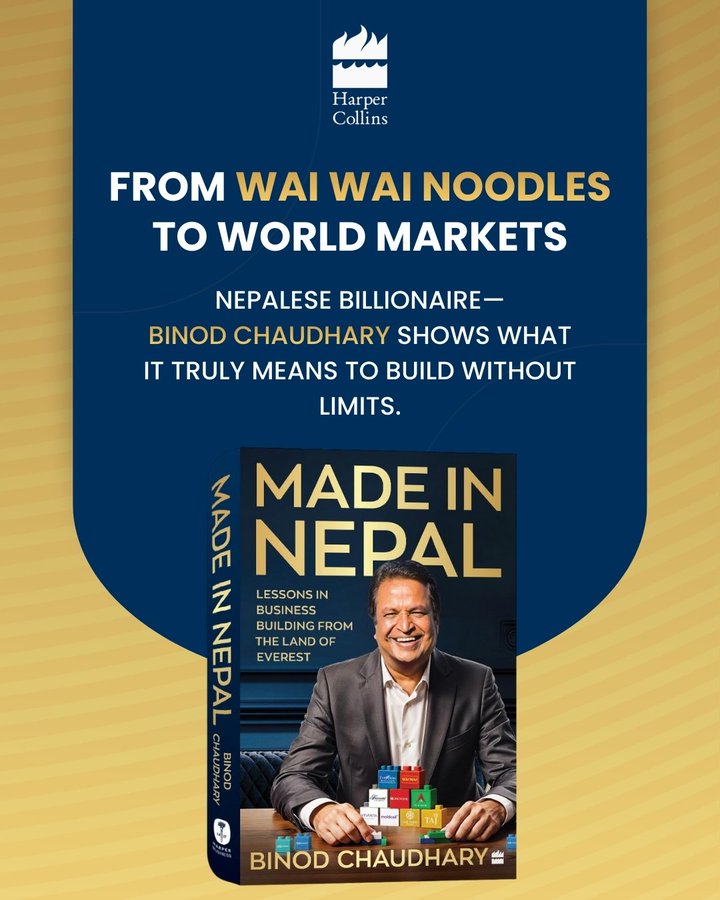
KATHMANDU: ‘Made in Nepal’, written by Binod Chaudhary, Nepal’s first billionaire, is more than a business memoir; it is a reflection on ambition, resilience, and the possibility of building globally competitive enterprises from one of the world’s least developed economies.
The book by Chaudhary, the force behind the global success of Wai Wai noodles, offers both a personal narrative and a broader commentary on entrepreneurship in challenging environments.
For Chaudhary, life does not slow down after achieving success. Wai Wai, his iconic noodle brand, is no longer confined to neighbouring India; it has extended its reach to diverse markets such as Serbia, Kazakhstan, Moldova, Bangladesh, and Egypt. Even after decades in business, Binod—still a quintessential rebel willing to push boundaries—remains fiercely competitive, constantly challenging rivals and often doing so to their disadvantage.
In ‘Made in Nepal’, published by Harper Business, Binod chronicles his ventures into sectors ranging from cement and hospitality to telecommunications and banking, detailing the risks he embraced and the challenges he confronted—sometimes emerging victorious, at other times gaining hard-earned lessons.
The book also offers insights into his political engagements, succession planning, and his vision for the future of a business empire that represents both a lifelong passion and the culmination of his life’s work.
The book’s central takeaway is clear: global success does not require perfect conditions—only clarity of vision, courage to take risks, and the determination to persist. For anyone interested in business, leadership, or Nepal’s economic potential, this book offers both motivation and meaningful insight.
At its core, the book traces Chaudhary’s journey from his family’s modest trading background to leading a diversified multinational conglomerate with interests spanning food, hospitality, finance, and infrastructure.
The transformation of Wai Wai from a local product into an internationally recognized brand serves as the book’s central case study. Through this story, Chaudhary demonstrates how strategic thinking, bold risk-taking, and relentless execution can turn limitations into advantages.
One of the book’s key strengths is its honest portrayal of the Nepali business environment. Chaudhary does not romanticize success; instead, he openly discusses bureaucratic hurdles, policy uncertainty, political instability, and weak infrastructure.
These challenges are not presented as excuses but as realities that entrepreneurs must learn to navigate. In doing so, Made in Nepal becomes a guide for operating in emerging and frontier markets, not just Nepal.
The book is also rich in leadership lessons. Chaudhary emphasizes the importance of long-term vision, patience, and adaptability, especially in volatile economies. He highlights failures and setbacks alongside successes, reinforcing the idea that resilience matters as much as intelligence or capital. His reflections on managing family businesses, building professional teams, and expanding internationally provide practical insights for entrepreneurs at different stages of growth.
Beyond business, the book ‘Made in Nepal’ carries a strong national narrative. Chaudhary repeatedly returns to the idea that Nepali businesses can compete globally if they think beyond borders and invest in quality, branding, and scale. This message makes the book particularly relevant for young entrepreneurs, policymakers, and students who often view Nepal’s limitations as insurmountable barriers.
In terms of style, the book is straightforward and accessible rather than overly technical. While some sections lean toward self-affirmation and optimism, they are balanced by concrete examples and lived experiences. Readers looking for academic theory may find it light, but those seeking inspiration grounded in real-world practice will find it engaging and instructive.
Overall, ‘Made in Nepal’ stands as an important contribution to South Asian business literature. It successfully combines personal storytelling with broader lessons about entrepreneurship, leadership, and nation-building.
The book’s central takeaway is clear: global success does not require perfect conditions—only clarity of vision, courage to take risks, and the determination to persist. For anyone interested in business, leadership, or Nepal’s economic potential, this book offers both motivation and meaningful insight.





Comment