




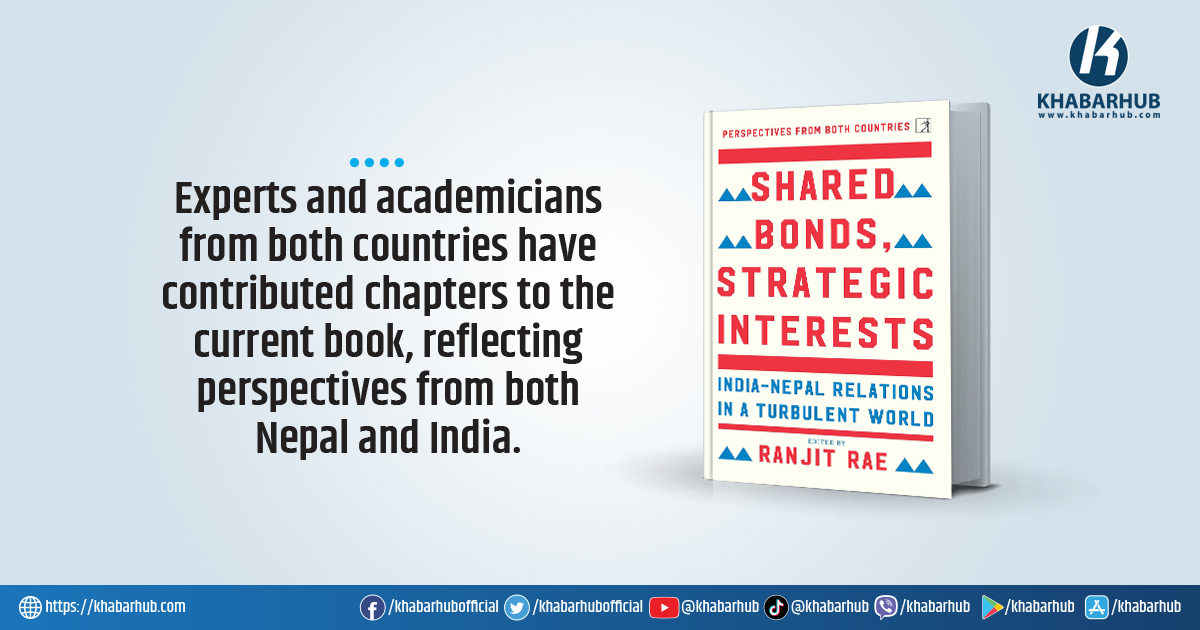
A book edited by former Ambassador to Nepal, Ranjit Rae, which provides a factual and analytical view of the current state of Nepal–India relations and the strategic interests of the two countries in today’s turbulent world, was released a few weeks ago. Rae, a former Indian ambassador to Nepal, had written a book titled Kathmandu Dilemma a few years ago, which was widely discussed in Nepal.
Experts and academicians from both countries have contributed chapters to the current book, reflecting perspectives from both Nepal and India. Divided into five parts, the book contains a total of 17 chapters spanning nearly 300 pages.
Of the four chapters included in the first part, the opening chapter, The Kali–Mahakali Matrix, focuses on sub-themes such as moving beyond roti-beti ties, cultural and social bonds, and strengthening cultural exchanges. Other chapters in this section include The Indian Gorkhas’ Quest for Identity in India and From a Border to a Transitional Heritage. One chapter specifically focuses on the Janakpur–Ayodhya Corridor, highlighting the cultural connectivity it has sustained between the two countries.
Harivansh Jha emphasizes the importance of the Janakpur–Ayodhya corridor as a symbol of cultural connectivity between Nepal and India. By highlighting pilgrimages, holy scriptures, yoga, meditation, and broader civilizational dimensions of the relationship, he underscores the significance of 65 religious sites located across the two countries, the majority of which are in Nepal.
The Ramayana Circuit, Buddha Circuit, and Sikh Circuit—dedicated to Guru Nanak, the first Sikh guru who traveled extensively across present-day India and Nepal—are expected to significantly contribute to tourism growth in Nepal.
Ojha also highlights challenges Nepal will face following its graduation from Least Developed Country (LDC) status in 2026, particularly stricter market access requirements in the US and EU. Under these circumstances, Nepal may seek to redirect exports toward neighboring countries, with India potentially acting as a buffer under the bilateral trade treaty.
As overseas employment has become crucial to Nepal’s economy, labour has long been one of the country’s major exports. An estimated 3.5 to 6 million Nepalis are employed in India alone. The business sector in Nepal also employs a large number of Indians. However, Indians are not permitted to work in Nepal’s government sector, while some government-run organizations in India recruit Nepali labourers.
Scope of Himalayan Buddhism
In the fourth chapter, Himalayas: Borders and Transnational Heritage, author Amish Raj Mulmi expresses concern that the broader historical and cultural connections among Himalayan communities are often excluded from bilateral discussions. He argues that historians have tended to emphasize cultural transmission through India’s historical maritime connections while neglecting trans-Himalayan networks of exchange.
Mulmi contends that this oversight stems from a continuation of British imperial imaginings of the Himalayas as a frontier region, which contradicts the reality of long-standing mobility and exchange. Religious and trade-based Himalayan relations are frequently ignored, while both Nepal and India compete over the legacy of the Buddha. He suggests that both Kathmandu and Delhi should place the Buddha at the center of their cultural outreach to one another.
Mulmi further argues that contemporary Buddhism largely comprises Theravada traditions, especially in Sri Lanka, and Vajrayana traditions, often referred to as Tibetan Buddhism due to their global spread by Tibetan exiles. Buddhism has also entered subcontinental politics through the Ambedkarite tradition, which challenged Brahmanical hegemony.
However, Tibetan Buddhism alone does not adequately describe the religious practices of the Himalayan region. The Newar community of the Kathmandu Valley, for instance, is influenced by Mahayana and Tantric traditions of northern India rather than the four major Tibetan schools. As such, Mulmi proposes the term “Himalayan Buddhism” to better capture the religion’s complexity, diversity, and evolving nature.
He notes that Tibetan exiles have globalized Buddhism, intertwining it with political identity. Consequently, governments in South Asia have found engagement with Buddhism challenging. A recent example is Sri Lanka, which reportedly declined a visit by the Dalai Lama to avoid antagonizing the People’s Republic of China. To some extent, China has persuaded, enticed, or pressured other countries into limiting engagement with Himalayan Buddhist heritage due to its association with Tibetan exile politics, while simultaneously promoting a version of Buddhism aligned with Chinese perspectives.
Political and Security Dynamics
In his paper Reimagining the Future of Historical Borders, Rishi Gupta examines political and security relations between India and Nepal from the British Raj to the present. He argues that while India remains preoccupied with its security concerns, Nepal faces political instability that complicates the formulation of a coherent, future-oriented India policy. Gupta also suggests that Nepal’s changing demographics require India to reassess its approach, emphasizing the need to acknowledge how demographic shifts influence policymaking and politics. Data from UNFPA are included to support this analysis.
Regarding the 1950 Nepal–India Friendship Treaty, former ambassador Jayant Prasad argues that the time has come to revise and update the treaty to meet the needs of the 21st century. He suggests retaining its strongest elements, including mutual respect for sovereignty, independence, and territorial integrity. In practice, however, the treaty has disproportionately benefited Nepali citizens. During periods of political instability in Nepal, it has often been used as a political tool.
Prasad warns that amending or repealing Articles 6 and 7 could potentially curtail several rights currently enjoyed by Nepali citizens, including movement, residence, employment, property ownership, trade, transit, border management, and currency stabilization.
In his chapter Great Power Rivalry in Nepal: Challenges for India, Pramod Jaiswal highlights the unique nature of Nepal–India relations through political, economic, defence, and strategic lenses. Using Nepal Rastra Bank data, he notes that imports from India in convertible foreign currency during the first six months of FY 2024/25 amounted to a substantial figure. He also points out that India accounts for nearly 70 percent of Nepal’s defence procurement through grant-assisted training and support.
Jaiswal further analyzes the implications of China’s increasing involvement in Nepal, including rising Chinese FDI and agreements under the Belt and Road Initiative (BRI). However, he notes that domestic debates persist in Nepal regarding the financing of BRI projects, particularly concerns over debt sustainability.
Historically, China’s involvement in Nepal has focused on securing its borders from potential threats emanating from Tibet. While the “Love Package” project implemented by the China Foundation for Poverty Alleviation is mentioned, the analysis would have been strengthened by addressing China’s growing presence in Madhesh, which directly borders India’s Bihar state.
As Jaiswal notes, if the United States prioritizes global competition with China over regional dynamics, China may expand its presence in Nepal, potentially marginalizing India’s influence over Nepal’s foreign policy.
Development and Connectivity
The third part of the book comprises five chapters addressing economic engagement, development partnership, and connectivity. Purushottam Ojha notes that as of mid-July 2023, Nepal had received foreign investment from 58 countries, with India holding the largest FDI stock.
The fourth part of the book examines the mobilization of soft power to strengthen India–Nepal relations. Anurag Acharya and Sangita Thapaliya analyze the role of film and contemporary soft power trends in improving bilateral ties.
Ojha also highlights challenges Nepal will face following its graduation from Least Developed Country (LDC) status in 2026, particularly stricter market access requirements in the US and EU. Under these circumstances, Nepal may seek to redirect exports toward neighboring countries, with India potentially acting as a buffer under the bilateral trade treaty.
In Indian Investment in Nepal: Reforms, Constraints, and Potentialities, Mahendra P. Lama reviews Nepal’s evolving FDI landscape. In 2023–24, China accounted for 63 percent of approved projects, followed by India (32 percent) and the United States (23 percent). He examines investment sectors, incentives, market access, and locational advantages, noting that core FDI sectors include energy, health, information and communication technology, agriculture, tourism, mining, and minerals.
According to Riya Sinha, Nepal and India have strong potential for enhanced railway connectivity. Two railway links—Jaynagar–Bijalpura/Bardibas and Raxaul–Birgunj—are operational. Additional links, including Nepalgunj, Nautanwa–Bhairahwa, and New Jalpaiguri–Kakarbhita, are planned, while Jogbani–Biratnagar is fully operational.
Aligned with its “Neighbourhood First” and “Act East” policies, India is actively expanding cross-border rail connectivity with Nepal and other neighbouring countries such as Bangladesh, Bhutan, and Myanmar.
Govinda Raj Pokhrel, in Hydropower: The Driving Force of Economic Engagement Between India and Nepal, explores hydropower cooperation. Meanwhile, Nihar Nayak, in Water Resources Management: Changing Dynamics, Challenges, and the Road Ahead, discusses bilateral water mechanisms, the Pancheshwar, Saptakoshi, Sunkoshi, and Gandak projects. He emphasizes that while water cooperation has offered opportunities, it has also faced challenges related to costs, benefit-sharing, and communication.
Soft Power and Defence Cooperation
The fourth part of the book examines the mobilization of soft power to strengthen India–Nepal relations. Anurag Acharya and Sangita Thapaliya analyze the role of film and contemporary soft power trends in improving bilateral ties.
In the final section, Maj. Gen. Binoj Basnyat explores defence cooperation and humanitarian assistance and disaster relief, examining past, present, and future security collaboration. Similarly, Lt. Gen. Rakesh Sharma discusses the military dimension, tracing its historical legacy and future trajectory. The concluding chapter by Lt. Gen. J.S. Sandhu analyzes key developments following the 2015 Nepal earthquake.




Comment