




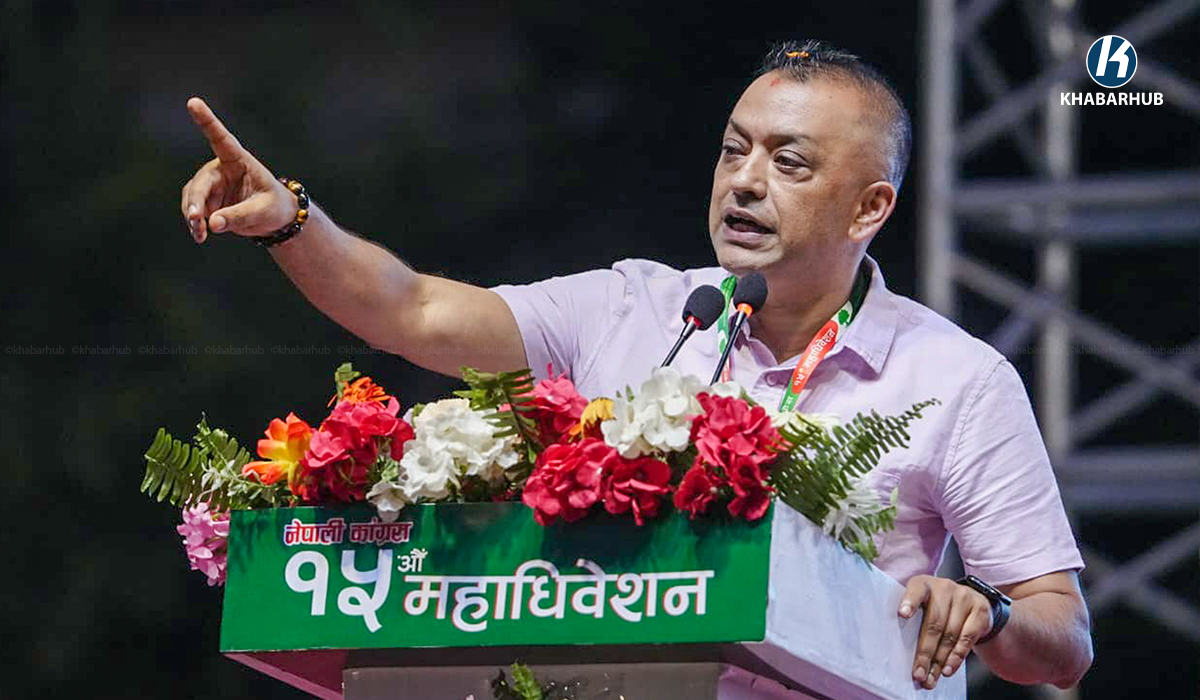
KATHMANDU: Nepali Congress President Gagan Kumar Thapa has said the party should leave its 15th General Convention with renewed energy and a commitment to change the country, with the belief that a transformed Nepali Congress can transform the country as well.
Addressing the inaugural ceremony of the party’s 15th General Convention, Thapa said the event should not be limited to selecting new leadership but should also be an opportunity for a serious review of the party’s past, present and future direction. He said the Nepali Congress must transform itself and move forward in line with public expectations and the country’s needs.
“We have to leave this General Convention with the belief that a changed Nepali Congress can change the country too. We have to make this convention successful and leave with renewed energy,” Thapa said.
He said it was difficult to hold the General Convention simply as a celebration given the country’s recent situation. Recalling the loss of thousands of lives in the Rasuwa floods and landslides and the suffering of many families, Thapa said he did not want to hold the convention under such circumstances.
“Thousands of citizens are no longer with us because of the Rasuwa floods. We did not want to hold this General Convention, but we were compelled to do so within the constitutional and legal framework,” he said.
Thapa said the Nepali Congress must seriously reflect on recent political developments. He said politics revolving around the same leadership, positions and power for a prolonged period had created a perception among the public that all political parties and leaders were the same.
He described this pattern as “musical chairs,” saying the repeated return of the same people as prime ministers and ministers had weakened public trust in political leadership.
“Politics had become like a musical chair, sending the message that all parties and leaders were the same. This led to what happened on September 8 and 9,” he said.
Thapa said excessive politicisation had spread from social media to different levels of society. He said even everyday issues were increasingly viewed through a political lens, contributing to dissatisfaction and polarisation.
He described the events of September 8 and 9 as a consequence of this situation. He said the Nepali Congress subsequently held a special general convention to correct and strengthen itself and later accepted the people’s verdict in the election that followed.
Noting that the Nepali Congress had won and lost many elections in the past, Thapa said electoral defeat should not be a reason for disappointment. He said the current General Convention should be taken as an opportunity to chart a new course for the party.
Thapa said the party could no longer address the country’s challenges merely by highlighting its past political achievements. He said the Nepali Congress needed to seriously examine why political change had not been accompanied by corresponding economic and social transformation.
He said the country had gone through decades of political struggle and conflict without bringing the expected changes to people’s lives.
“Why did we have to go through 35 years of war? The same thing happened during the peace process. Within these 35 years, villages have been emptied. Why were jobs not created? Why did young people have to leave the country?” he asked.
He said the Nepali Congress must find answers to these questions before moving forward. The party, he said, should develop clear policies to create jobs and opportunities for young people within the country, connect villages with production and economic activities, and make the economy more dynamic.
Thapa said the Nepali Congress had the responsibility of building a bridge between democracy and people’s everyday lives. He said public trust in democracy would weaken if political rights were not translated into services, opportunities and economic development that citizens could experience.
“The Congress will serve as the bridge between democracy and delivery,” he said. “If the bridge collapses, trust collapses.”
Thapa also said the Nepali Congress should serve as a bridge between the older and younger generations. He said the party should combine the aspirations of the younger generation with the political experience of the older generation.
He said the Nepali Congress should not compromise on its principles for short-term political gains. Electoral victories and defeats alone, he said, should not be considered the measure of political success, stressing the need for value-based politics.
“We are not like the lalupate [a seasonal flower]. We are clear about who we are. We are ready to lose five elections if we have to stand by our principles, but we will not compromise on them,” he said.
Thapa said the party should develop a political culture that respects industrialists and businesspeople. He said the private sector should not be viewed merely as a source of tax revenue but as a partner in production, employment and economic development.
He also linked the reopening of Khula Manch after 10 years with the political culture of engaging in dialogue with the public. Saying Khula Manch was more than just an open ground in Kathmandu, he recalled its important role in Nepal’s democratic movement.
Recalling that leaders including BP Koirala, Ganesh Man Singh and Girija Prasad Koirala had engaged with the public from the same venue, Thapa said open spaces where citizens can raise questions are still necessary.
“People should not have their party membership revoked for questioning their leaders,” he said. “This country needs Khula Manch. That is why we have reopened Khula Manch after 10 years.”
He said Parliament, too, should remain open to people’s questions and voices. He said citizens would not feel that Parliament and the system of governance were open to them unless the prime minister listened to their concerns. He also called for an environment within the party where leaders can be questioned and dissenting views can be expressed.
Thapa also raised the issue of former party president Sher Bahadur Deuba’s absence in the context of leadership and generational change within the Nepali Congress. He said a chair had been kept vacant for Deuba at the General Convention, but he did not attend, adding that the party now needed to develop a clear position on the matter.
“We kept a chair vacant for former party president Sher Bahadur Deuba, but he did not come. How many times should we go, and how should we go to bring him?” he said.
Thapa said the party also needed to speak clearly about leaders who had left the Nepali Congress.
“Some colleagues have left. They have left the Congress. We also have to say this. We need to answer this now,” he said.
He said a clear political position was also needed regarding the party’s relationship with leaders and cadres who had left alongside changes in the party’s leadership and organisation.
Thapa said Nepali Congress lawmakers elected to Parliament must fulfil their responsibilities while respecting the mandate given by voters. He said the party had trained its lawmakers and prepared them to work effectively in Parliament.
“You voted for them. We have trained 40 to 50 Congress representatives in Parliament on your behalf, taught them and sent them there,” he said.
He said lawmakers should raise public concerns in Parliament, question the government and play an effective role in policymaking. The votes received from the public, he said, should be treated not merely as a means of winning elections but as a responsibility.
Thapa said the Nepali Congress must now move away from politics of frustration and criticism. Rather than criticising others on social media, blaming others or focusing only on past failures, he said the party should establish its identity through its work and results.
“Let us make a commitment, not to establish ourselves through frustration and criticism, but through our actions and our own identity,” he said.
He said the party’s future journey must remain connected to the people. The Nepali Congress, he said, should move forward by strengthening democratic practices within the party, listening to public concerns, addressing the aspirations of young people, creating jobs and prioritising economic development.
Thapa said the Nepali Congress should emerge from the 15th General Convention with renewed energy. Along with a change in leadership, he said, there should also be changes in the party’s thinking, working style and political culture.
Calling for the party to leave the convention with the belief that “a changed Nepali Congress can change the country,” Thapa said it should commit to becoming a political force that not only protects democracy but also brings tangible changes to people’s lives through democracy.






Comment