




Strategic Assessment 2022-2026: The past four years have marked a decisive rupture in the post-Cold War security order. The era once defined by managed competition and economic globalization is giving way to systemic fragmentation. Between 2022 and early 2026, armed conflicts worldwide have risen to levels not seen since World War II.
The scale of this deterioration is difficult to overstate. Conflict-monitoring institutions such as ACLED report that one in seven people globally experienced conflict exposure between mid-2023 and mid-2024. The economic cost of violence exceeded $19 trillion annually. This is not a cyclical spike—it is the structural deterioration of the international security environment.
From Eastern Europe to the Middle East, from the Sahel to Southeast Asia, the international system is fragmenting. South Asia, situated at the intersection of the Indo-Pacific and Eurasian theatres, is directly exposed to these currents. For the first time in decades, the region faces simultaneous pressures from global great-power competition, intensifying conflicts along its borders, and growing internal instability across multiple states. Understanding these pressures—and preparing for them—is no longer optional.
For the first time in decades, the region faces concurrent pressures from global confrontation, border instability, and internal political fragility.
The Global Conflict Landscape: 2022–2026
The wars of this period have not merely produced human suffering—they have reshaped geopolitical alignments in ways that will define the next decade. Each of the major conflicts below represents a distinct driver of global instability, yet together they form an interconnected web that diminishes international cooperation and amplifies regional risks.
Russia–Ukraine War (February 2022 – Present)
Russia’s full-scale invasion of Ukraine triggered the most consequential rupture in European security since 1945. The war has caused massive displacement, hundreds of thousands of casualties, and sustained NATO-Russia confrontation.
Missile strikes and proxy provocations reinforce perceptions of Iran as a source of instability rather than a counterweight to external pressure.
Its consequences extend far beyond Europe: energy markets have been restructured, defense spending across the West has accelerated, and strategic alignments from Central Asia to the Indian Ocean have shifted. The conflict remains the central driver of global instability.
Israel–Hamas War (October 2023 – Present)
Triggered by the October 7 Hamas attacks, large-scale military operations in Gaza caused significant civilian casualties and infrastructure destruction. Critically, the conflict exposed how local wars can rapidly escalate into broader regional crises. Direct military exchanges involving Iran—notably during the June 2025 twelve-day confrontation—demonstrated that the Middle East remains a flashpoint capable of drawing in major powers.
Sudan Civil War (April 2023 – Present)
The bitter struggle between the Sudanese Armed Forces and the Rapid Support Forces has displaced over 12 million people, creating one of the world’s most severe humanitarian crises. Beyond its immediate suffering, Sudan’s collapse has destabilized the Horn of Africa and the Red Sea corridor, adding maritime dimension to a land-based conflict.
Myanmar Civil War (2021 – Present)
Post-coup instability continues to intensify, with ethnic armed groups and resistance forces expanding operations. Myanmar’s fracturing directly destabilizes Southeast Asia, complicates regional security architectures, and threatens supply chains along South Asia’s eastern frontier—consequences that receive insufficient attention in strategic analysis.
Other Major Conflicts
The Nagorno-Karabakh conflict saw a rapid Azerbaijani offensive in September 2023 displace hundreds of thousands of ethnic Armenians, demonstrating how frozen conflicts can thaw suddenly. The Yemen Civil War, though fluctuating in intensity, witnessed Houthi forces engaging in sustained maritime disruptions across the Red Sea from 2023 to 2025, threatening global trade routes. The Syrian Civil War remains unresolved after more than a decade, with shifting alliances perpetuating humanitarian crisis.
Additional flashpoints compound the picture: insurgencies and coups across the Sahel, renewed fighting in eastern Democratic Republic of Congo, near-total state collapse in Haiti, and systemic tensions in the Taiwan Strait and along the Pakistan-Afghanistan border.
Reginal Flashpoints Along the Himalayas
The Himalayan arc concentrates strategic risk in a way few regions on earth match. Multiple overlapping conflicts, each with distinct drivers, compress the maneuvering space available to regional states — and their simultaneous convergence is making traditional hedging strategies increasingly difficult to sustain.
The most acute recent demonstration came in May 2025, when four days of crisis between India and Pakistan marked the most serious confrontation between the two nuclear-armed rivals in decades. Under Operation Sindoor, missile strikes escalated long-standing tensions to levels not seen in a generation, featuring military operations that exceeded previous limits in geographic scope, weapons systems deployed, and overall impact.
The crisis ultimately de-escalated following substantial diplomatic intervention led primarily by the United States — but it confirmed that missile warfare along the India-Pakistan western front is no longer a theoretical risk. It is a demonstrated reality.
Beyond that bilateral flashpoint, the broader arc remains under persistent strain. The Pakistan-Afghanistan border maintains an open-war posture with no resolution in sight. Myanmar’s civil conflict threatens India’s northeastern states, disrupting supply chains and complicating any vision of regional economic integration. China-India border confrontations continue intermittently across the Line of Actual Control, sustained by territorial disputes that diplomacy has managed but not resolved.
Compounding these external pressures, domestic instability in Sri Lanka, Nepal, and Bangladesh reflects weak institutions, economic strain, and political fragmentation — each condition increasing vulnerability to external interference and reducing South Asia’s capacity to present a coherent face to the world.
When crises of this density converge simultaneously, the luxury of strategic ambiguity diminishes. The Himalayan arc is no longer simply a zone of managed rivalry. It is a region in which the margin for miscalculation is narrowing.
South Asia now faces a compressed strategic environment, where multiple conflicts, internal unrest and external pressures converge simultaneously-leaving little room for miscalculations
Taken together, these conflicts reflect a world in which the rules-based order is under simultaneous assault from multiple directions. South Asia’s strategic buffer zones are shrinking.
The Emerging Eurasian Convergence
Amid this volatility, a pattern of coordination has emerged among China, Russia, and Iran. This entente does not reflect a formal NATO-style alliance—it reflects something more durable: shared exposure to Western sanctions, overlapping security concerns, and growing economic complementarity.
The convergence is hardening across several domains:
Energy and infrastructure integration, including Russian oil flowing to Chinese and Indian markets at discounted rates
Alternative financial mechanisms designed to reduce exposure to dollar-denominated systems
Coordinated diplomatic positioning at the UN and in multilateral forums
Expanding military interoperability through joint exercises and arms transfers
This alignment is partly defensive, partly opportunistic. In a world where Western sanctions are intensifying and global conflicts proliferate, Eurasian powers are advancing complementary strategies. For South Asia, the key question is not whether a formal bloc solidifies—it may not—but how this convergence reshapes the region’s strategic space: the corridors available for trade, the energy relationships that underpin economic stability, and the maritime competition that will define Indian Ocean geopolitics for the next generation.
US Strategy Towards Iran: Implications for South Asia
Recent analysis, including Joel Rayburn’s Hudson Institute assessment, outlines U.S. objectives for potential kinetic action against Iran. These objectives provide a window into the strategic logic shaping the Middle East—and, by extension, South Asia’s external environment.
The stated objectives include:
Eliminating Iran’s nuclear program and preventing its future reconstitution
Neutralizing the ballistic missile and drone threat that Iran could deploy against U.S., Israeli, or regional forces
Disrupting Iranian sponsorship of proxies, including Hezbollah, Houthis, and Shia militias in Iraq
Degrading the regime’s domestic repression capacity, creating space for internal opposition
Operationally, such a campaign would prioritize disrupting Iran’s command, control, and communications networks; suppressing air defenses; neutralizing missile launch infrastructure; and targeting nuclear facilities. Analysts suggest that coordinated external strikes and internal uprisings could fracture Iran’s security forces, allowing domestic protests to gain critical leverage—though significant risks of escalation and regional blowback remain.
The implications for South Asia are immediate and concrete:
Energy vulnerability: Oil price volatility directly affects India, Pakistan, Bangladesh, and landlocked Nepal, where energy imports are acutely sensitive to Gulf disruptions. A major Iran conflict could trigger price spikes that strain fragile budgets and fuel inflation across the region.
Maritime competition: Increased U.S., Iranian, and allied naval activity in the Arabian Sea heightens Indian Ocean strategic competition, complicating India’s maritime posture and threatening commercial shipping lanes.
Diplomatic compression: Smaller South Asian states would face intensified pressure to signal alignment choices—a demand incompatible with the non-alignment strategies that have historically served them well.
Iran at the Fulcrum — Ambition Constrained
Iran occupies the center of Middle Eastern escalation, but its strategic posture is defined as much by structural limitation as by ideological ambition. Scholars including Behnam Ben Taleblu and Karim Sadjadpour illuminate a paradox at the heart of Iranian power: a regime that projects regional influence through proxies and missiles while resting on increasingly fragile domestic foundations. Understanding Tehran today means holding both dimensions in view simultaneously.
Since the 1979 revolution, the Islamic Republic institutionalized clerical authority under the doctrine of Velayat-e Faqih. Under Supreme Leader Ali Khamenei, this evolved into a coherent deterrence doctrine — asymmetric warfare, ballistic missile capability, layered proxy networks, and deliberate nuclear threshold ambiguity. For decades, this architecture projected resilience. Recent joint U.S.–Israeli strikes — which resulted in the death of Supreme Leader Khamenei — have exposed the fragility beneath that façade and introduced a succession crisis that now sits at the center of Iran’s strategic uncertainty.
Leadership, Succession, and the Limits of Decapitation
Iran’s strategic coherence flows from centralized authority vested in the Supreme Leader. Attacks on that authority cascade through the entire system — IRGC command cohesion, nuclear decision-making, proxy coordination across Lebanon, Iraq, Syria, and Yemen, and the credibility of strategic signaling toward adversaries. Yet Iran’s deep state structure, with its overlapping security and bureaucratic pillars, resists simple decapitation. Any external strategy — whether limited strikes or a broader kinetic campaign — must grapple with both military and political objectives simultaneously: disrupting command structures, neutralizing missile arsenals, and creating conditions in which domestic opposition can translate grievance into governance change. The succession crisis now unfolding is fueling internal political fragility that constrains long-range strategic execution in ways that external pressure alone could not.
Legitimacy Under Pressure
For two decades, Iran has absorbed cyclical protest — fueled by economic deterioration, political repression, and generational estrangement. Domestic uprisings have intensified despite brutal crackdowns, a pattern suggesting that the regime’s legitimacy deficit is structural rather than cyclical. Sanctions have driven inflation and unemployment to levels that erode regime legitimacy at its base. Security apparatus repression has contained dissent, but at cost: resources diverted inward cannot be projected outward. The strategic implication is a narrowing of bandwidth. Iran’s posture has accordingly shifted from revolutionary expansion toward defensive consolidation. The objective is no longer exporting revolution — it is preserving the regime itself.
Regional Isolation
Iran historically leveraged Shia networks and resistance narratives to construct regional influence. That leverage is diminishing. Gulf states have recalibrated toward domestic modernization and regime stability, and are increasingly aligning with Western security interests.
For South Asia, Iran’s trajectory matters not as an abstraction but as a concrete variable. Instability in Iran directly affects oil markets that South Asian economies depend upon, regional trade routes running through the Gulf, and political calculations in neighboring states.
Missile strikes and proxy provocations reinforce perceptions of Iran as a source of instability rather than a counterweight to external pressure. Quiet security coordination among Arab capitals, Washington, and Tel Aviv is contracting Tehran’s operational space. Strategic isolation imposes real ceilings on influence, however expansive the rhetoric.
Economic Constraints
Iran’s hydrocarbon reserves should provide strategic depth. They do not, in practice. Sanctions, chronic underinvestment, and financial isolation have hollowed out economic leverage. Disruption near the Strait of Hormuz may temporarily spike oil prices, but prolonged instability risks infrastructure damage and accelerates the very diversification away from Middle Eastern energy that weakens Iran’s long-term position. Sustainable strategic autonomy requires economic normalization — something fundamentally incompatible with perpetual confrontation.
Great-Power Alignment and Its Limits
Iran has deepened institutional ties with Russia and China, embedding itself within Eurasian balancing frameworks. But Moscow and Beijing value Iran as a stable partner, not as an ideological project. Prolonged internal crisis in Tehran introduces uncertainty into multipolar architecture both powers are invested in maintaining. Iran’s fragility, paradoxically, becomes a liability within the very partnerships it has cultivated.
The Deterrence Paradox
Iran’s missiles, proxies, and nuclear ambiguity were designed to make regime change prohibitively costly. Yet deterrence is not absolute. When adversaries conclude that ideological rigidity or nuclear acceleration has become intolerable, they may accept — or even prefer — escalation. The instruments built to protect the revolution can, under certain conditions, produce the coalitions that threaten it. This is not a theoretical risk. It is the strategic condition Iran now inhabits.
Integrative Assessment
Iran’s core objectives — regime survival, regional influence, deterrence against Israel and the United States, and contribution to multipolar realignment — remain intact as stated policy. But they now operate within a structure of tightening constraints: leadership succession uncertainty, societal fatigue, regional isolation, economic attrition, and recalibrating great-power partnerships.
The Islamic Republic has demonstrated resilience before. What distinguishes the current moment is that its posture appears increasingly reactive rather than transformative — a defensive holding action rather than ideological expansion. The death of Khamenei has sharpened that condition into an acute crisis rather than a chronic one.
For South Asia, Iran’s trajectory matters not as an abstraction but as a concrete variable. Instability in Iran directly affects oil markets that South Asian economies depend upon, regional trade routes running through the Gulf, and political calculations in neighboring states. A transformed Iran — whether through internal change or sustained external pressure — would reshape the strategic map that South Asian policymakers must navigate. The task of regional assessment is therefore not simply to catalog Iran’s ambitions, but to measure, rigorously, the constraints that now define them.
South Asia’s Strategic Front: India
India’s foreign policy has long rested on the principle of multi-alignment: deepening strategic engagement with the United States while maintaining historical ties to Moscow and pragmatic relations with Tehran. This approach has served India well in calmer times. It is now under severe stress.
States that navigate this environment successfully will share certain characteristics. They will have strengthened their domestic economic foundations, reducing vulnerability to external shocks.
Three pressure points are particularly acute. First, Chabahar Port and India’s westward connectivity corridors through Iran risk being reshaped if Beijing deepens its influence in Tehran—a realistic scenario if Iran’s post-conflict leadership pivots further east. Second, Russia-China alignment complicates India’s defense procurement supply chains, forcing a costly and time-consuming diversification toward Western platforms. Third, protecting India’s energy flows through the Arabian Sea demands accelerated investment in naval assets and intelligence infrastructure that India has historically underinvested in.
India’s fundamental challenge is not choosing sides—a binary choice would be strategically ruinous. It is sustaining meaningful strategic autonomy under conditions of unprecedented pressure. This requires:
Accelerated maritime investment and capabilities expansion, particularly in the Indian Ocean Region
Supply chain diversification to reduce dependency on any single supplier bloc
Disciplined diplomatic signaling that preserves relationships across competing powers without being perceived as unreliable by any of them
India’s size and economic weight give it more room to maneuver than its smaller neighbors. But room to maneuver is not infinite, and the margin for error is narrowing.
Nepal: Resilience Over Rhetoric
Nepal’s vulnerabilities are acute, its strategic space narrow. Yet its position between two great powers—India and China—has historically been a source of both constraint and leverage. Navigating the coming decade will require converting vulnerability into a disciplined form of strategic patience.
Three exposures demand immediate attention. Nepal’s remittances from the Gulf comprise roughly a quarter of GDP—a figure that makes the country acutely sensitive to Middle Eastern instability. Its infrastructure, digital networks, and energy projects are increasingly scrutinized through a great-power lens, with both India and China seeking to shape Nepal’s connectivity choices. And non-alignment, far from being an ideological luxury, is a strategic necessity for a small state that cannot afford to antagonize either of its giant neighbors.
The path forward for Nepal requires concrete institutional action:
Diversifying labor markets and remittance sources to reduce concentration risk in Gulf employment
Expanding hydropower generation and domestic electrification to reduce petroleum dependency and create export revenue
Institutionalizing strategic foresight and early-warning mechanisms—capacities that most South Asian states lack and urgently need
Maintaining principled neutrality in great-power disputes, backed by consistent diplomatic practice rather than ad hoc positioning
The lesson of this era is that internal resilience is not separate from foreign policy—it is foreign policy. States that cannot manage their own economic fragility become instruments of others’ strategies.
Beyond Blocs: The Strategic Tests
It is tempting to read the current moment as a new Cold War—a binary contest between Western liberalism and an authoritarian Eurasian bloc. This reading is incomplete. The global order is not returning to binary structure. It is entering a harder, messier condition: hardened multipolarity defined by overlapping conflicts, economic fragmentation, and rivalries that cut across ideological lines.
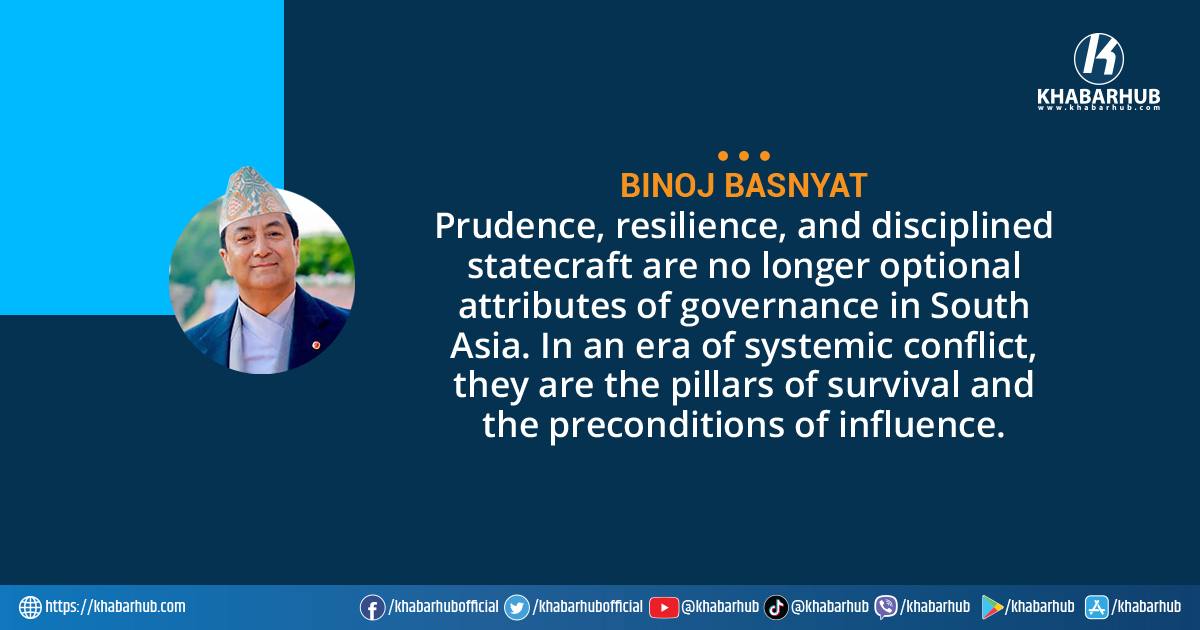
Prudence, resilience, and disciplined statecraft are no longer optional attributes of governance in South Asia. In an era of systemic conflict, they are the pillars of survival and the preconditions of influence.
For South Asia, this multipolarity manifests in specific, practical ways: more volatile energy markets with no stable pricing baseline; intensifying maritime competition in the Indian Ocean; diplomatic pressure from multiple great powers simultaneously demanding signals of alignment; and reduced tolerance for the strategic ambiguity that smaller states have traditionally used to preserve their options.
States that navigate this environment successfully will share certain characteristics. They will have strengthened their domestic economic foundations, reducing vulnerability to external shocks. They will have maintained genuine strategic autonomy—not the rhetoric of non-alignment, but the institutional capacity to actually resist pressure. And they will have invested in the foresight mechanisms that allow them to anticipate disruptions rather than merely react to them.
Conclusion: Strategic Autonomy in an Era of Systemic Conflict
The proliferation of wars since 2022 is not an anomaly to be waited out. It reflects the structural recalibration of power, legitimacy, and deterrence in the international system—a recalibration that will take decades to resolve. South Asia must prepare for a decade in which volatility is the baseline condition, not the exception.
The challenges are concrete: energy markets subject to sudden disruption; maritime competition intensifying across the Indian Ocean; diplomatic pressure steadily narrowing strategic maneuvering space; and the intersection of great-power conflicts with the region’s own internal instabilities creating compounding risks that no single state can manage alone.
The test for South Asian states is not weather a Eurasian bloc formalizes-it may not. It is weather they can preserve strategic autonomy amid systemic, overlapping crises that demand both resilience and discipline.
Meeting this test requires more than rhetoric about non-alignment or aspirations toward strategic partnership. It requires the patient construction of domestic resilience—economic diversification, institutional capacity, energy independence—that transforms vulnerability into durability. It requires diplomatic discipline: the ability to signal clearly without foreclosing options, to maintain relationships across competing powers without becoming a pawn of any of them.
Prudence, resilience, and disciplined statecraft are no longer optional attributes of governance in South Asia. In an era of systemic conflict, they are the pillars of survival and the preconditions of influence.
(Basnyat is a Maj. Gen. (retd) from the Nepali Army, a strategic affairs analyst, and is associated with Rangsit University, Thailand.)





Comment