




“Elections belong to the people.” Abraham Lincoln’s words sound straightforward, almost gentle. But history suggests that nothing about elections has been simple. The right to choose leaders was not gifted; it was argued for, protested for, sometimes bled for. Traces of electoral participation appear in ancient Athens around 508 BCE.
Cleisthenes allowed a limited group of citizens to take part in governance. The Roman Republic elected its consuls and tribunes. But those systems were narrow. Modern elections, universal, secret, periodic are relatively young.
New Zealand’s decision in 1893 to grant universal suffrage was revolutionary for its time. Most nations only embraced similar principles in the twentieth century. So when we speak of elections today, we are speaking of something hard-won and still evolving.
Nepal’s story follows that unsettled rhythm. The Rana regime. The monarchy. The restoration of multiparty democracy in 1990. The Constituent Assembly elections of 2008 and 2013. The federal elections under the 2015 Constitution. None of these were just routine political events. They were moments when the country paused, redefined itself, and moved again sometimes confidently, sometimes uncertainly. Elections here have never been quiet. They carry memory.
When People Turn Away from the Familiar
In every democracy, there comes a point when voters feel disappointed. Promises seem recycled. Leadership appears stagnant. Frustration accumulates quietly, then suddenly it is visible. And when that happens, new political forces emerge. This pattern is not uniquely Nepali. In Italy, the Five Star Movement rose rapidly on anti-corruption sentiment and a rejection of the political establishment.
In France, the 2017 election disrupted traditional party alignments in ways few predicted. In parts of Latin America, reformist waves have come and gone, fueled by public anger at entrenched elites. Nepal also has witnessed something similar.
Years of dissatisfaction about governance, service delivery, economic stagnation, and corruption have created space for newer faces. Younger voters, particularly Gen Z, have been more vocal. There is energy in that shift. A sense that perhaps politics can be reset.
History offers gentle warnings. The Five Star Movement, after its impressive rise, struggled with coalition management and policy coherence. Syriza in Greece won in 2015 promising to resist austerity measures imposed by external creditors. Yet once in power, it confronted the European Central Bank, the European Commission, and the IMF institutions that did not appear on the ballot paper but shaped the outcome anyway.
Governing turned out to be more constrained than campaigning. This does not mean new parties can’t succeed. It means that winning an election and running a government are two genuinely different skills. Popularity doesn’t automatically come with administrative depth. And moral appeal, however sincere, meets bureaucratic reality sooner or later.
The Geography That Does Not Change
Nepal sits between India and China. Prithvi Narayan Shah called it a yam between two boulders, and whatever else has changed, that geometry hasn’t.
India’s influence runs deep through trade, through the open border, through the sheer scale of labor migration, through decades of political entanglement. China’s engagement has grown more deliberate since Nepal signed onto the Belt and Road Initiative in 2017, with infrastructure projects that come with their own long-term implications. The United States has been more visibly present too, particularly around the Millennium Challenge Corporation compact, whose ratification in 2022 became a kind of proxy debate about alignment about which direction Nepal was leaning and what that meant.
What this creates is a situation where elections aren’t read only by Nepali voters. They’re read abroad. Investors, neighbors, and strategic actors all notice shifts in leadership and interpret them as signals, sometimes more dramatically than the actual policies warrant.
Henry Kissinger’s observation that perception often matters as much as reality in international affairs may say something uncomfortable about his broader worldview, but as a description of small-state diplomacy, it holds. A shift in government can communicate something louder than intended. For a country with limited room to maneuver, managing that signal matters.
Power, and Its Boundaries
There is a temptation in democratic moments to believe that sovereignty is absolute. That a mandate dissolves structural limits. But sovereignty today operates within interdependence. Hedley Bull argued that international order depends on shared expectations and rules among states. Continuity becomes part of credibility.
For smaller states, consistency in foreign policy even amidst domestic change helps maintain strategic space. Robert Putnam’s idea of the “two-level game” offers another lens. Leaders must satisfy domestic constituencies while negotiating internationally. They speak one language at rallies and another in diplomatic meetings, and sometimes the translation between the two is not smooth. Electoral promises must survive external feasibility.
Nepal occupies that narrow corridor. Lean too far toward one external partner, and domestic suspicion may grow. Appear unpredictable, and international confidence may weaken. The balancing act is delicate and ongoing. This is why elections here feel heavier. They are not merely about choosing representatives.
They are about signaling steadiness or change in a region where stability is constantly measured. Elections renew public consent. Institutions preserve continuity. Both are necessary. One without the other feels incomplete.
Responsibility After the Ballot
It is easy to celebrate the act of voting. It is harder to discuss what follows. The ballot box opens space for change, but it does not automatically provide capacity. Reform requires policy detail, fiscal discipline, diplomatic tact, and a willingness to negotiate, sometimes quietly.
It requires accepting that not every campaign promise can survive structural constraints. For Nepal, The deeper question is whether political actors old or new can translate public frustration into coherent governance without compromising sovereignty or credibility.
Foreign policy, especially for small states, is rarely about dramatic gestures. It is about limiting how much leverage others hold over you. It is about maintaining relationships without surrendering autonomy. It is about steadiness. Elections also function as diplomatic moments.
They shape how Nepal is perceived as a partner, a negotiator, and a stable actor. In international politics, credibility is cumulative. Election test whether domestic change strengthens or complicates that credibility.
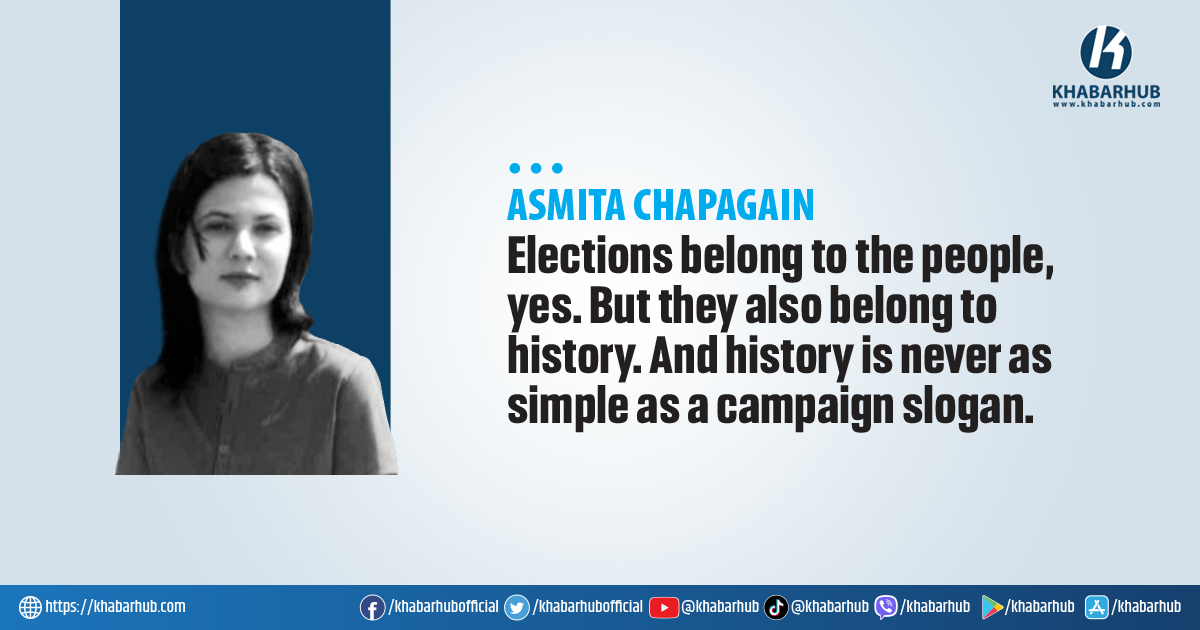
Elections, therefore, are moments of renewal. But they are also moments of testing. Testing institutional resilience. Testing diplomatic skill. Testing whether rhetoric can mature into responsibility. Elections in Nepal are not just political rituals. They are reminders of struggle, of geography, of constraint, and of possibility. They belong to the people, yes. But they also belong to history. And history is never as simple as a campaign slogan.
(Source: This article is based on publicly available sources and established academic literature)





Comment