




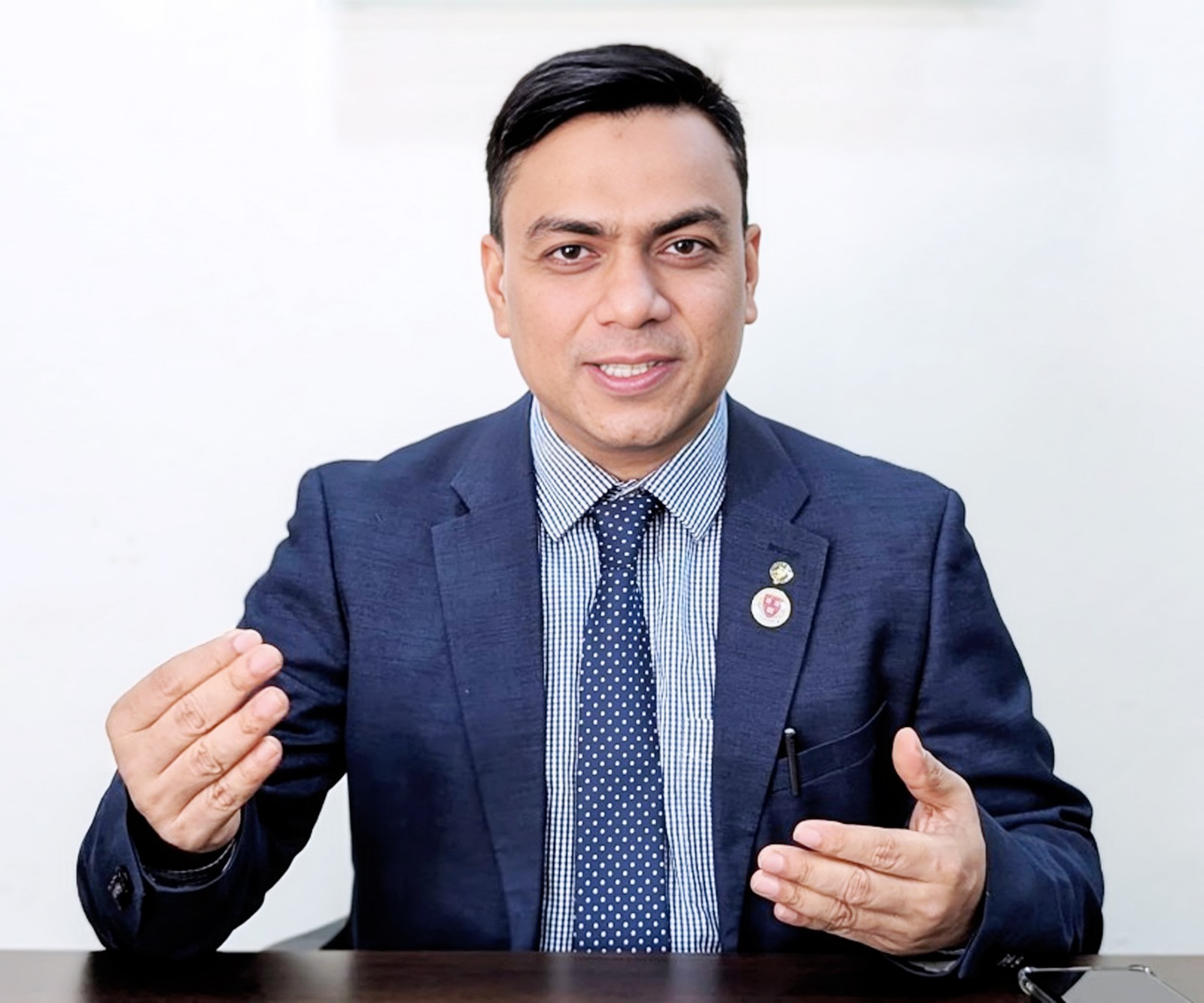
KATHMANDU: Professor Dr Mohammad Tarikul Islam is a Professor of Government and Politics at Jahangirnagar University in Bangladesh. In South Asia, he is highly regarded as an emerging political scientist. Before joining the university, Dr Islam worked with the UNDP for a period of seven years in different capacities.
Professor Islam often serves as a resource person at the National Defence College, Bangladesh Public Administration Training Centre, the National Institute of Local Government, and the Police Staff College. Dr Islam is perhaps a rare academic who has been affiliated with Oxford, Cambridge, Harvard, LSE, SOAS, and Hong Kong Polytechnic University in different prestigious capacities (Visiting Scholar, Post-Doctoral Fellow, Visiting Scientist, Visiting Professor, and Visiting Research Fellow).
Professor Islam’s selected book publications include Economic Diplomacy: Reshaping Bangladesh–Latin American Diplomatic Relations (Springer Nature); COVID in South Asia: Impact on Society, Economics and Politics (Routledge); Disaster, Governance and Development: Perspectives from Bangladesh (Springer Nature); and Local Government in Bangladesh: Contemporary Issues and Challenges (Routledge).
Professor Islam’s two significant books on Human Security and Media Diplomacy in Forced Migration have very recently been accepted by Springer Nature for publication in 2026.
Professor Tarikul Islam took time to speak with Khabarhub on the underlying challenges of SAARC and its chances of reinforcement. Below is an edited excerpt of the discussion:
After 40 years of existence, how would you assess SAARC as a regional organisation?
You are aware that former Bangladesh President Ziaur Rahman first proposed the South Asian Association for Regional Cooperation (SAARC) to other governments in 1980 in order to promote intra-regional cooperation and accelerate the economic and social development of its members. To me, SAARC’s advancement has generally been blocked by enduring regional disputes. Clearly, its inadequacy is embroiled in the regional security complex of South Asia. It could not figure out how to profit from its geo-strategic location in world politics and has remained among the poorest regions when contrasted with other locales. Unfortunately, it has consistently shown declining trends in recent years as well.
The reasons for the limited advancement of SAARC in South Asia are many; most notably, Indo-Pakistani contention and India’s “big brother” attitude within the SAARC region.
India is the biggest power in South Asia in terms of size and population; as a result, the other member states often view it with doubt. India’s relations with its neighbours lack mutual trust, making the functioning of SAARC ineffective and worrying.
India’s capacity to effectively lead regional cooperation is undermined by this paradox, where perceived dominance does not convert into undisputed influence. For platforms such as SAARC to flourish, India needs to move away from establishing domination and towards building trust. This would allow for fair partnerships based on mutual respect rather than strategic pressure.
Economic realities, institutional flaws, and political mistrust are the causes of SAARC’s low efficacy. People-to-people engagement is lacking in South Asian interstate relations. Above all, there is an absence of political will among SAARC member states to resolve disputes and channel their energy toward shared trust and collaboration for the advancement of the region.
How can SAARC promote the shared interests of its member countries?
South Asia is the most densely populated region in the world, with over two billion people living in SAARC countries as of 2025. SAARC requires consensus to function, and without political willingness from the two largest members to separate regional cooperation from bilateral disputes, SAARC cannot move forward.
SAARC aims to promote the welfare of the people by accelerating economic growth, social progress, and cultural development, as well as strengthening collective self-reliance. The organisation also seeks to contribute to mutual trust and understanding among member countries.
Regrettably, SAARC countries lack economic complementarity; rather, they are economically competitive markets where each nation exports broadly similar goods such as spices, cotton, and jute. Moreover, intra-regional trade remains limited, which obstructs economic integration in the subcontinent. Like the EU, the core idea of SAARC is a common market.
The two organisations—SAARC and BIMSTEC—focus on geographically overlapping regions. However, this does not make them equivalent alternatives. SAARC is a purely regional organisation, while BIMSTEC is interregional and connects both South Asia and ASEAN. Where their regions of interest overlap, SAARC and BIMSTEC complement each other in terms of capacities and objectives. BIMSTEC offers SAARC countries a significant opportunity to connect with ASEAN.
According to the World Bank, trade within South Asia accounts for only 5% of the region’s total commerce, or around $23 billion. In contrast, the Washington-based organisation notes that 25% of the foreign trade of ASEAN—comprising 11 Southeast Asian countries with a combined population of over 700 million—comes from trade among its members. According to World Bank estimates, South Asian countries could exchange goods worth $67 billion, three times their existing trade, if barriers were reduced.
To address issues such as connectivity, people-to-people contact, and streamlined trade in the region, SAARC must be positioned in a way that allows the entire region to benefit. There is a need for smart borders or seamless connectivity across South Asia, including roads, bridges, maritime routes, railways, telecommunications, and other infrastructure. Given the geographic proximity of South Asian states, cross-border cooperation is inevitable if the goals are reducing conflict, addressing terrorism, and facilitating smooth trade.
When SAARC became effectively dormant due to strained relations between India and Pakistan, the likelihood of trilateral strategic relationships increased. For example, Bangladesh’s growing ties with Pakistan and deteriorating relations with India allowed for trilateral cooperation with China. Countries must set aside long-standing geopolitical rivalries, especially India, the largest democratic nation in South Asia with a sizable economy. Nepal, Bhutan, Sri Lanka, and the Maldives are increasingly realising the need for broader regional cooperation that serves both their own economic interests and those of larger nations.
Pakistan is pursuing its regional diplomatic objective of creating connectivity in South Asia while bypassing India. Pakistan has maintained strong relations with China while fostering renewed ties with the United States and the Gulf, giving it diplomatic flexibility. This dual-track engagement has emboldened Islamabad to reassert itself as a major regional actor and reclaim a central role in regional diplomacy.
SAARC should be revitalised to address integration challenges such as accessibility, interpersonal connections, and effective trade, particularly given South Asia’s current economic distress and political upheavals. Open borders or consistent access across the region are essential, covering railways, roads, telecommunications, and maritime infrastructure. Given the region’s proximity, South Asian leaders seeking to reduce crises, combat terrorism, and enhance communication must collaborate across borders.
How does Bangladesh demonstrate credible leadership in fortifying SAARC?
Bangladesh believes that the success of SAARC in promoting regional integration, despite setbacks, remains possible. Undoubtedly, Bangladesh attaches great importance to SAARC and wishes to see it function as a vibrant regional organisation. Bangladesh is committed to the principles and objectives of the SAARC Charter and consistently believes that SAARC must continue to operate. Bangladesh is doing everything it can to keep SAARC functional.
Nobel laureate Professor Dr Muhammad Yunus, Chief Advisor to the Interim Government of Bangladesh, is optimistic about a functional SAARC. He often compares SAARC’s stagnation with the success of the European Union, noting that the EU prospered through teamwork. He has stated unequivocally that the European Union enabled European countries to achieve remarkable success. If there are issues between member states, alternative solutions can be devised, but the functioning of SAARC must continue.
By utilising its status as a founding member and bridging gaps among member states, Bangladesh is actively attempting to revitalise SAARC, which has remained largely dormant since 2016. Bangladesh also seeks to act as a liaison between ASEAN and SAARC and hopes to enhance economic connectivity and educational opportunities for the SAARC region by engaging with ASEAN. Recognising that political tensions have paralysed SAARC, Bangladesh advocates focusing on non-political and non-controversial areas such as trade, connectivity, and technology to rebuild trust and cooperation.
Bangladesh can propose that the SAARC Secretariat form a short mission comprising former diplomats and experts to travel across South Asia, promote public diplomacy, engage universities, and interact with the media. This mission would build networks with businesses and academics to highlight the benefits of regional cooperation through SAARC.
The aim would be to demonstrate how an active SAARC could deliver collective benefits for South Asian people, particularly in education, health, and employment, through initiatives such as a single visa, common currency, SAARC Bank, SAARC Parliament, and other shared necessities.
Do you have hope for an active SAARC as an academic?
Despite its flaws, SAARC has not been entirely inactive. However, it must be ensured that SAARC’s growth does not interfere with the region’s strategic dynamics. Considerable work remains, but with a logical and viable approach, challenges can be transformed into opportunities.
India possesses the potential and resources to make SAARC initiatives successful as the region’s largest and most developed country. It should move away from a biased stance and play a constructive role in promoting deregulation and unrestricted development among its neighbours. Notably, many SAARC countries share borders with India.
Functionalism—delaying contentious issues to enhance cooperation—would benefit South Asian countries given regional dynamics and emerging trilateral partnerships. India must approach the region with an open mindset and support unconstrained development among neighbouring countries.
Bearing regional realities in mind, avoiding controversial issues at this stage could enhance cooperation through SAARC. Disputes between any two members should not hinder cooperative efforts among others. Success in sub-regional initiatives could incentivise broader cooperation and contribute to SAARC’s evolution as an effective organisation.
Regional connectivity remains the cornerstone of peace, stability, development, and prosperity in South Asia. SAARC is intended not only for economic cooperation but also for cultural exchange, people-to-people contact, and resource sharing. SAARC should function more like the EU to maximise benefits in education, health, and employment through mechanisms such as a single visa, common currency, SAARC Bank, and SAARC Parliament. South Asian leaders must prioritise regional and public interests over hostility, supremacy, and hegemony.






Comment