




The year 2025 will be remembered not for a single defining event, but for a deeper realization that the world crossed a threshold. Systems that had appeared resilient for decades — economic, geopolitical, technological, and institutional — were tested simultaneously. Some bent. Others fractured. Few emerged unchanged.
It was a year of acceleration and anxiety. Artificial intelligence advanced faster than governance frameworks could keep pace. Conflicts deepened, even as fatigue with confrontation grew. Global growth limped forward amid tightening financial conditions, fragile supply chains, and rising public disquiet. Trust — in institutions, markets, and leadership — was repeatedly strained.
Yet 2025 was not a year of collapse. It was a year of exposure. It revealed what no longer works, what cannot be postponed, and what must change. In doing so, it created the conditions for renewal.
If 2025 was a year of disruption and reckoning, 2026 can become the year in which rebuilding begins — not automatically, but deliberately.
Several shifts converged in 2025 to reshape the global landscape.
For emerging and developing economies, these challenges are acute — but so are the opportunities. Many are less burdened by legacy systems and can leapfrog if institutions adapt quickly. Clean energy, digital infrastructure, and young populations offer powerful advantages when matched with credible policy frameworks.
Technology moved from promise to pressure. Artificial intelligence, digital finance, and automation began reshaping productivity, labour markets, and power structures at scale. But alongside opportunity came unease — about jobs, data, trust, and control. The gap between technological capability and institutional readiness became impossible to ignore.
Geopolitically, the costs of fragmentation grew clearer. Conflicts dragged on with devastating human and economic consequences, while the limits of escalation became evident. Supply chains remained vulnerable, energy security remained uneven, and global cooperation struggled under the weight of competing national priorities.
Economically, many governments spent the year managing risk rather than investing in transformation. Fiscal space narrowed. Development ambitions were tempered by inflation, debt, and political constraints. Inequality — within and across countries — remained stubborn.
Socially, citizens across regions demanded more than growth figures. They asked for jobs, dignity, resilience, and inclusion. Faith in institutions weakened where delivery lagged behind promises.
These pressures were not new. What changed in 2025 was their simultaneity — and the growing recognition that incremental adjustments would no longer suffice.
2026 can be different. History suggests that periods of upheaval are often followed by renewal — not because challenges disappear, but because incentives shift. Several factors indicate that 2026 could mark the beginning of a more constructive phase.
First, technology is entering a more mature stage. After years of experimentation, attention is shifting from novelty to application. In AI, the focus is moving towards productivity, sector-specific use cases, governance, and public value — from hype to deployment. Digital tools that once felt destabilising can now become stabilising forces, if applied responsibly.
Second, there is growing recognition that prolonged conflict benefits no one. While geopolitical rivalries will persist, the economic and social costs of instability are becoming harder to sustain. Reconstruction, trade normalisation, and selective cooperation are re-emerging as pragmatic necessities rather than idealistic aspirations.
Third, economic priorities are beginning to shift from crisis management to rebuilding capacity. Energy systems, infrastructure, digital public goods, and human capital are increasingly seen not as optional investments, but as foundations for resilience and growth. The conversation is moving from short-term firefighting to medium-term delivery.
Fourth, expectations are sharpening. Citizens and investors alike are less persuaded by grand strategies and more focused on outcomes. Governments are being judged on what works, not what is announced.
None of this guarantees success. But it creates a more favourable environment for progress than the turbulence of recent years.
Yet rebuilding requires more than optimism. Hope alone does not rebuild systems. The central lesson of 2025 is that capacity, coordination, and leadership matter more than vision statements.
Rebuilding in 2026 will depend on several deliberate shifts. It requires moving from ambition to execution. Many countries have no shortage of plans — on AI, climate, infrastructure, or development. The challenge lies in sequencing priorities, aligning institutions, and sustaining implementation beyond political cycles.
It requires moving from fragmentation to coherence. Economic transformation demands coordination across energy, finance, technology, education, and governance. Siloed policymaking weakens even the best ideas.
It requires moving from scale to inclusion. Growth that excludes large segments of society will not endure. Jobs, skills, and access must be central to rebuilding strategies, not afterthoughts.
2026 offers the chance to begin rebuilding — more thoughtfully, more sustainably, and more equitably. The task ahead is to shape it — patiently, pragmatically, and with purpose.
And it requires moving from control to trust. Whether in digital finance, AI governance, or public service delivery, systems work best when citizens trust them. Transparency, accountability, and fairness are not constraints on progress; they are enablers.
For emerging and developing economies, these challenges are acute — but so are the opportunities. Many are less burdened by legacy systems and can leapfrog if institutions adapt quickly. Clean energy, digital infrastructure, and young populations offer powerful advantages when matched with credible policy frameworks.
2026 is a year for measured optimism. Conflicts will not vanish overnight. Technological risks will remain real. Inequality will take sustained effort to address. But the direction of travel can change.
Rebuilding does not require unanimity or perfection. It requires enough alignment to move forward — country by country, sector by sector. It requires leaders willing to prioritise delivery over rhetoric, cooperation over posturing, and long-term value over short-term gain.
Perhaps most importantly, it requires recognising that progress is cumulative. Institutions are repaired gradually. Trust is rebuilt incrementally. Prosperity returns step by step.
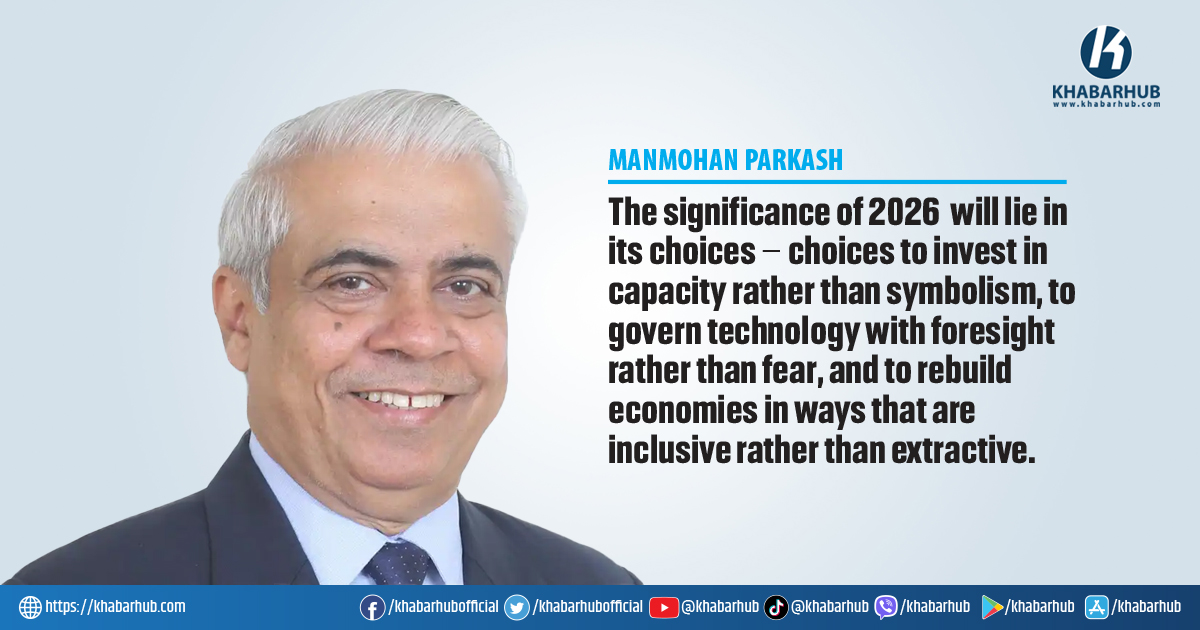
The significance of 2026 will lie in its choices — choices to invest in capacity rather than symbolism, to govern technology with foresight rather than fear, and to rebuild economies in ways that are inclusive rather than extractive.
2026 offers the chance to begin rebuilding — more thoughtfully, more sustainably, and more equitably. The task ahead is to shape it — patiently, pragmatically, and with purpose.
(Manmohan Parkash is a former Senior Advisor in the Office of the President and former Deputy Director General for South Asia at the Asian Development Bank. He writes on economic policy, technology, and development finance. Views expressed are personal.)






Comment