




The phrase “strong government” is heard frequently in today’s political debate. But my generation must ask a more fundamental question: Do we really need a strong government, or do we need a strong state? These are not the same thing. The ability of an individual to make decisions quickly, direct state mechanisms according to personal preferences, or suppress criticism and opposition does not, by itself, constitute strong governance.
In a democracy, government power should not be used to weaken citizens; it should be used to strengthen institutions and make the state more capable. A strong government does not mean powerless citizens, a silent Parliament, or public institutions operating according to the wishes of those in power. Rather, strong government means effective institutions, capable administration, accountable leadership, independent public bodies, and citizens who have confidence in the state.
The central spirit of the Gen Z movement must also be understood in this context. The movement was not simply about changing one government. It raised deeper questions about our system of governance and political culture. The demand was not for politics centered on individuals, but for a democracy grounded in strong institutions. It was about creating a society in which citizens could question the state without fear and demand accountability from those who exercise public power.
The aspiration of my generation is that institutions must be greater than individuals, the Constitution greater than political power, the law greater than personal commands, and the sovereign rights of citizens greater than the interests of any government.
In this context, the role of Parliament is critically important. Parliament should never be reduced to a chorus supporting the government of the day. When a political party holds an overwhelming parliamentary majority and its own lawmakers become unwilling or unable to question government decisions, parliamentary oversight can be weakened. Parliament is the institution that represents the people. It must scrutinize government decisions, debate public policy, oversee the executive, and ensure that the government remains accountable to the Constitution, the law, and the people.
Questioning the government and criticizing wrongdoing are not anti-government actions. On the contrary, scrutiny, criticism, and oversight are essential to responsible democratic governance. A government that cannot tolerate questions may appear powerful, but a government that can listen to criticism, answer legitimate questions, and accept accountability demonstrates institutional strength.
We must also understand the difference between the state and the government. Governments come and go. Prime ministers change. Political parties and coalitions change. State institutions, however, are designed to endure. The Constitution remains the fundamental legal framework, laws continue to govern public affairs, and citizens’ rights remain protected regardless of which party is in power.
Therefore, treating the state as though it were the private property of an individual or a government is a profound political mistake. Using state mechanisms to serve individual interests or attempting to demonstrate strength by suppressing citizens does not strengthen government. Instead, it weakens institutions and undermines public trust.
The authority of the state derives its legitimacy from the Constitution and the law, not from the wishes of any individual. When an individual becomes more important than institutions, democratic governance begins to weaken. And when institutions become weak, public frustration and political dissent are likely to grow.
Today, we need to move beyond the question, “Whose government is stronger?” and ask instead, “How strong are our institutions?”
Can the police operate effectively and professionally within the law? Can the administration function without undue political pressure? How much public trust does the justice system command? How effectively is Parliament performing its oversight role? Can constitutional and public institutions fulfill their responsibilities independently? And, most importantly, should an ordinary citizen fear the state, or should they be able to place their trust in it?
The answers to these questions reveal how strong our state truly is.
It would be a mistake to view the voice raised by the Gen Z generation merely as a political event. It reflected accumulated frustration, dissatisfaction, and a deep desire for change. But the ultimate destination of that aspiration cannot simply be a new face public institutions are accountable to citizens make the state strong. We need a country where citizens can face the future with confidence in their rights and dignity rather than live in fear of the state; where government is not merely an authority that governs people but an institution accountable to them; where Parliament is not an admirer of power but an effective voice of the people; and where public institutions operate according to the Constitution, the law, and their institutional responsibilities rather than the wishes or a new government.
We often hear ministers and even the prime minister speak as though they came to power through the Gen Z movement. But have the aspirations of the young people who participated in that movement truly been understood and internalized? Did young people take to the streets and make sacrifices simply to create another generation of ministers and prime ministers?
The old political culture, weak institutions, opaque decision-making, and lack of accountability remain visible. In many respects, only the faces have changed. We do not need only leaders from a new generation; we need a new political culture.
We need a state where criticism can be heard, disagreement is respected, public institutions are accountable to citizens, and state power is used not to demonstrate the influence of any individual but to protect the rights, security, and dignity of citizens.
That is the broader aspiration behind the call for political and generational change, and it is from this spirit that we must work toward building a strong, dignified, accountable, and modern Nepal.
The aspiration of my generation is that institutions must be greater than individuals, the Constitution greater than political power, the law greater than personal commands, and the sovereign rights of citizens greater than the interests of any government.
Before searching for strong leaders, we must build a strong system. An exceptional individual may exercise considerable influence for a few years, but strong institutions can build a nation for generations. Political leadership should therefore not be measured simply by how much personal power a leader possesses, but by how effectively that leader strengthens institutions, improves transparency, promotes accountability, and builds public trust.
Ultimately, the true strength of a state should not be measured by how much control it exercises over its citizens, but by how much trust citizens can place in their state.
Therefore, the central purpose of politics today should not be merely to make the government strong; it should be to make the state strong. We need a country where citizens can face the future with confidence in their rights and dignity rather than live in fear of the state; where government is not merely an authority that governs people but an institution accountable to them; where Parliament is not an admirer of power but an effective voice of the people; and where public institutions operate according to the Constitution, the law, and their institutional responsibilities rather than the wishes of individuals.
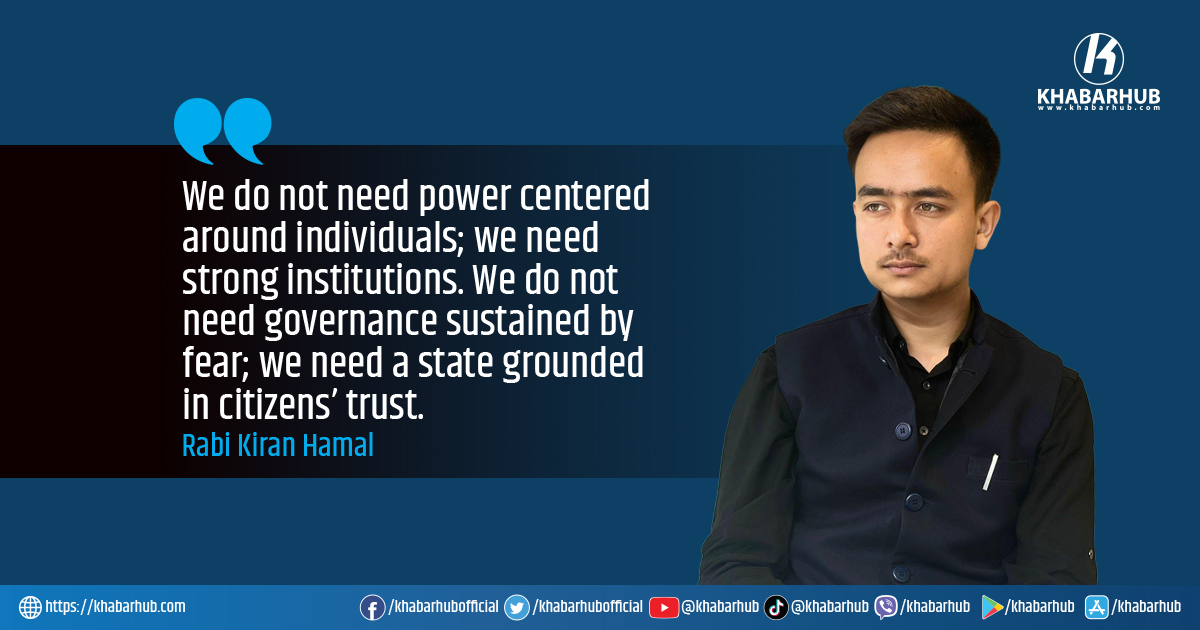
We do not need power centered around individuals; we need strong institutions. We do not need governance sustained by fear; we need a state grounded in citizens’ trust. And we do not need merely a change of government; we need a change in the culture of governance.
That is the broader aspiration behind the call for political and generational change, and it is from this spirit that we must work toward building a strong, dignified, accountable, and modern Nepal.






Comment