




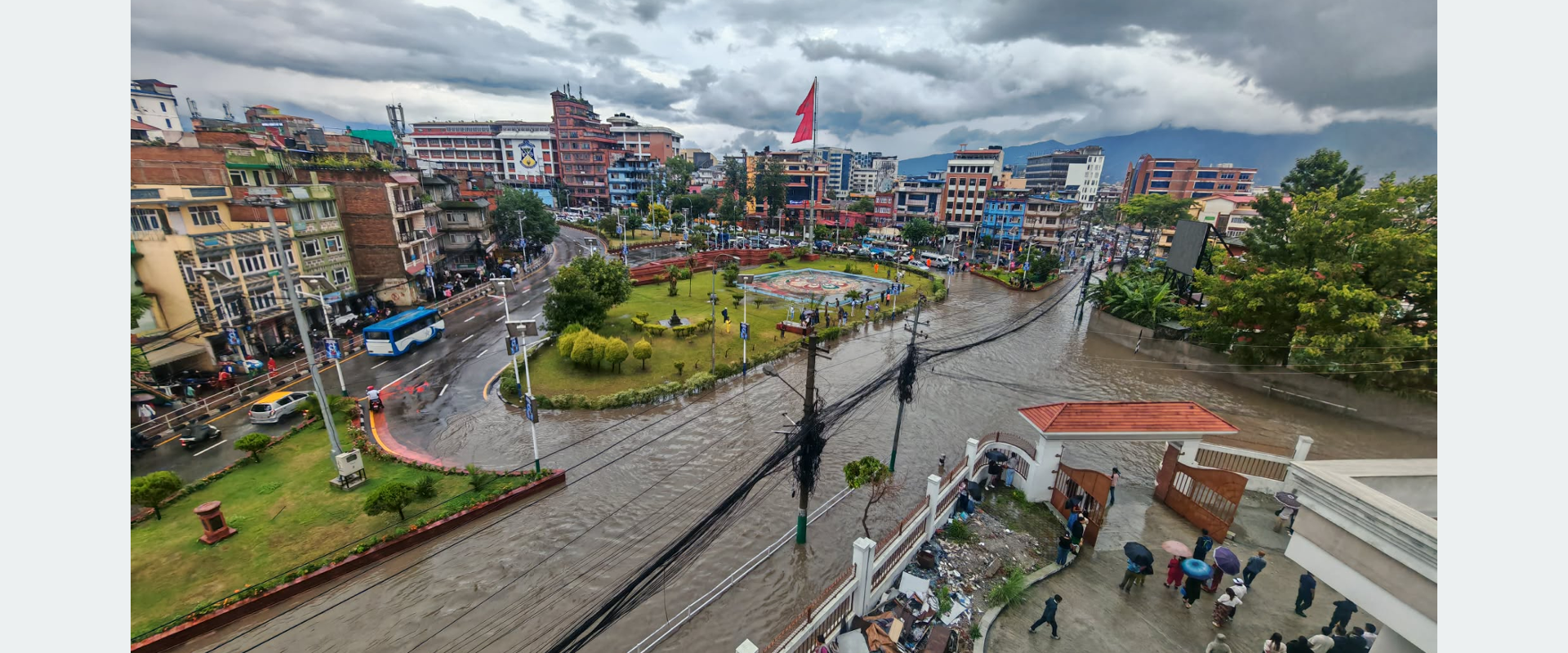
KATHMANDU: The flooding problem in the Maitighar Mandala area, considered one of the central points of Kathmandu, has persisted for years.
The main road leading to Singha Durbar, the Supreme Court, various ministries, and diplomatic missions is repeatedly submerged during rainfall, affecting both the general public and high-profile individuals.
Even during moderate rain, waterlogging disrupts pedestrians and vehicles, causes traffic congestion, and increases the risk of road accidents. The problem has been worsening year after year due to the lack of concrete initiatives and long-term policies to address it.
Acting Mayor of Kathmandu Metropolitan City (KMC) Sunita Dangol said that separate pipeline systems for sewage and rainwater drainage would be constructed in the Maitighar Mandala area as a long-term solution to the recurring flooding during the monsoon season.
Dangol said that in most areas sewage and rainwater currently flow through the same drainage system, which is unable to handle the increased load during heavy rainfall. She added the metropolis is taking initiatives to address both immediate and long-term challenges and stressed the need to formulate a comprehensive master plan.
Under the medium-term plan, Deputy Secretary Ram Bahadur KC said that old and narrow sewer pipes will be studied and replaced with larger pipes where necessary, while alternative drainage channels will also be constructed.
Studies have identified the main causes of flooding in Maitighar as an old and narrow sewer network, the combined drainage system for sewage and rainwater, unplanned urbanization, and encroachment on drainage infrastructure. Experts say the problem is becoming increasingly complex as existing infrastructure is unable to withstand the growing water pressure associated with climate change.
The issue has also been raised repeatedly in the Federal Parliament. During a meeting of the House of Representatives, MP Ranju Neupane (Darshana) urged the government to implement an effective long-term plan, stating that temporary management alone would not solve Maitighar’s flooding problem.
Meanwhile, Dr. Dharmaraj Upreti, Executive Chief of the National Disaster Risk Reduction and Management Authority, said the immediate flooding situation in Maitighar would be addressed soon and that studies would also be conducted in other flood-prone areas of the Kathmandu Valley, including Jamal.
“Every year, Maitighar experiences flooding with the onset of the monsoon. Business owners, drivers, and the general public suffer unnecessarily. What is needed now is not just a temporary remedy but a durable long-term solution,” he said.
Meanwhile, coordination has begun among Kathmandu Metropolitan City, the Kathmandu Road Division, and Kathmandu Valley Water Supply Limited under the leadership of the National Disaster Risk Reduction and Management Authority to improve drainage management in Maitighar and other parts of the Kathmandu Valley.
The concerned agencies have approved short-term, medium-term, and long-term action plans and have begun the implementation process. Under the initial plan, a report was prepared identifying obstructions, encroachments, and other problems affecting the drainage system in flood-prone areas, including Maitighar.
What does the study report say?
A technical committee formed to identify flooding problems in Maitighar and other parts of the Kathmandu Valley has concluded that the recurring monsoon flooding around Maitighar Chowk is primarily caused by the destruction of natural water retention areas.
The study also identified unplanned urbanization, limited drainage capacity, and weaknesses in drainage management as major contributing factors.
According to the report, long-standing structures built contrary to the urban development plan, obstruction of natural water flow, and poor drainage management have worsened the situation.
“For the past few years, the Singha Durbar complex and surrounding areas have experienced frequent waterlogging, affecting the regular functioning of government offices,” the report states. “The disappearance of natural water retention areas is the most serious problem.”
Deputy Secretary of the National Disaster Risk Reduction and Management Authority Ram Bahadur KC said areas that once temporarily stored rainwater and gradually released it have now been covered by buildings, roads, parking lots, and other physical structures, reducing the ground’s ability to absorb water.
“As soon as it rains, a large volume of water reaches roads and sewerage systems at once,” he said. “The loss of natural storage areas has increased surface runoff and heightened the risk of flooding.”
The report concludes that the system that once collected and slowly discharged rainwater has weakened, causing excessive water to enter the sewerage network during the monsoon.
Unplanned land use and encroachment have also been identified as major causes of flooding. The report states that natural drainage paths are blocked when structures are built on water flow routes and vacant land.
Similarly, the expansion of concrete surfaces, blacktopped roads, and other impermeable structures has reduced the soil’s water absorption capacity and increased surface runoff.
Structural weaknesses in the drainage network have been highlighted as another major factor. In some locations, rainwater drainage and domestic sewage are being carried through the same main pipe. During heavy rainfall, the combined flow exceeds the pipe’s capacity, increasing internal pressure, slowing water movement, and causing water to overflow through manholes.
Prabhat Shrestha, Information Officer at the Project Implementation Directorate (PID) under Kathmandu Valley Water Supply Limited (KUKL), said that sewage management around Maitighar, New Plaza, and Singha Durbar needs to be improved in an integrated manner.
The study has also identified a “bottleneck” problem in the sewer system, where large-diameter pipes are connected to smaller ones, restricting water flow. Such structural weaknesses create additional pressure during the rainy season and further increase flooding.
Another factor is the “backwater effect” in drainage lines connected to the Tukucha River. The report states that when the water level in the river or the main drainage channel rises, pressure pushes water back into the drainage network, causing overflow through manholes.
This is likely to make flooding in the Singha Durbar area more severe, especially during intense rainfall.
The report also points to a lack of institutional coordination as a significant problem. It says inadequate coordination among agencies responsible for sewerage, roads, buildings, and other infrastructure has resulted in different bodies working separately in the same area, complicating the problem instead of contributing to a lasting solution.
The report recommends both short-term and long-term measures to control flooding. It proposes developing a “delayed discharge” system that would collect rainwater for a certain period and release it gradually, constructing underground water storage tanks, and prioritizing the protection of natural water retention areas.
According to the report, these measures would help prevent excessive pressure from building up in the sewerage system while also reducing the risk of flooding.
The report also recommends developing separate drainage systems for rainwater and domestic wastewater, constructing new storm-water drains where necessary, and reassessing and upgrading the capacity of old sewer lines.
In addition, it calls for regular maintenance of the drainage network, routine cleaning of sewers and culverts, enlargement of pipes where needed, and installation of non-return check valves or flap gates to prevent backflow in outfall areas.
It further states that drainage infrastructure should be redesigned on the basis of watershed size, rainfall recurrence intervals, and projected maximum water flow.
The report concludes that the flooding problem in the Singha Durbar area cannot be solved through temporary repairs or sewer cleaning alone. A sustainable solution, it says, will be possible only through the protection of natural water systems, scientific urban planning, adequate-capacity drainage infrastructure, and effective coordination among the concerned agencies.
Medium-term and long-term plans
Under the medium-term plan, Deputy Secretary Ram Bahadur KC said that old and narrow sewer pipes will be studied and replaced with larger pipes where necessary, while alternative drainage channels will also be constructed.
According to him, the long-term plan includes preparing and implementing a detailed master plan for the separate management of storm water and sanitary sewage.
“Legal provisions will also be introduced to make rainwater harvesting and sewage treatment systems mandatory in new large government and commercial buildings,” KC said. “It has also been decided to establish rainfall measurement centers at various locations across the Kathmandu Valley.”
Prabhat Shrestha, Information Officer at the Project Implementation Directorate (PID) under Kathmandu Valley Water Supply Limited (KUKL), said that sewage management around Maitighar, New Plaza, and Singha Durbar needs to be improved in an integrated manner.
(RSS)






Comment