




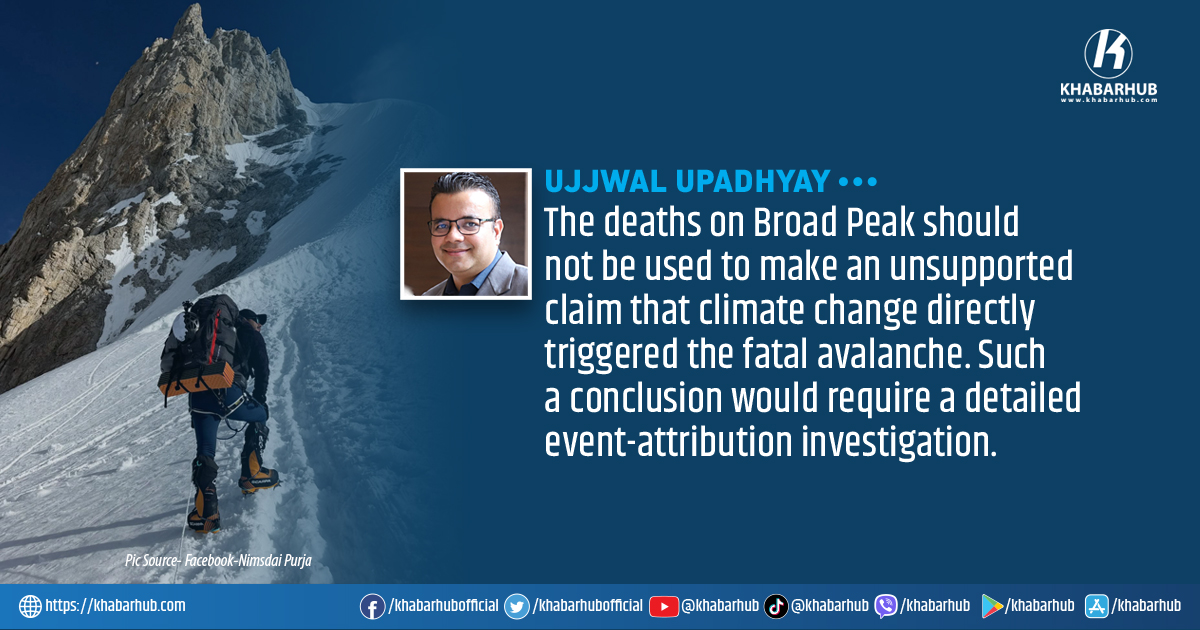
The avalanche that killed Nirmal “Nimsdai” Purja and nine other climbers has again exposed the extreme vulnerability of mountaineers in High Mountain Asia. Although no scientific assessment has yet attributed this particular disaster to climate change, it occurred within a mountain system where warming is demonstrably altering snowfall, snow stability, glacier movement, and avalanche behaviour.
On 30 July 2026, an avalanche struck a group of climbers on Broad Peak, the 8,051-metre mountain in Pakistan’s Karakoram Range. Ten climbers, including renowned Nepal-born mountaineer Nirmal Purja, were confirmed dead. The terrain and weather made rescue and recovery extraordinarily difficult.
The disaster should not be presented as proof that global warming directly caused one specific avalanche. Avalanches have multiple immediate triggers, including heavy snowfall, wind loading, buried weak layers, rapid temperature changes, and the structure and angle of the slope. Establishing the cause of an individual event requires detailed meteorological, snowpack, and terrain evidence.
But Broad Peak cannot be viewed in isolation from the transformation occurring across the Karakoram and Himalaya. Scientific studies now show that climate change is modifying the conditions under which avalanches form. It is increasing wet-snow instability in some areas, allowing substantial snowfall to persist at extreme elevations, shifting avalanche activity upslope, and destabilizing glaciers that can generate ice and ice-snow avalanches.
Climate change is not producing a single, uniform avalanche response across the Himalaya and Karakoram. It is generating geographically uneven changes determined by elevation, storm tracks, local topography, snowfall, rainfall, and temperature.
The emerging danger is not simply “more avalanches everywhere.” It is a more complex and less predictable avalanche environment.
A warmer Karakoram can still remain heavily snow-loaded
A common assumption is that warming will reduce snow and therefore reduce avalanches. Research from the Karakoram shows why this reasoning is incomplete.
A 2014 study published in Nature Geoscience by Sarah Kapnick and colleagues found that the Karakoram receives much of its precipitation from non-monsoonal winter weather systems. Because this precipitation arrives during very cold conditions, the region’s high elevations can continue receiving substantial snowfall despite rising average temperatures. The researchers concluded that the Karakoram’s distinctive seasonal cycle makes its annual snowfall less sensitive to warming than snowfall in much of the Himalaya.
This has serious implications for mountaineering.
Warming does not necessarily remove the deep snow loading that creates avalanche potential on Karakoram peaks. Heavy snowfall can continue accumulating on steep, wind-exposed slopes at elevations where temperatures remain below freezing. That accumulated snow may then be subjected to rapid warming, intense solar radiation, wind redistribution, or fluctuations around the freezing point.
The result can be a dangerous sequence: substantial snow accumulation followed by accelerated weakening. A warming Karakoram may therefore remain intensely snowy at expedition elevations while becoming increasingly difficult to interpret.
Direct evidence of warming-related avalanche increases
The clearest Himalayan evidence was published in 2018.
Researchers led by J.A. Ballesteros-Cánovas reconstructed approximately 150 years of avalanche activity in the western Indian Himalaya by studying trees damaged by past avalanches. Their analysis found that warming during recent decades had been accompanied by an increase in avalanche frequency. Rising winter and early-spring temperatures favoured the wetting of snow and the release of sudden wet-snow avalanches.
This finding is important because climate change can make a snowpack more hazardous even where total snow cover is declining.
As temperatures rise, liquid water enters the snowpack and weakens the bonds between snow grains and layers. Water can also increase the weight of the snow and reduce friction along the ground or along a buried snow surface. The resulting wet avalanches are dense, heavy, and highly destructive.
For climbers and trekkers, the practical consequences are profound. Traditional mountain travel often relies on overnight freezing to strengthen snow before early-morning movement. Warmer, and often cloudier, nights may prevent adequate refreezing, shorten the period of relative stability, or eliminate it altogether.
A route that was historically crossed safely at dawn may therefore remain unstable throughout the morning. Climbers following seasonal experience from previous decades may confront conditions that no longer behave in the same way.
Heavy snowfall followed by rapid warming
The climate-avalanche relationship is often created through sequences of weather rather than temperature alone.
A major 2023 review of avalanche research across High Mountain Asia (by Jakob F. Steiner et al.) found that heavy snowfall, wind, and rapid warming are among the dominant controls on avalanche release. In one monitored mountain area, heavy precipitation followed by rising temperatures within approximately three days substantially increased avalanche danger. Wet avalanches were particularly associated with sharp temperature increases late in the snow season.
The same review described distinct but overlapping Himalayan patterns. In the western Himalaya, avalanches are frequently associated with heavy winter precipitation delivered by westerly disturbances. In the central Himalaya, greater temperature variability and warmer pre-monsoon conditions favour wet avalanches. Exceptionally late monsoon or post-monsoon precipitation can also deposit heavy snow while temperatures remain comparatively high, creating rapid instability.
Climate change can intensify the danger associated with these transitions. A storm may still deliver deep snow at high altitude, but warmer conditions before, during, or after the event can alter how that snow bonds with the existing surface.
It is therefore not sufficient to assess only the quantity of snowfall. Avalanche forecasting must also consider snow temperature, recent wind, freezing levels, rainfall, solar radiation, and the speed at which conditions are changing.
Avalanche danger is shifting toward expedition elevations
A 2024 international review published in Nature Reviews Earth & Environment by Y. Li et al. clarified why warming does not produce one uniform avalanche trend.
The review found a general reduction in avalanche number, size, and active paths at some lower elevations as snow becomes scarcer. At the same time, the proportion of wet avalanches is increasing relative to dry avalanches. Heavy snowfall can still create peaks in avalanche activity at high elevations, while warming gradually shifts active avalanche conditions from lower to higher terrain.
This upward shift is especially concerning for mountaineering.
Expeditions operate precisely where snow is likely to persist longest: high passes, glacier basins, upper camps, and summit routes, often between 5,000 and 8,000 metres. Trekkers may encounter dry trails and reduced snow in lower valleys but still enter deeply snow-covered and unstable terrain near high passes.
Warming can therefore create a misleading visual contrast. Lower elevations may appear increasingly snow-free, while the most complex avalanche conditions become concentrated higher on the mountain.
These are also the elevations where evacuation is difficult, weather observations are scarce, and rescue teams face severe physiological and logistical limitations.
Glaciers are becoming avalanche sources
Climate-related avalanche risk is not limited to seasonal snow. Changing glaciers are creating another form of instability.
A 2024 study of the Annapurna II glacier in Nepal identified 270 ice-snow avalanches between 1988 and 2021. Recorded annual frequency increased from 10 events in 1988 to 27 in 2020, while the average deposit area declined by approximately 70 percent. The researchers connected this change to glacier movement, retreat, and variations in the amount of unstable ice available for release.
This suggests that some warming glaciers may produce more frequent, although individually smaller, ice-snow failures.
Glaciers respond to warming through thinning, retreat, fracturing, and changes in flow velocity. Meltwater can enter crevasses and reach the glacier bed, affecting internal stress and movement. Retreat can also remove physical support from hanging sections of ice and steep glacier margins.
For mountaineers, ice avalanches and serac collapses are especially difficult to manage. Snow avalanches may be linked to visible storms or measurable snowpack conditions. Glacier failures can occur during apparently calm, clear weather because the controlling stresses have developed over much longer periods.
A blue sky is therefore not necessarily evidence of a stable mountain.
The first regional satellite evidence
The strongest region-wide evidence was published in 2026.
Researchers (Arnaud Caiserman et al.) analysed 33 years of Landsat satellite imagery, covering 1990-2022, and compiled approximately 60 million avalanche deposits across 10,701 small catchments in High Mountain Asia. This represented the first long-term avalanche record of such scale for the region.
The findings do not support the claim that avalanches are increasing everywhere. No clear long-term trend was detected across approximately 85 percent of the studied region because snowfall and temperature conditions remained highly variable.
Climate change is therefore altering avalanche behaviour faster than regional monitoring systems are being developed to understand it.
However, the study identified localized increases in avalanche deposits in parts of western High Mountain Asia. In six catchments, including Drass-Shingo and the Upper Indus, the increases were partly explained by significant changes in temperature and snow variables.
This distinction is critical.
Climate change is not producing a single, uniform avalanche response across the Himalaya and Karakoram. It is generating geographically uneven changes determined by elevation, storm tracks, local topography, snowfall, rainfall, and temperature.
For risk management, localized change is enough to be deadly. Climbers do not experience the statistical average of an entire mountain range. They experience the condition of one slope, one glacier, or one route at a particular hour.
An already deadly and insufficiently monitored hazard
Avalanches are not an emerging concern only because of climate change. They are already among High Mountain Asia’s deadliest hazards.
The 2023 regional review by Jakob F. Steiner et al. documented more than 681 avalanche events associated with over 3,131 fatalities across eight countries. It also identified 564 avalanche deaths among people climbing peaks above 4,500 metres. Of those mountaineering fatalities, 191, approximately 34 percent, were locally hired guides and porters.
These figures show why changing avalanche conditions are also an issue of occupational safety and climate justice.
High-altitude workers repeatedly cross dangerous terrain while fixing ropes, establishing camps, carrying food and oxygen, and supporting clients. Their cumulative exposure is much greater than that of climbers who may cross the same section only a few times.
The tragedy on Broad Peak is a reminder that courage and technical excellence cannot substitute for understanding a rapidly changing cryosphere.
Yet the region still lacks the dense networks of high-altitude weather stations, snow observations, avalanche inventories, and operational forecasting systems available in many European and North American mountain areas. The 2023 assessment concluded that the relationship between climate and avalanche triggers remains insufficiently understood because of limited long-term observations, severe terrain, inaccessibility, and financial constraints.
Climate change is therefore altering avalanche behaviour faster than regional monitoring systems are being developed to understand it.
Broad Peak as a warning
The deaths on Broad Peak should not be used to make an unsupported claim that climate change directly triggered the fatal avalanche. Such a conclusion would require a detailed event-attribution investigation.
The scientifically supported conclusion is broader and more consequential: the climatic background against which Himalayan and Karakoram avalanches occur is changing.
High-altitude snowfall can remain substantial in the Karakoram. Warmer winters and springs can wet and weaken snowpacks. Extreme snowfall can still create major high-elevation avalanche cycles. Active avalanche conditions are shifting upward. Glaciers are retreating, accelerating, and fracturing, creating additional ice-snow hazards. Long-term satellite evidence now shows climate-related increases in avalanche activity in selected western High Mountain Asian catchments.
This changing risk environment requires mountaineering and trekking systems to move beyond fixed calendars and historical assumptions. Routes, camp locations, and climbing windows must be treated as dynamic rather than permanently established.
Better safety will depend on more high-altitude weather stations, snowpack monitoring, freezing-level forecasts, satellite observations, glacier-velocity analysis, and locally accessible avalanche warnings. Scientific information must be combined with the experience of guides and mountain communities, while recognizing that past experience alone may no longer capture the full range of emerging conditions.
The tragedy on Broad Peak is a reminder that courage and technical excellence cannot substitute for understanding a rapidly changing cryosphere.
The routes may remain marked on the maps. The mountains around them are no longer behaving exactly as they did when those maps of danger were formed.
(Ujjwal Upadhyay is Founder and Chair of Climate Action Nepal, a Loss and Damage Expert at UN-FAO, and a Climate-Induced Disaster Expert at Practical Action Nepal)




Comment