




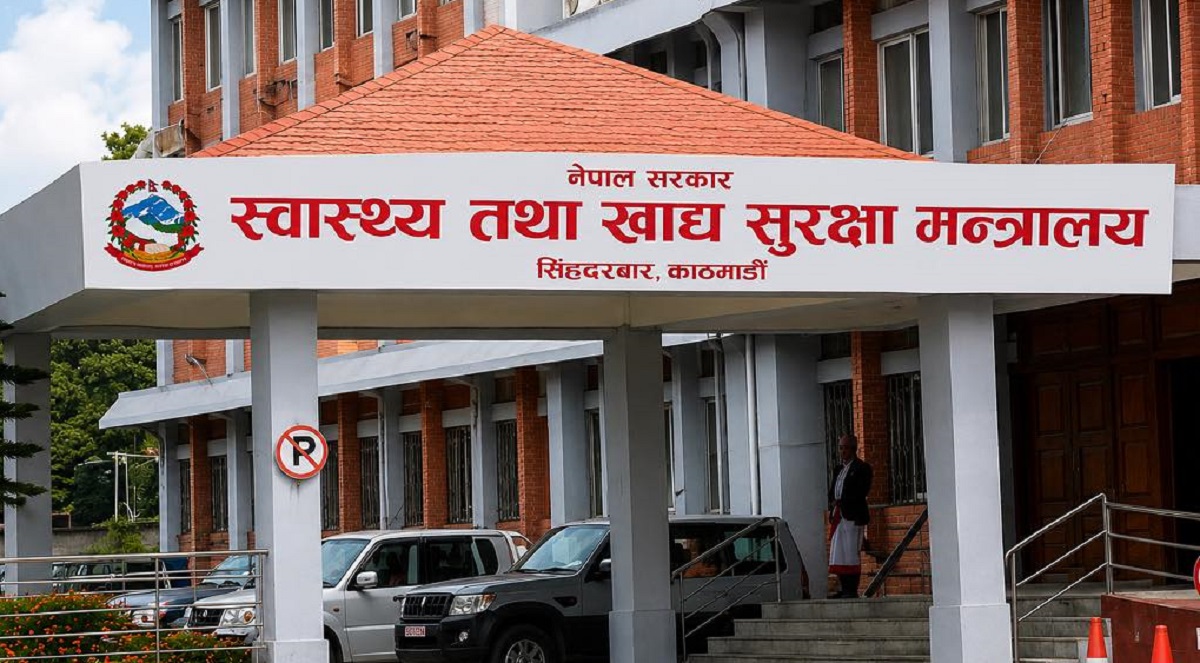
KATHMANDU: The government says it has made progress in improving Nepal’s public healthcare system during its first 100 days in office, with reforms focused on enhancing service delivery, strengthening digital systems, and expanding access to affordable healthcare.
According to the government, public hospitals have seen noticeable improvements in cleanliness, service management, and patient care. Digital record-keeping has also been introduced to securely maintain patients’ medical histories, while efforts are underway to ensure timely treatment and improve access to affordable medicines.
Healthcare reform forms a key component of the government’s 100-point governance reform agenda unveiled by Prime Minister Balendra Shah on March 27. Of the agenda, six priorities are dedicated to the health sector, with the Ministry of Health and Food Hygiene stating that implementation has already begun.
New work culture in the health sector
Ministry spokesperson Dr. Samir Kumar Adhikari said the ministry has introduced a more accountable and results-oriented work culture.
“The health sector’s overall work culture has changed,” he said, adding that delays, procedural violations, and decisions influenced by external pressures are being discouraged. He noted that federal hospitals and lower-level health institutions are now subject to continuous monitoring to improve accountability and service delivery.
Likewise, the government’s policy requiring hospitals to reserve 10 percent of their beds free of charge for eligible patients has begun yielding results, according to the ministry.
Since the launch of the Free Health Portal, a total of 2,262 patients have benefited from free hospital beds and related services. The portal allows patients to check bed availability before visiting hospitals.
So far, 213 hospitals have uploaded updated information on their bed capacity, including beds reserved for free treatment.
The portal also includes contact details and services of 32 blood transfusion centres, including facilities operated by the Nepal Red Cross Society and government hospitals, making it easier for patients to locate blood services.
To strengthen the initiative, the government has approved the Targeted Group Free Treatment Portal (Operation and Management) Procedure, 2083, which has been published on the ministry’s website.
Digital health records and hospital dashboards
The government has also introduced electronic patient record systems at five major federal hospitals on a pilot basis. These include Pokhara Academy of Health Sciences, Bharatpur Hospital, Bir Hospital, the National Trauma Center, and Kanti Children’s Hospital.
The hospitals have also launched digital dashboards to provide real-time information on their services and have begun implementing the Referral Guidelines, 2082 through institution-specific protocols.
Meanwhile, BP Koirala Institute of Health Sciences has introduced its own hospital dashboard, while 26 federal hospitals and health institutions have designated focal persons to monitor electronic attendance systems.
The ministry has also instructed every federal hospital to appoint a focal person responsible for overseeing implementation of the Hospital Service Improvement Procedure, 2082, as part of efforts to improve governance and service quality across the public health system.
Similarly, the Ministry of Health and Food Hygiene says it has significantly improved cleanliness and service management at government hospitals within the government’s first 100 days.
According to the ministry, all 26 federal hospitals and health institutions have completed cleanliness audits and established regular monitoring mechanisms by appointing designated focal persons.
The ministry has also provided continuous service delivery training to healthcare workers and soft skills training to 727 staff members from various hospitals. In addition, several government hospitals have begun operating their own pharmacies, supplying patients with affordable, quality medicines.
Progress in burn treatment
The government has also prioritized strengthening burn care under its 100-point governance reform agenda.
It has allocated Rs 20 million to Kirtipur Hospital to upgrade burn treatment services and earmarked an additional Rs 20 million to establish a dedicated Burn Treatment Fund in the fiscal year 2083/84.
To address resource shortages, the ministry has allocated Rs 100 million to replenish hospital funds. So far, 48 healthcare professionals from 12 federal hospitals have received specialized training in the emergency treatment and management of burn injuries. Additional funding has also been allocated to train more doctors, nurses, and health workers in burn care.
Air ambulance service moves closer to reality
The government says it is working to improve access to emergency medical evacuation, particularly for patients in remote areas such as Karnali and Sudurpaschim, where delayed treatment has often resulted in preventable deaths, including maternal fatalities.
To institutionalize the service, the Ministry of Health has prepared a draft of the Heli and Air Ambulance Service Operation Directive, 2082. The proposed directive is expected to establish a framework for making air ambulance services more accessible, efficient, and sustainable.
Healthcare support for Gen-Z protest victims
The ministry has also continued coordinating healthcare support for people injured during the September 8-9, 2025 Gen-Z protests.
According to the ministry, medical records of 2,599 injured individuals have been collected from 102 health institutions. The District-Level Classification Facilitation Committee has submitted details of 549 injured people under four categories, which have been verified by the Technical Committee for the Classification of Gen-Z Protest Casualties and forwarded to the Ministry of Home Affairs.
The government has also implemented the Procedure for Reimbursement to Hospitals for Medical Treatment of Injured Persons in Various Protests, Conflicts and Natural Disasters, 2082.
Under the scheme, hospitals have so far been reimbursed approximately Rs 8.7 million for the treatment of people injured during armed conflicts, people’s movements, and other protest-related incidents.
Policy reforms aimed at strengthening good governance
As part of its governance reform agenda, the Ministry of Health and Food Hygiene has prepared a report identifying key challenges in public procurement management along with recommendations for improvement. The ministry has also begun implementing several policy recommendations, including reports on the National Autism Guidelines, the promotion of generic medicines, service improvement at federal hospitals, and on-site monitoring of pharmaceutical industries, wholesalers, and pharmacies.
The ministry is also working to draft a new Health Service Act by consolidating and amending the Nepal Health Service Act, 2053, in line with the proposed Federal Civil Service Act. It has also implemented reports on integrating health services into the Federal Civil Service Act, 2080, and a five-year strategic action plan (2082/83–2086/87) for reforming the Department of Drug Administration.
Simplifying procedures and improving service delivery
To streamline administrative processes, the ministry has formed a Process Improvement Task Force led by the Chief of the Administration Division. The task force has been assigned to review existing procedures, identify bottlenecks in service delivery, and recommend simplified processes and monitoring mechanisms.
Authority has also been delegated to division heads to expedite decision-making within their respective areas. Administrative and departmental meetings have been shortened and made more results-oriented, while services related to food business licensing, laboratory reports, import and export permits, and quality certification have been digitized.
The ministry has introduced several new operational procedures, including the Hospital Service Improvement Procedure, 2082; the Targeted Group Free Treatment Portal (Operation and Management) Procedure, 2083; and the Procedure for Classification of Gen-Z Protest Injured Persons, 2082, with the aim of making public services more efficient, transparent, and responsive.
Similarly, the ministry has also prepared drafts of several legal and administrative reforms, including procedures for the selection, recommendation, and appointment of officials to public bodies under the Ministry of Health and Food Hygiene. It is also reviewing amendments to the Health Insurance Act, 2074, and the Safe Motherhood and Reproductive Health Rights Act, 2075.
In addition, drafts of the ministry’s Employee Code of Conduct and an Organization and Management Survey have been completed, while job descriptions and performance indicators have been developed for all positions within the ministry.
Capacity building and grievance management
Through the National Health Training Center, the ministry has provided Basic Life Support training to more than 12,000 participants and specialized emergency health service training to 30 personnel deployed in epidemic response areas.
To strengthen public accountability, the ministry has also restructured its health-sector grievance handling mechanism. A new three-member committee, formed under the coordination of the Head of the Public Information Coordination Branch, now oversees public complaints, with representatives from the Quality and Regulation Division and the Good Governance Unit serving as members.
(Inputs from RSS)



Comment