




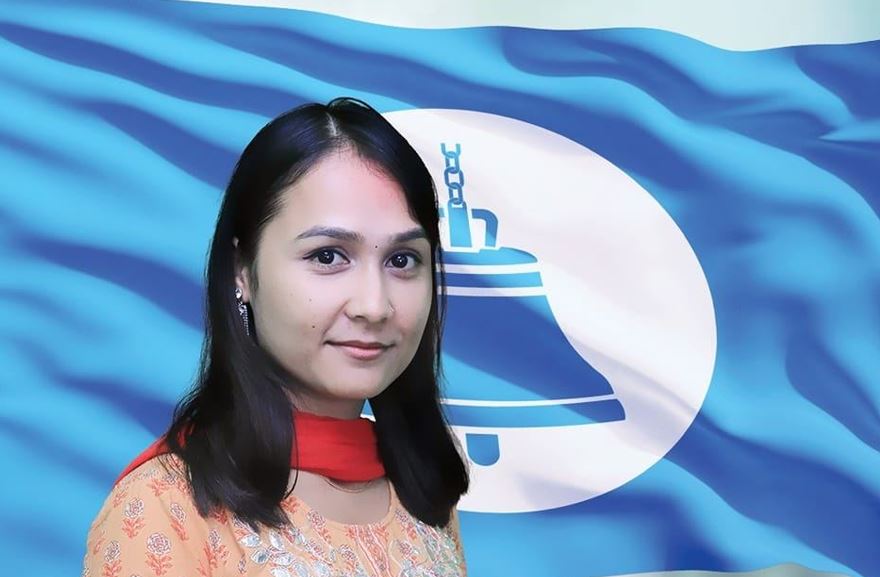
KATHMANDU: Nisha Dangi entered the Federal Parliament as a proportional representation (PR) lawmaker from the Rastriya Swatantra Party (RSP) following the 2022 general elections.
Having worked in the party secretariat since its inception, her selection as a PR lawmaker drew criticism from some quarters. However, she went on to silence many of her critics by securing a decisive victory in Jhapa Constituency No. 1 in the by-election held on March 5, 2026, defeating prominent candidates from major political parties.
Originally from a journalism background, Dangi also emerged as one of the most popular leaders at the party’s first general convention held in Chitwan, winning a central committee position with a strong mandate. In the subsequent election for office bearers, she was elected Joint General Secretary, securing 737 votes and defeating five other contenders.
Now serving as the party’s Joint General Secretary, Dangi says her immediate priority is to strengthen the party organization and expand it to the grassroots. She said RSP Chair Rabi Lamichhane is expected to finalize the expansion of the central committee, office bearers, and the party secretariat within a week, adding that the process has already begun.
According to Dangi, RSP Chair Lamichhane will ensure fairness while selecting members of the party’s leadership bodies.
“Our party has demonstrated that when young people are given responsibility, they can serve with commitment and integrity. Following the general convention, the party has gradually regained momentum. We should all work together to strengthen the organization,” she said.
Rejecting claims of factionalism within the party, Dangi said the leadership contest during the convention reflected healthy internal democracy rather than divisions.
“There was healthy competition during the party’s first general convention. I do not believe there are factions within the party. Those who make such claims should provide evidence. I have not experienced any such division,” she said.
She reiterated that the process of forming the party’s leadership structure is underway and expressed confidence that a clear organizational roadmap would be unveiled within the next week.
Presented below is an edited excerpt of Khabarhub’s conversation with Rastriya Swatantra Party Joint General Secretary Nisha Dangi.
The first meeting of the Rastriya Swatantra Party’s Central Committee has been held. What were the key discussions?
First, we congratulated everyone on the successful completion of the general convention and expressed our gratitude. We also formally completed the process of constituting the Disciplinary Commission, which had been functioning under an acting arrangement for a long time. It was not a lengthy meeting.
We discussed two or three agenda items, reached decisions on them, and concluded the meeting. Since many leaders also had parliamentary responsibilities, we kept the meeting brief so they could return to their work.
What is the party chairman doing to finalize the Central Committee, Secretariat, and office bearers?
The Chairman has already begun the process of finalizing the Central Committee, the Secretariat, and the office bearers. We were informed that consultations have started regarding appointments. The final decision rests with the Chairman.
Along with the 10 office bearers, he will complete the 51-member Central Committee and the Secretariat. Work on all these fronts is already underway. After careful consideration—and, if necessary, consultations with the office bearers—I believe the full leadership team will be finalized soon.
You represent the younger generation, often referred to as Gen-Z. Will more young leaders be included?
I cannot say with certainty, but I have heard discussions about bringing in more leaders from my generation. I believe capable young people will be included wherever they are needed.
Will they be included only in the Central Committee or also in the Secretariat and among the office bearers?
I expect many young leaders to be included in the Central Committee. There is also a possibility that one or two may be appointed to the Secretariat or as office bearers. Since the authority to make these appointments has been entrusted to the Chairman, he has been holding consultations.
One thing I can say with confidence is that the Chairman has made a sincere effort to bring the younger generation into leadership. We all joined this party because we trust his leadership. I believe he will make fair decisions and will not treat anyone unjustly.
You are a leader under 30, yet some people within the party argue that your generation should not be given leadership roles. What kind of leadership team should the party have?
I don’t believe anyone in the party should say that young leaders should be excluded. When I was elected to the Central Committee and later as Joint General Secretary, I was still under 30. Despite that, the general convention delegates elected me with an overwhelming mandate.
There were several strong candidates for the position of Joint General Secretary. If the delegates had believed that someone my age should not be elected, they could easily have voted for others. Instead, they placed their trust in me.
Likewise, our Vice President and Minister for Law, Justice and Parliamentary Affairs, Sobita Gautam, is only about a year older than I am. There are only a few of us around the age of 30 in leadership, so I don’t think age should be used as a reason to exclude young people.
Of course, we still have much to study, research, and learn, and we are committed to doing so. No one knows everything from the beginning.
Gradually, people are beginning to recognize that young leaders can also work with maturity and responsibility. We are living examples that, when given the opportunity, young people can perform effectively. Our party has demonstrated that youth, when entrusted with responsibility, can serve the country with dedication and integrity.
I have seen many leaders who genuinely encourage and support the younger generation. Our party has also created space for young people, allowing individuals like us to enter politics. For us, politics is not about seeking opportunities for personal gain; it is about serving the people. That is the spirit with which we are working.
How do you respond to those who believe young people lack maturity?
I do not agree with the idea that youth automatically means immaturity or that age alone brings maturity. You don’t have to look far—you can observe Parliament itself to see that maturity depends on an individual’s conduct, judgment, and work ethic, not on their age.
Whether someone is young or old, what matters is whether they can fulfill the responsibilities entrusted to them. People should be judged by their performance, integrity, and ability to deliver results—not by the number of years they have lived. Age, by itself, is not a measure of maturity.
So, has taking on the role of Joint General Secretary been challenging?
Not at all. I have previously served as the party’s chief whip, so I already had experience handling responsibility. I believe young people can often work more impartially because they are less influenced by temptation, pressure or intimidation.
When I was entrusted with the role of Joint General Secretary, I was determined to work hard to make the party more dynamic and strengthen its organizational management. I fully understand my responsibilities and enjoy doing this work. Now it’s about delivering results.
There are allegations that your party also has factions. Is that true?
I have never experienced factions within our party. I often hear such claims, but even from the day I joined the party, I have never felt that there were factional divisions. Even today, I do not see any sub-groups or camps. I believe such narratives are being created from outside. As far as I am concerned, there are no factions in our party.
But some party leaders themselves have spoken about an “establishment” group trying to influence internal elections.
People are free to express what they think or hear. Perhaps some leaders voiced concerns based on their own perceptions. But I do not believe there are actual factions within the party. If someone has made such statements, they are the best person to explain why. Personally, I have never felt that the party is divided into camps.
I have never been denied any opportunity because of alleged factionalism. Some colleagues may have shared their personal impressions, but they should explain the basis for those views. Our first General Convention has only recently concluded, and we are still in the process of institutionalizing the party.
Still, didn’t those public statements send the wrong message?
I think it depends on how people interpret them. The party has just completed its first General Convention, and this is the first time we are moving forward as a fully institutionalized organization. In many ways, the convention has helped bring everyone together and establish a common rhythm.
Many members came from different political backgrounds, and we have worked to integrate everyone into one organization. In that sense, I believe we are all part of the same establishment.
Those who joined after the General Convention can be described as new members, but everyone who joined before the convention contributed to building the party. Some joined earlier, some later—that is the only difference. Since the first General Convention, the party has entered a new phase with a clearer organizational structure and direction.
Would you describe the General Convention as a healthy competition?
Absolutely. The entire process was democratic, and we accepted the outcome through democratic means. Had the process not been democratic, we would have raised our concerns. But we are satisfied with how it concluded.
Not only I, but many party members are happy with the outcome. As this was our first General Convention, there are naturally lessons to learn. However, I do not believe there was any unhealthy competition.
We also explored the possibility of consensus to send a message of unity, but at the same time we respected the democratic process. Both approaches were given due importance.
For instance, two or three elected members were unable to take the oath immediately due to technical issues. Who should take responsibility for that?
Their oath-taking was delayed because of some procedural shortcomings during the election process. I believe the Election Commission will review the matter and make an appropriate decision within a day or two.
Since this was our first General Convention, some technical errors were perhaps inevitable. Organizing a convention of this scale is a major undertaking, and one or two mistakes may have occurred. The important thing is that they are corrected.
How should the party Chair proceed with finalizing the Secretariat, Central Committee and office bearers?
The Chair should continue leading the party in the same spirit he has demonstrated so far. If any communities, groups or sections remain underrepresented, they should be accommodated. Likewise, those who have joined the party through the adjustment process should also be given appropriate space.
We have entrusted the overall responsibility of leading the party to the president, and I am confident he will make decisions that serve the party’s best interests. I do not think it is necessary for me to advise him on that.
The responsibilities of Central Committee members, office bearers and Secretariat members are different. The president has already said that responsibilities will be assigned according to each person’s role and capacity. Everyone should carry out the duties entrusted to them with full commitment.
As I often say, the people did not elect us simply for a five-year term—they are evaluating us over these five years. The real test will come after that.
Will the president finalize the Central Committee and Secretariat appointments at the next meeting?
It may or may not be finalized at the next meeting, but the process will certainly move forward. The president has already begun consultations on nominating Central Committee members. As for the Secretariat, several office bearers automatically become members under the party statute, while others need to be nominated.
I believe that process is also underway, and I expect the organizational structure to be completed within about a month.




Comment