




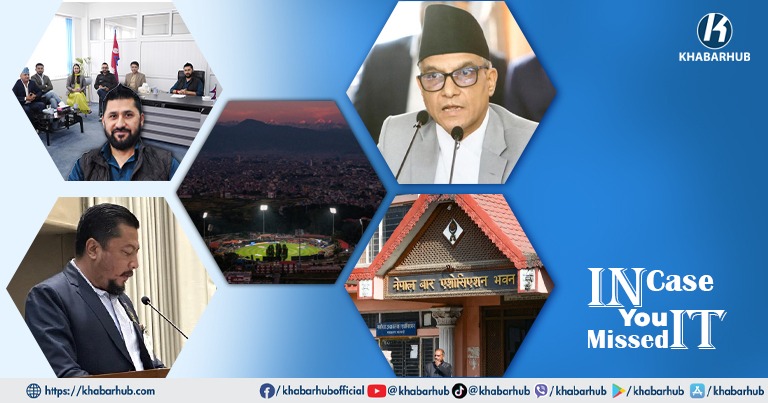
KATHMANDU: The past week was significant for Nepal’s political and institutional landscape, with developments ranging from proposed judicial restructuring and concerns over press freedom to diplomatic achievements, climate negotiations and economic recovery. The events have offered an early indication of the priorities and challenges confronting the government led by Prime Minister Balendra Shah.
While the government has demonstrated an intention to pursue institutional reforms and strengthen Nepal’s international engagement, controversies involving the judiciary, police and media have raised important questions about constitutional accountability, democratic freedoms and the limits of executive authority.
The week’s developments also highlighted a broader reality: Nepal’s political transformation cannot be measured solely by government announcements or administrative decisions. Its success will ultimately depend on how effectively the state strengthens democratic institutions, protects fundamental rights and translates diplomatic opportunities into tangible economic benefits.
Judicial restructuring: Reform must follow constitutional principles
One of the most consequential developments was the Rastriya Swatantra Party’s decision to initiate a parliamentary process for restructuring the judiciary. The ruling party’s secretariat meeting concluded that Parliament must play an indispensable role in addressing controversies surrounding the judicial system.
The inclusion of women and historically underrepresented communities must also be reflected in actual candidate representation rather than remaining an administrative commitment. The Candidate Club could therefore become an important test of whether the RSP can translate its stated commitment to political reform into democratic practices within its own organisation.
The decision came amid allegations and public debate involving senior judicial officials and individuals reportedly connected to controversial financial transactions. The Nepal Bar Association also called for an impartial investigation into allegations linking the Chief Justice and other judges to an individual under investigation.
The controversy has placed the judiciary under considerable public scrutiny. Chief Justice Manoj Kumar Sharma, however, has denied any connection with the individual concerned, describing media reports linking him to the matter as false and misleading. Such denials underline the importance of establishing facts through independent investigations rather than allowing allegations to become conclusions in the court of public opinion.
The RSP’s decision to involve Parliament could provide a constitutional avenue for addressing questions of judicial accountability. However, restructuring the judiciary is a far-reaching undertaking that requires more than political determination.
Parliamentary intervention must respect constitutional provisions, judicial independence and established procedures. The possibility of impeachment proceedings against judges, which was reportedly discussed at the party meeting, makes these safeguards particularly important.
Judicial accountability and judicial independence are not competing objectives. A credible judicial system must be independent enough to decide cases without political pressure while remaining accountable when credible evidence of misconduct emerges.
The government therefore faces a delicate responsibility: ensuring transparency and accountability without creating the impression that judicial restructuring is an instrument of political control.
Press freedom: A test of democratic commitment
Another major issue that dominated public discussion was the arrest of two journalists, including Bishwa Mani Subedi of Nepal Press and Shobha Raj Baral, over a report concerning Nepal Police Inspector General Dan Bahadur Karki.
The arrests triggered concern among media organisations and press freedom advocates, particularly after reports that plainclothes police personnel had entered media newsrooms and detained journalists. Press Council Nepal strongly objected to the reported police intervention, arguing that disputes arising from published news should be addressed through established legal and regulatory mechanisms.
The Council also emphasised that journalists should not be detained without clear legal grounds and that the authorities must respect due process.
The Prime Minister’s Office subsequently clarified that Prime Minister Balendra Shah had not been informed about the arrests beforehand. According to the Prime Minister’s press expert, Shah expressed serious concern after learning about the incident and instructed the authorities to release the detained journalists immediately.
This episode presents an important test of the government’s democratic credentials. The Prime Minister’s reported intervention indicates concern over the incident, but the larger issue goes beyond the release of individual journalists.
Press freedom is not merely a professional privilege enjoyed by media organisations; it is a fundamental democratic safeguard that enables citizens to scrutinise those exercising public authority. Journalists must be accountable for inaccurate reporting, but allegations of misinformation cannot automatically justify police intervention, intimidation or arbitrary detention.
At the same time, media organisations have a responsibility to verify information, seek responses from concerned parties and distinguish factual reporting from speculation.
The government’s challenge is to ensure that both principles are upheld. Its response should reinforce institutional safeguards rather than depend solely on the personal instructions of the Prime Minister.
Police accountability and institutional credibility
The Nepal Police statement warning of legal action against individuals allegedly attempting to damage the organisation’s reputation has added another dimension to the controversy.
The police have a legitimate responsibility to protect institutional integrity, maintain public order and counter deliberate misinformation. However, such responsibilities must be exercised within the boundaries of constitutional freedoms and applicable laws.
The timing of the statement, following reports concerning pressure on the Inspector General, has also raised questions about communication between security institutions, the government and the media.
An independent and professional police organisation should be able to maintain public confidence through transparency, accountability and impartial law enforcement. Protecting its reputation should not become a reason to discourage legitimate public scrutiny.
The government must therefore establish a clear distinction between deliberate disinformation and responsible investigative journalism.
Local elections: An opportunity for internal democratic reform
The RSP’s decision to introduce a ‘Candidate Club’ for selecting candidates for upcoming local-level elections is another noteworthy development.
By inviting applications from interested and eligible individuals for ward chairperson and ward member positions, the party appears to be moving towards a more structured candidate-selection mechanism.
The formation of seven subcommittees covering technology, grievance coordination, inclusion, women’s participation and capacity development suggests an attempt to institutionalise the selection process.
If implemented transparently, this approach could broaden political participation beyond established party networks and provide opportunities for individuals with professional, social and community experience. However, the success of the initiative will depend on its practical implementation. A genuinely open selection process requires transparent eligibility criteria, fair evaluation, accessible applications and effective grievance-handling mechanisms.
International support for Nepal’s proposals is encouraging. Nevertheless, diplomatic endorsement must translate into financial commitments, technological cooperation and practical implementation.
The inclusion of women and historically underrepresented communities must also be reflected in actual candidate representation rather than remaining an administrative commitment. The Candidate Club could therefore become an important test of whether the RSP can translate its stated commitment to political reform into democratic practices within its own organisation.
Diplomatic engagement: More time for LDC graduation, greater responsibility
On the international front, Nepal secured an additional three years to prepare for graduation from the Least Developed Country (LDC) category, following unanimous approval by the United Nations General Assembly.
The decision postpones Nepal’s graduation from November 24, 2026, to November 24, 2029. It represents a significant diplomatic outcome for the Shah-led government, which argued that Nepal needed additional time to strengthen economic resilience, expand productive capacity and prepare for the withdrawal of international support measures.
The extension is particularly relevant given Nepal’s dependence on remittances, limited industrial competitiveness, vulnerability to natural disasters and exposure to external economic shocks.
However, postponing graduation should not be mistaken for an economic achievement in itself. The additional three years must be used to diversify exports, improve productivity, attract investment, strengthen domestic industries and create employment opportunities.
The government must also ensure that Nepal’s Smooth Transition Strategy moves beyond policy documents and produces measurable results. Otherwise, the country could face similar structural challenges when the revised graduation deadline approaches.
Himalayan climate resilience: Nepal seeks international cooperation
Nepal also received support from representatives of 53 countries for four proposals aimed at strengthening Himalayan climate resilience during a regional dialogue in Bangkok.
The proposals included a satellite- and AI-based multi-hazard early warning system, a Himalayan Climate Resilience Mechanism, grant-based disaster financing and a comprehensive risk-based approach to infrastructure investment.
Taken together, last week’s developments reveal a government facing simultaneous challenges in institutional reform, democratic accountability, economic management and international diplomacy.
These initiatives reflect Nepal’s growing recognition that climate change is not simply an environmental issue but also a matter of economic security, regional cooperation and human survival.
The Himalayas are particularly vulnerable to rising temperatures, glacial instability, landslides and flash floods. Their consequences extend beyond national boundaries, affecting downstream settlements, agriculture, hydropower and regional economies.
International support for Nepal’s proposals is encouraging. Nevertheless, diplomatic endorsement must translate into financial commitments, technological cooperation and practical implementation.
Economic recovery and disaster preparedness
Several other developments offered encouraging signs for economic recovery.
Nepal exported electricity worth Rs 5.92 billion to India in Asoj, while exports to Bangladesh resumed at 40 megawatts following disruptions caused by the August floods. The reopening of the Langtang Valley trekking route through alternative trails also offered relief to tourism entrepreneurs and communities affected by the disaster. Similarly, the United States announced plans to provide more than $150 million worth of helicopters, drones and riverboats to strengthen Nepal’s disaster-response capacity.
These developments demonstrate the importance of energy exports, tourism and international cooperation in supporting economic recovery. However, Nepal must also invest in resilient infrastructure, disaster preparedness and stronger local economic institutions.
Governance, public accountability and the road ahead
Other decisions, including the suspension of N-PABSAN activities and the appointment of a new Film Development Board chairman, highlighted the government’s continuing involvement in administrative and institutional management. Meanwhile, political remarks by former Prime Minister Pushpa Kamal Dahal concerning the historical contribution of the Maoist movement reflected continuing debates over Nepal’s political identity and transformation.
The additional time secured internationally and the political mandate enjoyed domestically provide opportunities, but neither guarantees success. What matters now is the government’s ability to turn commitments into credible, measurable and lasting reforms.
These developments suggest that Nepal’s political transition remains an evolving process, involving competing interpretations of history, institutional authority and the direction of governance.
Conclusion: Reform must deliver results
Taken together, last week’s developments reveal a government facing simultaneous challenges in institutional reform, democratic accountability, economic management and international diplomacy. The RSP has signalled its intention to restructure the judiciary and introduce a more organised system of local-level candidate selection. The government’s diplomatic engagement has also produced important outcomes on LDC graduation and Himalayan climate resilience.
Yet the controversy surrounding journalists’ arrests has highlighted the need for greater consistency between the government’s reform agenda and its commitment to democratic freedoms. Ultimately, the credibility of the Shah government will depend not on the number of initiatives it announces but on the institutions it strengthens and the results it delivers.
Judicial independence must be protected, press freedom respected, police accountability strengthened and economic vulnerabilities addressed. Similarly, international diplomatic achievements must be converted into domestic development outcomes. The central challenge for the government is to demonstrate that political change can produce institutional integrity, economic opportunity and stronger democratic governance. The additional time secured internationally and the political mandate enjoyed domestically provide opportunities, but neither guarantees success. What matters now is the government’s ability to turn commitments into credible, measurable and lasting reforms.






Comment