




KATHMANDU: The draft Strategic Environmental Assessment Report of the Kathmandu Valley Urban Transport System Master Plan, jointly prepared by the Ministry of Physical Infrastructure and Transport and a team of experts from the Japan International Cooperation Agency (JICA), has been made public.
The master plan aims to develop a safe, inclusive and sustainable transport system across Kathmandu, Lalitpur and Bhaktapur districts through 2050. The report says the valley’s growing traffic congestion cannot be addressed through conventional road expansion alone, noting that vehicle density has reached 868 vehicles per kilometre. Average traffic speeds during office hours have fallen to 13.6 kmph in the morning and 10.6 kmph in the evening.
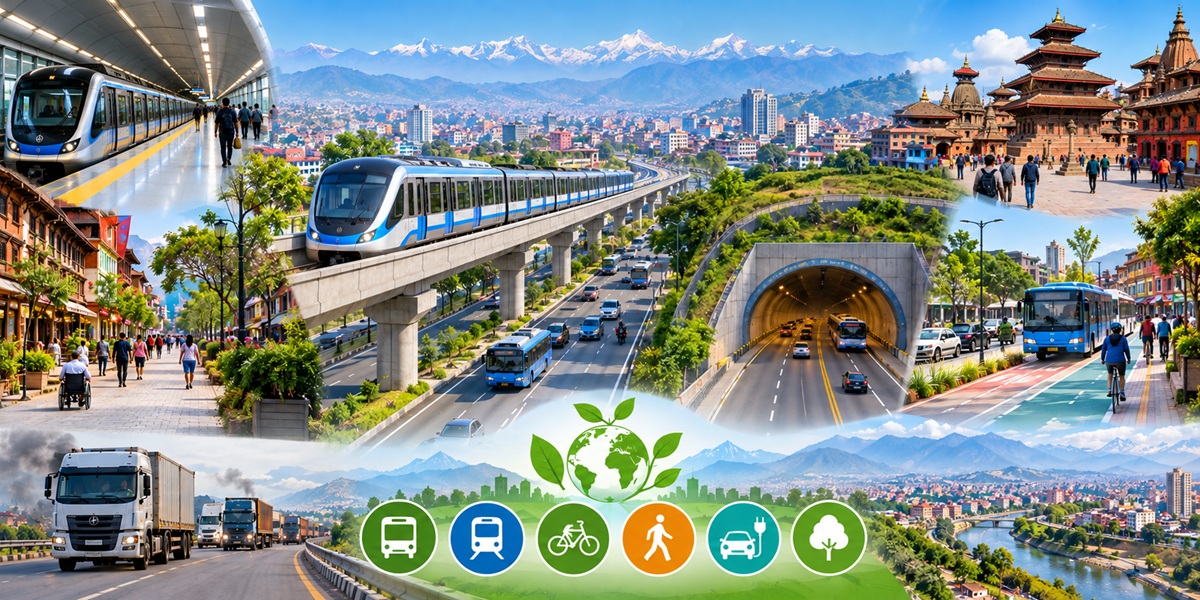
Mass transit and tunnels proposed along Kathmandu-Bhaktapur corridor
The master plan identifies large-scale public transport infrastructure as a key strategy for addressing the valley’s growing traffic pressure. It proposes a 14.6-kilometre east-west mass transit system, including a Metro Rail Mass Rapid Transit line, connecting Ratna Park in Kathmandu with Bhaktapur, a corridor identified as having high passenger demand. The proposed metro line would run underground through major urban areas, including the Koteshwor section.
The plan also proposes upgrading the underpass at Maharajgunj, constructing an underground tunnel along the Chabahil-Gaushala section, and improving the Ring Road and riverside corridors to ease congestion.
It also calls for integrated utility corridors beneath major roads to reduce repeated road excavation for infrastructure such as drinking water pipelines, electricity lines and fibre-optic cables.
The study found that fine particulate pollution in the Kathmandu Valley is significantly above national standards. It also reported that fuel-powered vehicles, which account for only 2.3 percent of the total vehicle fleet, are responsible for around 80 percent of emissions.
If the integrated transport strategy is fully implemented, greenhouse gas emissions are projected to fall by around 20.6 to 21 percent by 2050 compared with a scenario without the plan. This would amount to a reduction of approximately 159,244 tonnes of emissions annually. The plan also anticipates improvements in air quality through expanded public transport and greater adoption of electric vehicles.
Car-free pedestrian zones proposed in Thamel and Basantapur
The master plan proposes restricting private vehicles in the historically, culturally and commercially significant Thamel and Durbar Square areas, including Basantapur and Asan, to create pedestrian-friendly, car-free zones.
The plan prioritises wider and safer footpaths, green spaces and disability-friendly infrastructure. It also calls for detailed studies on parking facilities, alternative access routes and connecting roads around areas where private vehicle access would be restricted.
As the Kathmandu Valley is home to seven UNESCO World Heritage Sites, the plan proposes making heritage impact assessments mandatory for transport projects located near protected heritage areas.
The report also calls for land acquisition and rehabilitation measures that provide appropriate compensation and protect the livelihoods of displaced and landless people, including squatters, in line with international standards.
It proposes close institutional coordination among the federal, provincial and local governments, as well as local bodies, small-scale transport operators and other stakeholders, to implement the master plan.



Comment