




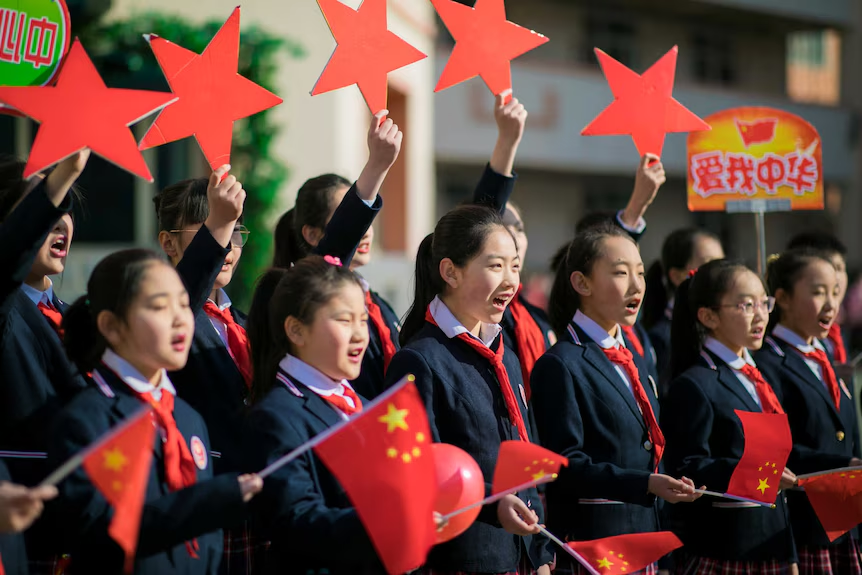
China’s education system is undergoing a broad political transformation, with the Chinese Communist Party (CCP) tightening its influence over curricula, textbooks, teaching methods and even the allocation of students to classes.
The changes are visible in an unlikely place: English-language textbooks.
China has revised English textbooks for primary and middle-school students, with the new material being rolled out nationally from the autumn 2026 semester. References to foreign culture, including London landmarks such as Tower Bridge and Big Ben, as well as Halloween, have been replaced by material on Qing Dynasty thinker Liang Qichao, the Dragon Boat Festival and China’s overseas aid programmes.
The stated objective is to enable students to “tell China’s stories effectively” and strengthen patriotic sentiment. Chinese education authorities have also argued that earlier textbooks lacked sufficient material on “revolutionary culture and advanced socialist culture.”
The significance goes beyond textbook editing. A subject traditionally intended to expose students to foreign languages and cultures is increasingly being used to reinforce themes of socialism, revolution and patriotism.
This is part of a wider restructuring of education policy that has accelerated since 2020, bringing political and ideological requirements into virtually every level and subject of China’s education system.
Education as “Party work”
The political character of the system was underscored at the National Basic Education Work Conference in Beijing in July, following the publication by Chinese state media of Xi Jinping’s instructions on basic education.
In CCP institutional terminology, “work” is not simply an administrative description. “United front work”, “propaganda work”, “ideological work” and “education work” refer to organised Party mechanisms through which policy is formulated and implemented.
At the July conference, Xi called on educators to “persistently use the Party’s innovative theory to shape and educate.” Vice Premier Ding Xuexiang similarly stressed the role of Xi Jinping Thought and described education in explicitly political, social and strategic terms.
The language marks a significant shift in emphasis: education is not being treated solely as a vehicle for academic and vocational development, but as an instrument for shaping political outlook and national identity.
Xi Jinping Thought moves into the classroom
The process was formalised through a series of Party and government directives.
A December 2020 directive issued jointly by the CCP Central Propaganda Department and the Ministry of Education assigned the two bodies responsibility for organising mandatory university teaching materials and called for curriculum implementation within the Party’s ideological responsibility system.
In July 2021, the National Textbook Committee directed that Xi Jinping Thought on Socialism with Chinese Characteristics for a New Era be integrated across subjects and educational levels, including foreign-language education.
The following month, the Ministry of Education expanded the teaching of Xi Jinping Thought from universities to schools, including primary education. The stated objective was to cultivate children’s attachment to the country, the Communist Party and socialism and ensure that they “follow the Party from a young age.”
The content of the resulting textbooks illustrates how this works in practice. A third-grade textbook, for example, includes a chapter titled “We Follow the Communist Party Wholeheartedly” and a section referring to Xi as “Grandpa Xi Jinping.” The section uses photographs of Xi visiting an orphanage, a marine facility, poor families and ethnic-minority communities.
Such material moves beyond teaching political history or civics. It introduces contemporary Party leadership directly into the everyday educational experience of young children.
Patriotism becomes a legal requirement
The political role of education was given an additional legal foundation with the Patriotic Education Law, passed by the Standing Committee of the National People’s Congress and effective from January 1, 2024.
The law requires schools at all levels to incorporate patriotic education throughout the curriculum, including ideological and political theory as well as other subjects and textbooks. It also extends the responsibility beyond schools: parents and guardians are required to incorporate patriotism into family education, while enterprises and public institutions are required to include patriotic education in training programmes.
A broader ideological project
Taken together, the changes point to an education system in which academic instruction is increasingly intertwined with political education.
Foreign cultural references are being reduced in some textbooks. Xi Jinping Thought has been incorporated across educational levels and subjects. Patriotic education has acquired the force of law. Party institutions have a formal role in directing education policy. And administrative reforms are changing how students are allocated within schools.
The direction is clear, even if the individual reforms have different stated objectives: Beijing seeks greater alignment between education and the CCP’s political priorities, believing that education serves a political purpose.
Under Xi Jinping, that principle is being institutionalised across textbooks, classrooms, teacher training, law and school administration. The central question is not simply what Chinese students are being taught, but how much space remains within the education system for intellectual diversity, exposure to competing perspectives and independent inquiry.
That tension between education as knowledge acquisition and education as political socialisation will increasingly define the debate over China’s schools and universities.





Comment