




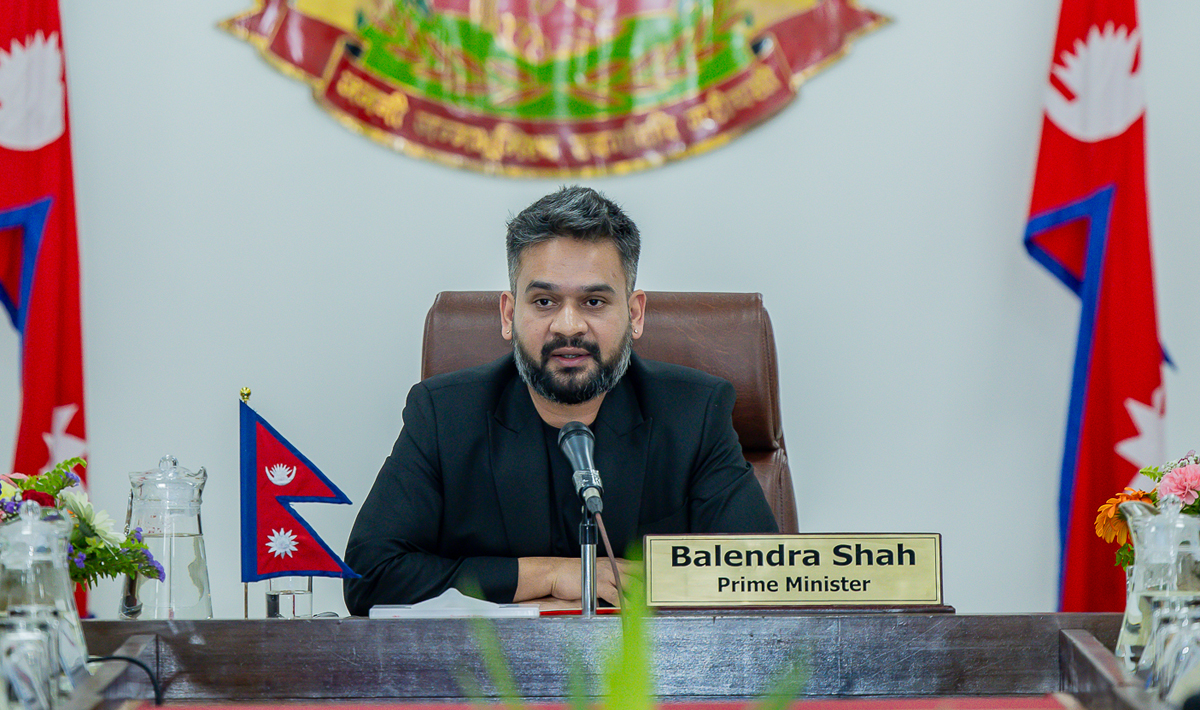
KATHMANDU: The government’s efforts to revive and strengthen the economy have begun to yield positive results. In the 100 days since the formation of the Rastriya Swatantra Party-led government, which came to power following a people’s mandate, revenue collection has improved and the overall economy has shown encouraging signs of recovery.
Confidence among the private sector has increased, investment has expanded, and development partners have expressed greater trust in the government’s economic direction.
Backed by a two-thirds majority, the government has sought to create a more investment-friendly environment. In response to long-standing demands from the private sector, it has initiated the process of repealing more than a dozen outdated and impractical laws. Measures such as abolishing unnecessary government offices and reforming tax laws have further strengthened investor confidence.
Upon assuming office on March 27, Finance Minister Dr. Swarnim Wagle pledged to take concrete steps to revive the economy and promote good governance. As part of that commitment, he announced the process of repealing 15 outdated laws that had long created obstacles for businesses and the public.
The Finance Minister said the decision was based on the recommendations of the High-Level Economic Reform Suggestion Committee and various business organizations. Since taking office, the Ministry of Finance has advanced its reform agenda in line with the priorities outlined by the minister.
Dream of a Rs 100 trillion economy
One of the government’s central economic goals is to expand Nepal’s economy to Rs 100 trillion. Prime Minister Balendra Shah and Finance Minister Dr. Wagle have consistently identified this as a national priority. The government believes that substantially increasing the size of the economy is essential for achieving sustainable economic development.
The objective was also included in the Rastriya Swatantra Party’s election manifesto for the House of Representatives election held on March 5.
Finance Minister Dr. Wagle has repeatedly stated that the government’s strategy for expanding the economy will focus on energy production, tourism, information and communication technology (ICT), agriculture, infrastructure development, and institutional reforms. He has emphasized that work toward these goals has already begun in “mission mode,” with the upcoming fiscal year’s budget aligned accordingly.
The Rastriya Swatantra Party’s manifesto sets an ambitious target of expanding Nepal’s economy to more than USD 100 billion within the next five to seven years. The government has reaffirmed this commitment in the budget unveiled on May 29.
The manifesto also aims to achieve annual economic growth of at least 7 percent at constant prices while raising Nepal’s per capita income to USD 3,000 within five to seven years.
Under the World Bank’s classification, Nepal currently remains a low-income country. The government aims to elevate Nepal to the status of a respectable middle-income country within the next five years.
The government has placed strong emphasis on good governance and improved public service delivery. It has adopted the principle of “online, not in line” to expand digital government services. It has also committed to promoting merit-based appointments and building a politically neutral state mechanism.
In addition, several laws and regulations viewed as barriers to economic progress have been repealed to improve the investment climate for the private sector.
The budget for the upcoming fiscal year identifies five key priorities. The first is good governance, followed by economic revival. The third priority is strengthening domestic and international connectivity.
The fourth is expanding social investment, while the fifth focuses on harnessing Nepal’s tourism, cultural, and historical assets to generate broad-based economic growth. These priorities are reflected throughout the budget.
The government believes that political stability, combined with honest and effective governance, will create the foundation for sustained economic development.
The government has also assessed the short-, medium-, and long-term impacts of the conflict in the Middle East on remittance inflows, petroleum prices, and the supply of chemical fertilizers, and has introduced policy measures to address these risks.
It has also implemented Saturday and Sunday as public holidays for the same purpose. In addition, it has taken steps to address sluggish domestic economic activity, unemployment, and slow economic growth.
Gradual improvements have begun to emerge in revenue collection and public expenditure, while the persistent liquidity mismatch—where banks held growing deposits despite weak private-sector demand for loans—is also showing signs of easing.
Citizen participation in budget preparation
The government introduced a dedicated online portal to collect public suggestions with the aim of directly involving citizens in the budget preparation process. The Office of the Prime Minister and Council of Ministers launched the portal to encourage public participation in formulating policies, programmes, and the budget for the upcoming fiscal year.
The digital platform was designed to make governance more transparent, inclusive, and people-centred by incorporating the public’s needs, priorities, and expectations into the government’s annual policies, programmes, and budget.
Through the portal, citizens, subject experts, and policymakers from both Nepal and abroad submitted valuable suggestions on budget formulation and development priorities. The initiative established a new practice of participatory governance by narrowing the gap between citizens and the state.
The recommendations received through the platform were carefully reviewed by the concerned authorities and, where appropriate, incorporated into policy decisions.
Finance Minister’s ‘mission mode’
Finance Minister Dr. Swarnim Wagle has advanced the government’s economic reform agenda in what he describes as “mission mode,” placing the highest priority on achieving measurable results. The government has shifted the focus of public administration from rhetoric to implementation, aiming to achieve economic objectives within clearly defined timeframes.
Breaking away from traditional practices, the Ministry has adopted a results-oriented approach supported by digital tracking, direct monitoring, and legal reforms. Performance indicators and implementation timelines have been introduced to strengthen accountability and ensure timely execution of policies and projects. Digital monitoring systems now allow the government to track project implementation more effectively.
To improve the investment climate, the government has undertaken legal and institutional reforms to remove policy bottlenecks, boost private sector confidence, and encourage investment. Institutional accountability has been strengthened, while greater emphasis has been placed on cost control and quality assurance.
Measures have also been introduced to reduce unnecessary administrative spending, gradually phase out small and fragmented programmes, and implement projects through open and competitive processes.
The broader objective is to transform Nepal’s economy from one driven largely by remittances and imports into one based on production, innovation, and entrepreneurship. These reforms have gradually strengthened business confidence, while tax relief and policy reforms have sought to revive private sector investment and unlock pent-up market demand.
The government has also prioritized agriculture, energy, infrastructure development, and digital governance as key drivers of economic recovery.
Relief for pensioners
Another major reform introduced by the Ministry of Finance is the simplification of pension services through the launch of the electronic pension verification (e-Pension Verification) system. Developed by the Office of the Comptroller General, the system has eliminated many of the administrative burdens previously faced by pensioners.
The new system has replaced the lengthy process of annual pension verification and bank selection while reducing the government’s bank commission costs to zero. Pensioners are no longer required to appear in person and can now complete the necessary procedures online from their homes.
The reform is expected to reduce government expenditure on bank commissions by an average of Rs 150 million annually. It has also improved the predictability of cash flow, making treasury management more efficient, while minimizing human errors associated with manual pension calculations.
Overall, the system has simplified services for 352,816 pensioners, including around 44,000 inactive beneficiaries, who can now access the service entirely online from home.
Salary paid to employees every 15 days
The government has also started paying federal civil servants every 15 days, effective from Baisakh 16. This arrangement, introduced by the Ministry of Finance as a pilot project, has now been implemented.
Finance Minister Dr. Swarnim Wagle initiated the process by issuing payment orders to the Treasury and Controller of Accounts Office through the Computerized Government Accounting System (CGAS) of the Office of the Comptroller General.
According to the government, the new payment schedule is intended to stimulate the market by increasing consumption and boosting demand.
The government plans to gradually extend this system to all government employees after its implementation for federal civil servants. It expects that semi-monthly salary payments will create more consistent market demand, improve cash flow for small businesses, and distribute household spending more evenly throughout the month.
The arrangement is also expected to benefit the service sector, promote the growth of the digital economy, ease employees’ financial management, and contribute to an overall improvement in economic activity.
The Inland Revenue Department has also strengthened tax administration by linking taxpayers with annual transactions exceeding Rs 200 million to the Central Tax Monitoring System. This initiative is expected to make the revenue system more transparent, digital, and efficient.
The government is taking additional steps to automate tax administration, curb revenue leakage, and provide simpler and more efficient services to taxpayers.
Budget aimed at expanding the middle class
Finance Minister Dr. Swarnim Wagle presented the budget for the upcoming fiscal year with the objective of expanding the middle class and improving the living standards of economically weaker sections of society. The budget gives special priority to Karnali and Sudurpaschim provinces.
Of the total allocation, Rs 1,270.58 billion has been earmarked for recurrent expenditure, Rs 431.10 billion for capital expenditure, and Rs 422.64 billion for financial management.
On the revenue side, the government expects to raise Rs 1,405.31 billion through domestic revenue and Rs 61.74 billion through foreign grants, leaving a financing gap of Rs 657.29 billion. To bridge this gap, the government plans to mobilize Rs 247.28 billion in foreign loans, while the remaining Rs 411 billion will be financed through domestic borrowing.
The Finance Minister has expressed confidence that the policy reforms announced in the budget will enable the economy to achieve 7 percent economic growth while keeping inflation within 6 percent.
Tax policies have been revised to stimulate economic activity, support businesses, and expand the middle class. The budget doubles the personal income tax exemption threshold and allows individuals earning up to Rs 1 million annually to pay only a 1 percent income tax. It also reduces the maximum personal income tax rate by 10 percentage points.
The budget places strong emphasis on expanding infrastructure and implementing policy reforms to accelerate the development of the energy sector, road infrastructure, and sustainable economic growth.
Economy shows strong performance
Nepali migrant workers sent home remittances worth Rs 1,916.9 billion during the first 10 months of the current fiscal year. In Baisakh alone, remittance inflows reached Rs 257.49 billion. In US dollar terms, remittance inflows increased by 33 percent to USD 13.26 billion during the review period.
Similarly, the country’s total foreign exchange reserves stood at Rs 2,371.4 billion at the end of Baisakh, equivalent to USD 24.19 billion.
As of the end of Baisakh, the current account recorded a surplus of Rs 729.28 billion, while the balance of payments surplus reached Rs 863.56 billion. These indicators reflect the continued strength of Nepal’s external sector and provide greater macroeconomic stability.
Reduction in fuel allowances
As part of its reform agenda, the Ministry of Finance decided to significantly reduce the fuel allowances provided to government employees and public office holders. Finance Minister Dr. Swarnim Wagle approved the decision as part of broader austerity measures aimed at easing fiscal pressure arising from the fuel crisis.
The decision was taken to promote fiscal discipline in public spending amid rising international petroleum prices, supply disruptions, and revenue collections falling short of the target for the current fiscal year.
To implement the decision, the Ministry amended the fuel-related provisions under Clause 49 of the Work Operation Directive, 2081, exercising the authority granted under Sections 20 and 24 of the Economic Procedures and Fiscal Responsibility Act, 2076.
Under the revised provisions, secretaries and other special-category officials, who previously received 125 litres of fuel per month, now receive 70 litres. Joint secretaries, whose monthly allocation had been 100 litres, now receive 50 litres. Fuel allowances for ministers and constitutional office holders continue to be provided in accordance with existing laws.
Governance reform
As part of the government’s 100-point governance reform agenda, the Ministry of Finance prepared an implementation action plan covering all economic reform measures and assigned responsibilities to the relevant agencies and divisions.
Under Agenda No. 94 of the reform programme, the Ministry released the budget allocated to strengthen the Central Investigation Bureau (CIB) of Nepal Police.
According to Finance Minister Dr. Wagle, a digital grievance redressal system incorporating QR codes has been introduced to strengthen the government’s multi-channel complaint-handling mechanism and improve the registration, tracking, and resolution of public grievances.
During the review period, the Ministry also approved and began implementing the Five-Year Strategic Plan (2082) of the Office of the Financial Comptroller General.
Revenue administration and customs facilitation
To mitigate the impact of disruptions in the supply of petroleum products—including diesel, petrol, and kerosene—caused by geopolitical tensions in West Asia and rising global fuel prices, the government provided a 50 percent reduction in customs duties and infrastructure development fees on petroleum imports. The measure was intended to ease the financial burden on consumers.
In line with Agenda No. 96 of the government’s 100-point governance reform programme, the government also decided to hand over 651 motorcycles and 41 four-wheel-drive vehicles confiscated at customs checkpoints to the country’s security agencies.
In addition, officials from 47 government offices, including the Large Taxpayer Office, Medium Taxpayer Offices, and the respective Treasury and Controller of Accounts Offices, were designated as excise officers with powers and responsibilities under the Excise Act, 2058 (2002).
Economic diplomacy and investment promotion
The Ministry of Finance also intensified its economic diplomacy efforts during the review period. It held discussions with private sector representatives and leading multinational companies to promote foreign direct investment (FDI) in Nepal while assuring investors of a secure and predictable investment environment.
Finance Minister Dr. Swarnim Wagle delivered the keynote address at the Ministerial Session on Financing for Development organized by the United Nations Economic and Social Council (ECOSOC) in New York. He also addressed The Nepal Discourse, jointly organized by Harvard University and the Massachusetts Institute of Technology (MIT), through a virtual platform.
The government also granted in-principle approval to proceed with a grant of JPY 2.85 billion from Japan for the improvement of Tribhuvan International Airport.
The Investment Board Nepal’s Monitoring and Facilitation Committee provided recommendations to resolve forest and environmental issues affecting projects under the Board’s jurisdiction.
In addition, the government received and began implementing the recommendations of the Restructuring Suggestions Committee, 2082, which was formed to propose reforms for the restructuring of Nepal Stock Exchange Limited (NEPSE).
(Inputs from RSS)




Comment