




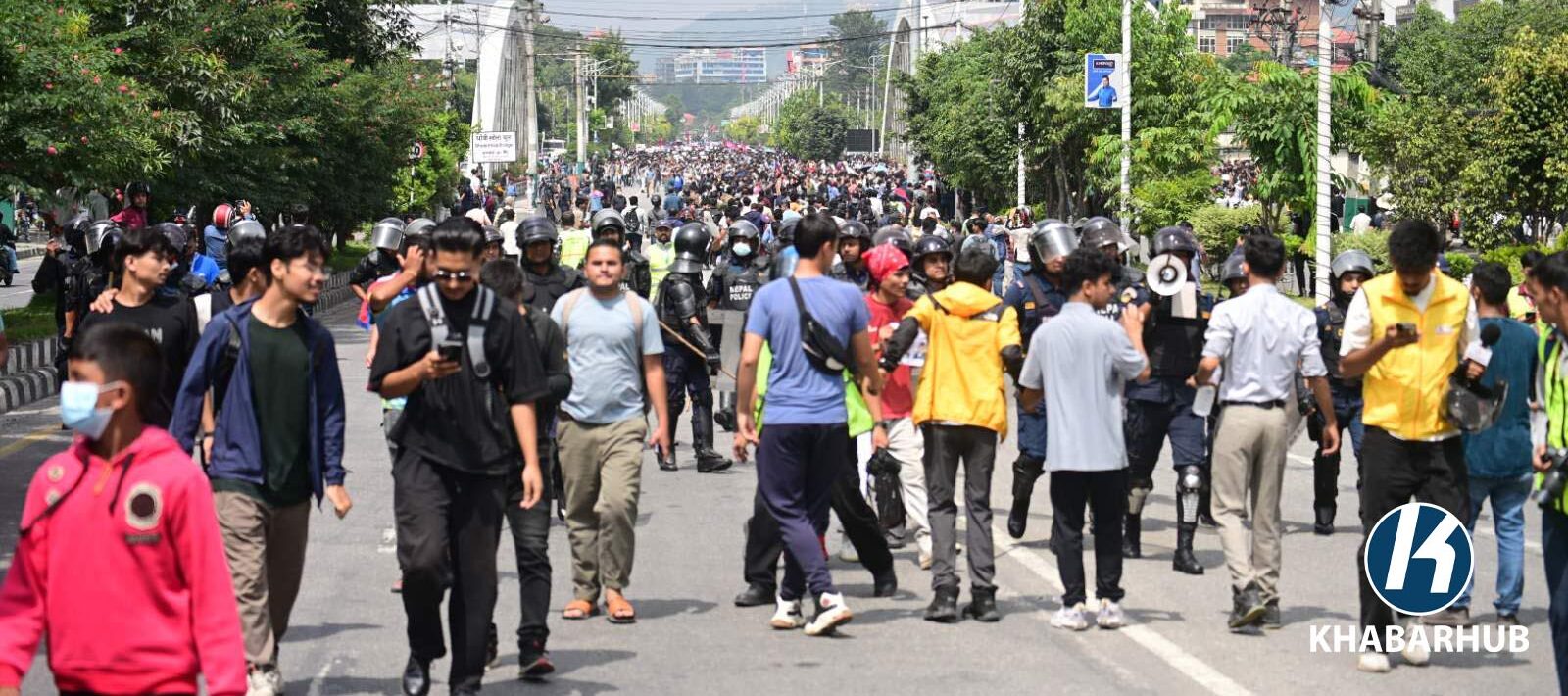
KATHMANDU: A new political realignment is taking shape as sections of the GenZ–led movement signal readiness to enter formal party politics through a negotiated agreement with the Rastriya Swatantra Party (RSP), even as a key faction of the movement opts to remain outside the power structure.
While the Gen-Z Front and Council are preparing the groundwork for a political and ideological partnership with RSP, the Gen-Z Movement Alliance has made it clear that it will continue its role as a street-based opposition, exposing deepening divisions within the youth-driven movement over the path forward.
Notably, the key role in bringing these three leaders together was played by Sudan Gurung, a prominent figure of the Gen-Z movement. After facilitating the unification, Gurung is also preparing to join the Rastriya Swatantra Party, if he has not already done so.
However, senior Gen-Z leaders who led protests on September 8 and 9 have not yet joined the Rastriya Swatantra Party, according to party vice-president DP Aryal. Uparjung Rai, Koshi Province coordinator of the Gen-Z Council, also confirmed that not all Gen-Z members have joined the party.
“It would be incorrect to say that all Gen-Z members have joined the Rastriya Swatantra Party,” Rai said. “Some individuals may have chosen proportional representation—that is their personal decision. Even the former king’s grandson, Hridayendra, falls under the Gen-Z category, so it would be wrong to place everyone in the same group based on where one individual stands.”
Niraula said that while the Front and the Council may be discussing unity with the Rastriya Swatantra Party, the alliance is preparing to intensify street protests. “If everyone enters power, there will be no opposition,” she said. “We work within civil society, organize discourse, continue political dialogue, and will both support and pressure the government to implement the 10-point agreement we submitted earlier.”
As Rai suggested, only a section of Gen-Z has aligned with the Rastriya Swatantra Party, while several core Gen-Z organizations remain outside it. Although Gurung has played a central role in bringing together the three high-profile leaders now in the spotlight, not all Gen-Z factions have followed suit. While two groups are preparing to join the party, the Gen-Z Movement Alliance has decided to stay out for now.
This has raised questions about how Gurung, who could not unite all Gen-Z factions, managed to bring together the three prominent leaders. When asked, Gurung’s close associates said that the focus was on uniting the principal leaders first.
“They will remain as guardians,” one aide said, adding that discussions with other groups are ongoing. “Once a broader ideological and political understanding is reached, others will also join the Rastriya Swatantra Party.”
Uparjung Rai had earlier echoed a similar view in an interview with Khabarhub, stating that Gen-Z had put forward a proposal during the merger talks involving Balen Shah, Kulman Ghising, and Rabi Lamichhane.
“We proposed that just as there is an agreement with the Rastriya Swatantra Party, there should also be a clear agenda with Gen-Z,” he said. “We have made it clear that we will join only if we are given responsibility to carry that agenda forward.”
Rai added that the party’s electoral success would also depend on how it accommodates Gen-Z’s concerns. Meanwhile, another member of Sudan Gurung’s secretariat said that the Gen-Z Front and the Gen-Z Council are preparing the groundwork for joining the Rastriya Swatantra Party. According to him, efforts are underway to draft a formal political and ideological agreement.
“Sudan and I are working together to outline points for a political agreement,” he said. “Just as we submitted a 10-point demand to the government, we will enter the party only after securing a written agreement with the Rastriya Swatantra Party on those same points.”
Uparjung Rai also claims that Gen-Z factions are preparing a political and theoretical agreement and that only after the Rastriya Swatantra Party (RSP) commits—clearly outlining how and in what form it will implement this agreement—will the three main groups and other factions decide whether to formally join a political party.
Front and Council accused of misleading the alliance
Until Monday, the Gen-Z Front led by Rakshya Bam had been in favor of joining the Rastriya Swatantra Party through a political and theoretical agreement. However, while Bam’s group was close to taking a decision, it has since failed to do so, expressing dissatisfaction over the inclusion of various popular figures and close associates in the party’s proportional representation list.
Although the Rastriya Swatantra Party appears open to discussion, Front coordinator Rakshya Bam has publicly criticized the proportional list, sarcastically demanding corrections. The party, for its part, has said it is willing to review the list if mistakes are found. This has raised doubts over whether the Front still intends to join the party through an agreement.
Despite repeated attempts to contact her, Bam said she has not yet reached a final decision. In contrast, the Gen-Z Council and Sudan Gurung’s group are firmly in favor of joining the Rastriya Swatantra Party through a political and theoretical agreement. Leaders of the Gen-Z Movement Alliance accuse these factions of attempting to mislead the broader alliance.
Amit Khanal, a core leader of the Gen-Z Movement Alliance, which comprises 13 major groups, said the alliance has collectively decided not to join the Rastriya Swatantra Party under any agreement. He added that Sudan Gurung’s entire team is currently in talks with alliance leaders, though sources say those efforts have not succeeded.
When asked about this, alliance leader Monica Niraula said, “Friends have naturally held discussions and offered advice, but we have already decided not to go.”
Staying on the streets, not entering power
Asked why the alliance has chosen not to join the Rastriya Swatantra Party, Niraula said the present moment demands a strong street-based opposition rather than participation in power.
“The alliance consists of 13 groups with organizations in 41 districts. Our core team has more than 15 members, and none of them is joining the Rastriya Swatantra Party,” she said. “If individuals from other districts decide to go, that is their personal freedom. We respect individual choices, but the core team will not go anywhere.”
Niraula said that while the Front and the Council may be discussing unity with the Rastriya Swatantra Party, the alliance is preparing to intensify street protests. “If everyone enters power, there will be no opposition,” she said. “We work within civil society, organize discourse, continue political dialogue, and will both support and pressure the government to implement the 10-point agreement we submitted earlier.”
Khanal echoed the sentiment, saying that with no confidence in either old or new political forces, the movement will not abandon the streets. “The Rastriya Swatantra Party is like a river,” he said. “If you sail on it, you go wherever it flows. Our Gen-Z Movement Alliance is not ready to flow in that direction. We do not share the party’s ideas.”
Khanal added that leaders such as Kulman Ghising, Balendra Shah, and Rabi Lamichhane are currently being tested by the public. “If they pass, that is fine. If not, we will also take action against them,” he said.
Khanal added that while individual members may join the party at their discretion, the alliance as a whole will not. “We work on grassroots and social issues, landless squatters, street children, marginalized voices. Parties have ruled for 30 to 35 years while the streets were emptied. We are bringing politics back to the streets.”
He warned that if all ministers and lawmakers follow the RSP model, grassroots voices could be further marginalized. The alliance includes leaders such as Rijan Rana Magar Laxmi, James Karki, Monica Niraula, and Saman Limbu.
Khanal said he was previously associated with Janardan Sharma’s Progressive Democratic Party and briefly assisted Dr. Baburam Bhattarai as an IT advisor. “I wanted to see whether something genuinely new would emerge. When it didn’t, I left,” he said. “There is little hope even from the new forces. The RSP’s momentum feels seasonal—it may not last the year. That is something worth reflecting on.”
Ojaswi Bhattarai is currently serving on the board of directors of Pralopa, representing the movement. Khanal claims that he left the movement after understanding the internal environment and finding it unsuitable.
“What I want to make clear to everyone is that the entire Gen-Z Movement Alliance is not going anywhere,” Khanal said. “We have organizations in 43 districts. If a friend from Banke leaves, it is not appropriate to say that the Gen-Z Movement Alliance has left. We, too, have our own independence.”
He clarified that the alliance is not opposed to elections. “If impartial and independent candidates contest elections, we can support capable individuals on our behalf. We are ready to extend support during elections,” he said.
Khanal added that leaders such as Kulman Ghising, Balendra Shah, and Rabi Lamichhane are currently being tested by the public. “If they pass, that is fine. If not, we will also take action against them,” he said.
Using a metaphor, Khanal remarked, “If you put your hand in hot rice, it will burn. You should let it cool before eating. Right now, Balen, Rabi, and Kulman are under scrutiny. Let’s see what they do.”





Comment