




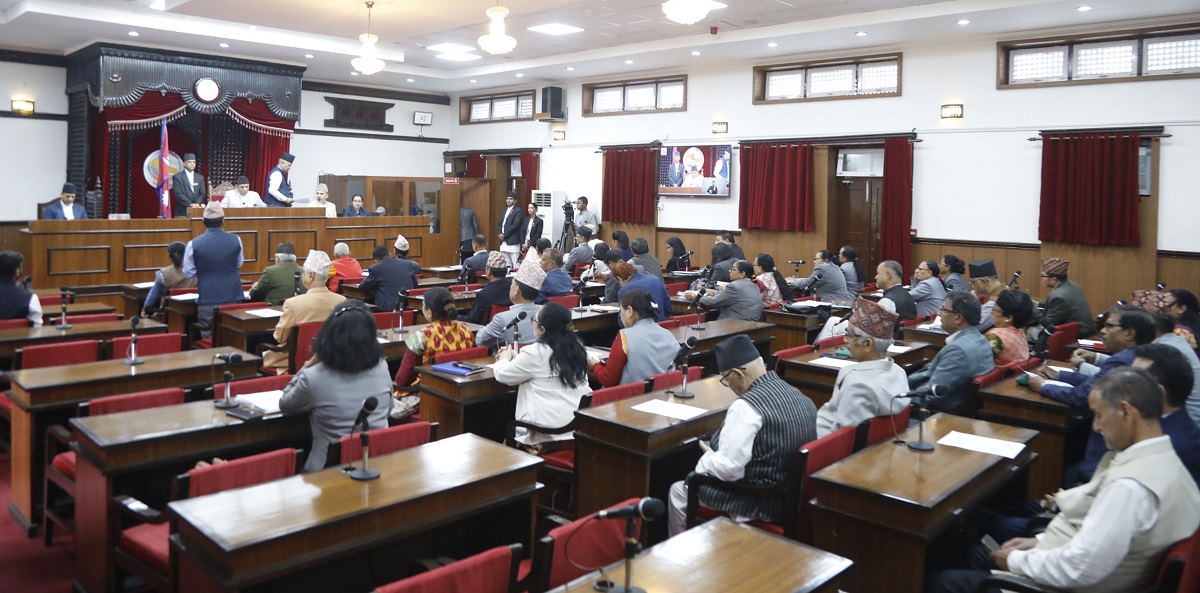
KATHMANDU: The National Assembly has formed a nine-member parliamentary special committee to study disaster risks, damage and rehabilitation in the Bhotekoshi and Kaligandaki corridors.
At Thursday’s National Assembly meeting, Chairperson Narayan Prasad Dahal announced the formation of the ‘Parliamentary Special Committee for Study and Monitoring of Disasters in the Bhotekoshi and Kaligandaki Corridors’.
The committee members are Krishna Prasad Poudel, Geeta Devkota, Ghanshyam Rijal, Shrikrishna Prasad Adhikari, Samjhana Devkota, Somanath Portel, Pooja Chaudhary and Tul Prasad Bishwakarma. One additional member will be appointed later.
The committee will study and review disaster risk reduction preparedness, loss of life and property, the search for missing and affected people, rescue, relief and compensation, treatment of the injured, management of bodies and the status of rehabilitation in the Bhotekoshi and Kaligandaki corridors.
Its mandate also includes analysing the impacts of climate change and recommending a long-term roadmap for the rehabilitation of affected people, reconstruction of physical infrastructure, risk reduction and climate justice.
The committee will recommend measures for developing and effectively implementing scientific and modern early warning systems and technologies to provide timely information on disaster risks before disasters occur. It will also conduct scientific analysis of the causes, risks and long-term impacts of disasters through consultations with subject experts.
The committee will study appropriate frameworks for cooperation with neighbouring countries affected by disasters, including the exchange of experience, technology, information and resources, as well as opportunities for cooperation in disaster risk reduction, rescue, relief and rehabilitation.
It will also study international mechanisms under which countries that have contributed less to climate change but are more severely affected can receive compensation for loss and damage from countries with higher contributions, as well as the potential legal basis for such arrangements.
The committee has also been tasked with conducting scientific studies based on geological, geographical and climate-related risks to identify locations where new settlements can be established with lower risks of future damage.
The committee will remain in place until the end of Poush 2083. It may formulate necessary procedures, work plans and schedules for its activities and is required to coordinate with the special committee formed by the House of Representatives as necessary.

Comment