




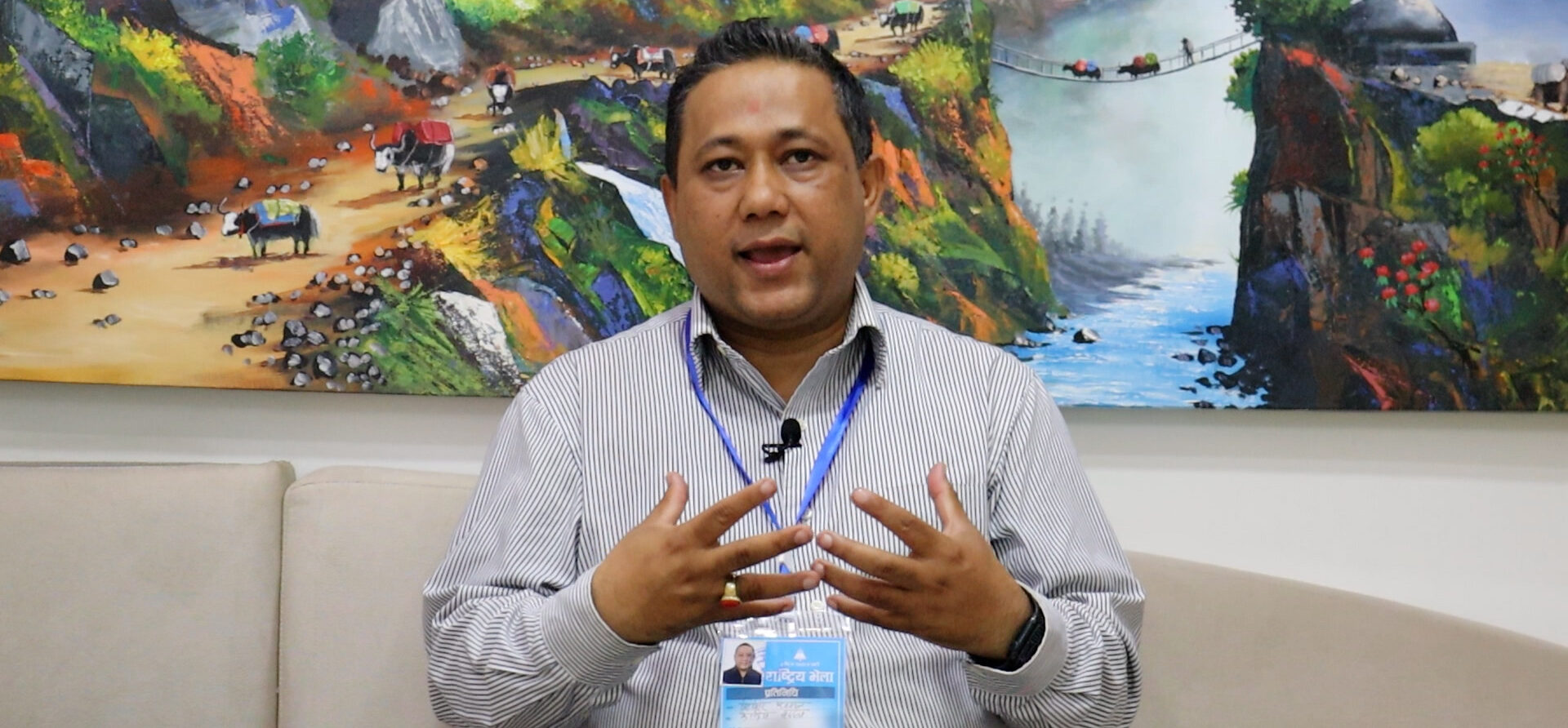
KATHMANDU: A year-long effort to bridge differences within Nepal’s alternative political forces has borne fruit, with Kathmandu Mayor Balendra Shah (Balen) and Rastriya Swatantra Party (RSP) Chair Rabi Lamichhane, including RSP leader Shishir Khanal emerging at the centre of a new political alignment.
Khanal has been appointed the party’s political ambassador to represent the RSP in political dialogues and negotiations. Party Chair Rabi Lamichhane, Vice Chair Dr Swarnim Wagle and other senior leaders who hold strong ideological and factual positions within the party have also expressed confidence in Khanal, who has remained at the forefront of key political decisions.
Khanal said that after Balen’s entry into the RSP, the party’s goal is to secure a parliamentary majority and form a single, stable government. He believes that alternative political forces must unite to address issues related to people’s livelihoods.
Referring to the special political situation that emerged from the Gen-Z uprising, Khanal said that if the RSP fails to bring together alternative forces and the public, the country could face greater instability and traditional parties would continue to dominate the ideological space.
“The leadership of parties that have ruled for a long time has pushed Nepal towards instability,” Khanal said. “To put the country on the path of prosperity, we are working to build a strong political force and a strong party capable of providing a stable government. If governments change every three months, the country cannot move forward. We want to create an alternative political force by using the special opportunity created by the Gen-Z uprising.”
He said he would step aside once the RSP secures a majority. According to Khanal, Balen Shah will become both the prime minister and the parliamentary party leader after the election, and there will be no interference from within the party on this decision. He added that discussions are underway with various alternative forces, including Kulman Ghising, and that the party is currently holding talks with all sides in the first phase.
“Our plan is to unite as many forces as possible within a single party,” Khanal said. “If that is not possible, we can move to the second phase and consider front-level cooperation through an alliance.”
He said discussions are also being held with Madhesi leader CK Raut, the Madhesi Alliance, Nagarik Unmukti Party and Resham Chaudhary, as well as emerging political forces in the Sudurpaschim. Leaders such as Gopi Hamal have shown a positive attitude towards joining the party, and talks are also expected with former Dharan mayor Harka Sampang and others.
After party unification, Chair Rabi Lamichhane and Vice Chair Swarnim Wagle have said that a team including Balendra Shah will campaign nationwide. Khanal expressed confidence that the RSP would secure a majority through the electoral process. “The Nepali people gave a majority to the Nepali Congress and CPN-UML in the 2022 election. There is no reason why it cannot happen again in the upcoming election,” he said.
Khanal shared these views while speaking on prospects of party unity, the consolidation of new political forces, government formation and the agreement with Balen Shah. An edited excerpt of the conversation follows:
You recently met Kathmandu Metropolitan City Mayor Balendra Shah. What is his position in the Rastriya Swatantra Party (RSP)?
He is our leader. His position will be next to the party chair. We will convene a central committee meeting and formally induct him as a central committee member, after which further responsibilities will be assigned.
RSP has made significant efforts to bring alternative forces together. Who are you currently in talks with?
We are in discussions with Resham Chaudhary and other groups representing the Tharu community in western Nepal. Talks are also ongoing with Nagarik Unmukti Party leaders. We are still holding discussions with Kulman Ghising as well. Final negotiations are underway with several individuals and groups associated with the Gen-Z movement. There is strong support from Gen-Z activists.
There are reports that the door is open for cooperation with Kulman Ghising, but that he has sought the post of Prime Minister. Have there also been discussions about changing the party’s election symbol?
So far, the situation remains the same. If cooperation is not finalized by the time the proportional representation closed list is submitted to the Election Commission, we will move toward a different cooperation modality. Efforts are still ongoing.
Discussions are also being held on leadership roles. Based on the needs of the country and the strength of the party, RSP is ready to offer dignified and appropriate positions to all.
Are the talks still ongoing?
Yes, the dialogue is continuing. Even today, we are in constant communication. What is clear is that sooner or later, alternative political forces and leaders with different perspectives will come together.
Are there talks with CK Raut in Madhesh, Gopi Hamal in the Sudurpaschim, and Harka Sampang in the east?
Gopi Hamal is positive. Discussions are ongoing in Madhesh through the Alliance, and talks are also being held with leaders of the five-party alliance there. If formal cooperation is not possible, we remain in overall dialogue with individuals. CK Raut is part of these discussions, and we are also in contact with Harka Sampang in the East, who represents a new political force.
Is the Madhes alliance a new one?
New forces are open to flexible cooperation. Our effort is to bring alternative political forces under a single platform. The plan is two-phased: in the first phase, we aim to form a single party as much as possible. If that is not feasible, cooperation through alliances or fronts will be pursued in the second phase.
Why is there such a push to build a new political force? Is this driven by resentment toward traditional parties?
It is not about revenge. The reality is that parties that have ruled for decades have failed to take Nepal toward the prosperity people aspire to. The country has remained trapped in narrow interests, resulting in chronic instability. Deep structural reforms have been ignored, while governments keep changing within short intervals. This has created widespread frustration in society.
Today, Nepal is in a special political moment shaped by the Gen-Z movement. If we fail to build a strong political force and a strong party capable of providing stable governance and ensuring good governance, the country will continue to suffer. In the current constitutional framework, governments formed through unstable coalitions that collapse every three or six months cannot save the nation.
An alternative political force is now coming together by utilizing the opportunity created by the Gen-Z movement. Balen Shah, Kulman Ghising and we are aligned in this vision. If alternative forces fail to unite at this critical juncture, traditional forces will once again dominate the country and its people.
But can traditional parties really be challenged with new faces and individuals? Do you have organizational strength nationwide?
In the 2079 BS elections, RSP emerged as the fourth-largest party with more than 1.1 million votes. Since then, people have closely observed and appreciated our performance in Parliament. Although our time in government was brief, we worked on service delivery and good governance. Due to the short tenure, results were not visible everywhere, but the intent and direction were clear.
RSP has reached a point where it can emerge as Nepal’s leading political force. Does bringing other forces on board strengthen the party further?
RSP has reached a stage where it can become the country’s number one political force. Bringing other forces together only adds to that strength. This party is not merely a gathering of well-known personalities. It represents a collective of capable individuals who have excelled in their respective fields and are deeply connected to the Nepali people.
However, there is a financial crime case involving the party chair. Is that affecting the party?
We are clear about the issue involving our party chair. Cases were filed with the intention of destabilizing him through legal manipulation, which we see as political vendetta. The matter will be resolved through the courts, and we have clearly stated that we will accept the court’s verdict. The government itself has acted with political bias in this matter. Even today, our party chair has reiterated his respect for the rule of law.
Is it realistic to secure a majority under the current constitution and legal framework?
For this, one only needs to look at the election. At that time, the then Maoist Centre and UML contested under a single election symbol and secured a majority. That was the first election under the current constitution. If it was possible in 2074 BS, why should it not be possible in 2082, especially when voters have already given a clear two-thirds mandate to a single force in the past? RSP can secure a majority and emerge as the leading political force.
Will Chair Rabi Lamichhane and leader Balen Shah campaign nationwide for this?
We are currently focused on commitments and policy preparation. We are working on a clear roadmap to ensure effective delivery through policy reforms if we form the government. We are preparing at least 50 key decisions that can be implemented immediately. Party leader Balen Shah, who has recently joined the party’s political campaign, along with Dr Swarnim Wagle and other leaders, will campaign across the country.
Is the plan to make Balendra Shah prime minister merely a temporary or tactical agreement?
Not at all. This was a collective decision taken unanimously by the party’s top leadership. If RSP secures a majority, Balendra Shah will become prime minister. Rabi Lamichhane and Dr. Swarnim Wagle will lead the party organisation. There is no confusion on this. Balen Shah will be the parliamentary party leader after the election. We are confident of securing a majority and are working honestly toward that goal.
If other RSP leaders object, could that create controversy?
No. We have already moved beyond that stage. There is no such issue within the party.
If Kulman Ghising joins RSP, would he also demand the post of Prime Minister?
That is not possible. The prime ministerial position is already decided. However, other responsibilities can be discussed based on mutual understanding. That said, the party is firm that after the election, Balendra Shah will be the parliamentary party leader and prime minister.
From where will Balen Shah contest the election?
That has not been finalised yet. He is comfortable contesting from any constituency.
How will candidates be selected?
This responsibility has been entrusted to two leaders, Rabi Lamichhane and Balen Shah. They will finalize candidates who are competent, credible and free from controversy. Together, they will select leaders who uphold the party’s principles and organisational discipline.
Has Prime Minister Sushila Karki provided any support to RSP?
There has been no formal support. If that were the case, we would have seen corrective action regarding the politically motivated case against Party Chair Rabi Lamichhane within the government’s executive authority. So far, no such decision has been taken. Any perception of support is speculative. We have not experienced it directly.
Do you think the election will be held on March 5, 2026?
Judging by the preparations, it appears likely. Elections are the proper democratic way to resolve the country’s current political situation. I urge everyone to ensure that the election is conducted peacefully.


Comment