




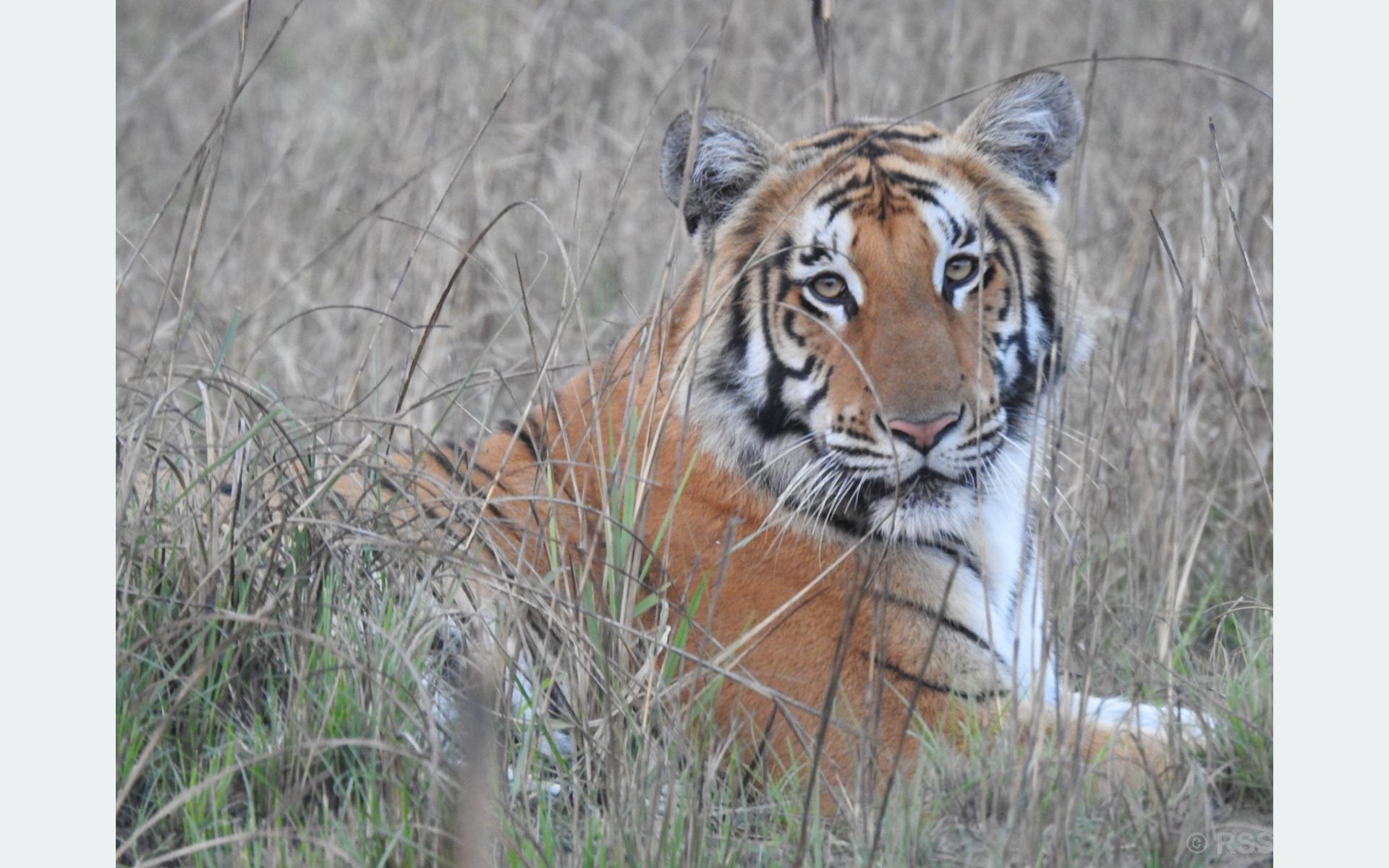
KANCHANPUR: Shuklaphanta National Park, located in the Sudurpaschim Province of Nepal, has become increasingly renowned as a thriving habitat for (striped) Bengal tigers.
Despite covering a relatively small area of just 305 square kilometers, the park is now home to 44 tigers—a remarkable density considering its size.
According to Purushottam Wagle, the park’s information officer, the tiger population has steadily increased over the years due to sufficient prey availability and effective habitat management. In 2013, the park recorded 17 tigers, which grew to 16 in 2018, 19 in 2021, and 36 in 2022.
As per the latest camera trap-based census, the number has reached 44, including 24 males, 17 females, and 3 additional tigers identified through data analysis.
“There is a high density of tigers even in a compact area because Shuklaphanta provides a highly suitable environment with ample food and water,” said Wagle. “The park has more than 100 natural and artificial lakes, well-maintained core zones, and effective conservation practices, all of which have contributed to this growth.”
The park is also enriched with grasslands, rivers such as the Chaudhar, Syali, and Mahakali, and water bodies like Ranital and Sikari Lake. These not only enhance biodiversity but ensure year-round water access for wildlife.
The primary prey for tigers in Shuklaphanta includes bison, chital (spotted deer), and wild boar, with the park currently supporting over 2,300 bison and 44 tiger cubs.
Despite its ecological richness and increasing tiger population, Shuklaphanta National Park has not yet attracted significant tourist attention. Wagle attributes this to inadequate publicity, poor infrastructure, and a lack of private sector investment.
“Although Shuklaphanta has enormous potential as a tourist destination, particularly for Indian visitors due to its proximity to the border, logistical challenges and high airfares continue to hinder growth,” he said.
He further pointed out that while some international tourists do arrive to experience the park’s pristine nature, the absence of structured tour packages and equitable airfare policies has limited tourism.
“Tourists often return from Kathmandu, Pokhara, or Chitwan instead of coming here,” Wagle explained. “We need better infrastructure, targeted tour packages, and greater investment from the private sector to unlock the park’s full potential.”
With its vast grasslands—considered among the largest in Asia—and a flourishing population of rare wildlife, Shuklaphanta remains a hidden gem with immense promise for eco-tourism and conservation success.






Comment