




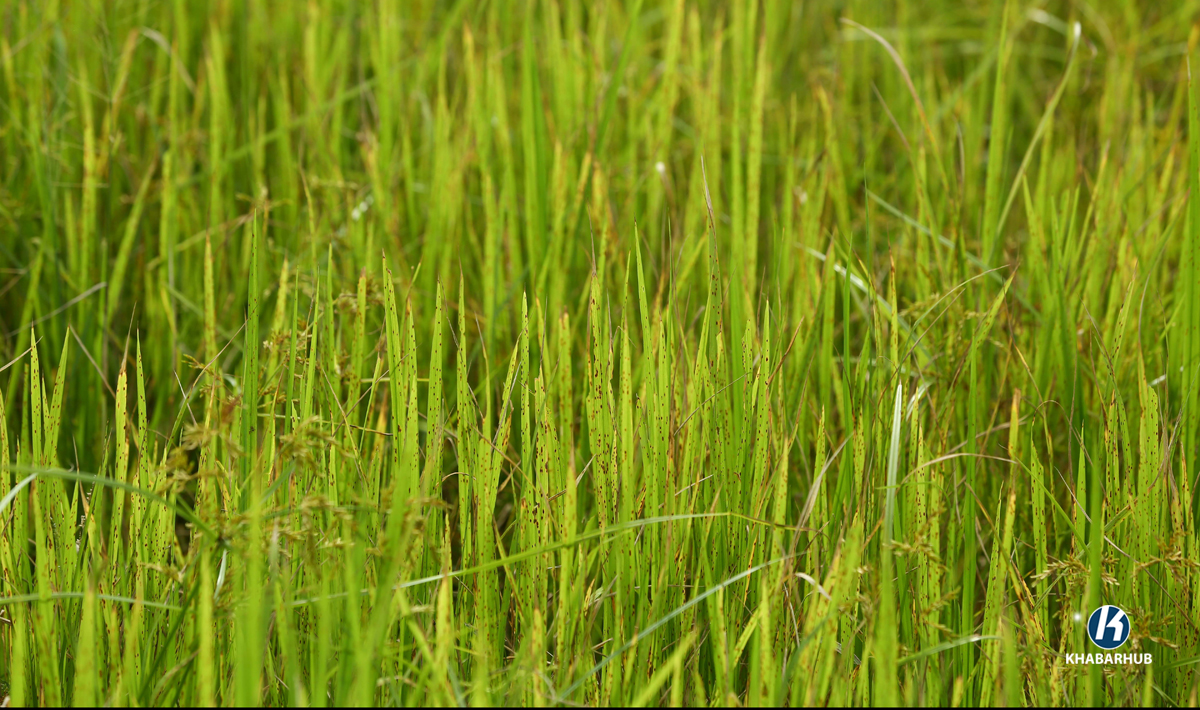
KANCHANPUR: The indigenous Anadi rice, renowned for its rich flavor and deep cultural value, is facing extinction in Kanchanpur as farmers increasingly shift to high-yield hybrid and improved rice varieties.
Dhan Bahadur Chaudhary, a farmer from Simalfant, still recalls the unforgettable taste of beaten rice made from Anadi paddy. “When I was young, we roasted Anadi rice over the fire and pounded it to make chiura. It was delicious, I used to fill my pocket with it on the way to school,” he reminisced. “Now, it’s almost impossible to find this variety.”
He said farmers have abandoned the crop, drawn to hybrid varieties that offer higher yields. “In the Tharu community, bread offered to deities during the Atwari festival was made from Anadi rice flour,” said resident Paradesi Dagoura, adding that the variety was also popular for making misoula, chiura, roti, and traditional liquor due to its unique flavor. “It’s now extremely difficult to even find its seeds,” he lamented.
According to Ram Prasad Chaudhary of Jonapur, Anadi rice can thrive in dry conditions with limited water, making it potentially valuable in the face of climate change. “If we can preserve its seeds, it could serve as an ideal crop even under today’s climatic challenges,” he said.
Farmer Ramkisan Rana shared that Anadi used to be planted in every household in small plots, but the spread of hybrid rice has pushed it to near disappearance. Alongside Anadi, other local rice varieties such as Nimai, Simtari, Raimanuwa, Anjana, Mansuli, Thapachini, and Chaina are also fading away.
Farmers say these traditional varieties are better adapted to local soil and climate, offering stable yields, superior taste, and high ecological value. Agricultural leader Paltu Dagoura noted that incorporating native varieties in new rice breeding programs could enhance both productivity and environmental resilience.
Lal Bahadur Dhami, chief of the agriculture division at Krishnapur Municipality, warned that the growing shift toward market-oriented and high-production farming has displaced traditional seeds. “This not only threatens biodiversity but also undermines our traditional food culture,” he said, calling for coordinated efforts among local governments, research centers, and communities to collect, preserve, and reintroduce native rice varieties like Anadi.






Comment