




Terrorism has multiple definitions, leading to varied responses worldwide. Whether it is the 9/11 terrorist attack on the Twin Towers in New York, the recent Pahalgam attack, or the war against Iran’s proxies—including Operation Midnight Hammer, the U.S.’s offensive in the Iran-Israel conflict—actions taken to defend national interests may be considered terrorism by some and acts of freedom by others.
The U.S. reaction to the 9/11 attacks was comprehensive, involving military operations, domestic security enhancements, and the launch of the broader “War on Terror.”
The immediate response included security reinforcement and rescue efforts, while the longer-term strategy involved the establishment of the Department of Homeland Security, enactment of the Patriot Act, and military interventions in Afghanistan and Iraq.
This global coalition marked a new and distinct kind of war. President George W. Bush’s policy signaled that any country harboring or supporting terrorists would be considered hostile, fostering an international alliance against terrorism.
Over 80 countries suffered losses on September 11, 2001, with more than 136 nations providing various forms of military assistance and 46 multilateral organizations expressing support—all under U.S. leadership and international cooperation.
Terrorism is no longer viewed solely as a bilateral issue between India and Pakistan. The recent ceasefire was achieved through global diplomacy, and lasting peace in the region demands both global consensus and regional accord.
In contrast, the terrorist attack in Pahalgam, while comparable in its nature, prompted a different international response. It triggered ‘Operation Sindoor’ and a shift in India’s doctrinal approach.
The global reaction was largely characterized by calls for restraint rather than collective action. While most major powers and regional players condemned the attack and expressed solidarity with India, none explicitly accused or blamed Pakistan for cross-border terrorism.
Countries such as France, Israel, Russia, the U.S., Greece, the Netherlands, and Singapore offered unconditional support to India, aligning with its narrative. Conversely, many nations in the Global South issued generic condemnations without naming the perpetrators or chose to remain silent.
Terrorism in South Asia remains an ongoing challenge, demanding new approaches. All six South Asian countries—Afghanistan, Bangladesh, Bhutan, Maldives, Nepal, and Sri Lanka—condemned the attack and expressed solidarity, yet a unified regional strategy remains elusive.
Nonetheless, opportunities for collective efforts exist, such as joint military exercises and intelligence sharing, as demonstrated by Nepal and India. Pakistan also condemned the attack but strongly denied allegations of supporting cross-border terrorism.
The reactions to the Pahalgam attack highlight several trends. Firstly, the firm support from key nations for India’s anti-terrorism efforts reflects India’s growing stature in international diplomacy and indicates an international shift toward supporting India’s security priorities.
Secondly, de-escalation and renewed dialogue are critical for peace between India and Pakistan. The lack of sustained engagement to foster lasting peace and stability in the region is a complex issue rooted in historical conflicts, mistrust, and unresolved disputes.
However, the reluctance of many countries—despite credible evidence—to explicitly name Pakistan underscores ongoing diplomatic challenges, particularly in engaging the Global South. Lastly, key nations—particularly the U.S.—continue to engage with Pakistan as a strategic maneuver against rival China, drawing a parallel to its role as a U.S. ally against the Soviet Union during the Cold War.
India has acted decisively to prevent future incidents, suspending ‘Operation Sindoor.’ Pakistan has warned India that any move to restrict water into the country would be considered “an act of war.” The conflict persists, with neither New Delhi nor Islamabad positioned for decisive victory.
India’s strategic and doctrinal shift, along with Pakistan’s denial of terrorist affiliations, has momentarily paused the war, allowing space for diplomatic maneuvering.
Terrorism is no longer viewed solely as a bilateral issue between India and Pakistan. The recent ceasefire was achieved through global diplomacy, and lasting peace in the region demands both global consensus and regional accord.
Geopolitical Shifts and the New World Order
Global trends present a complex picture. The number of countries experiencing terrorist incidents rose from 58 in 2023 to 66 in 2024, the highest since 2018. Terrorism persists despite a decline in overall attacks. Five key considerations shape the evolving geostrategic landscape in South Asia, with direct implications for counterterrorism efforts:
Firstly, the global priority is shifting from Europe to Asia. A notable geopolitical transition is underway, with China and India—emerging economic powers—playing central roles in regional dynamics.
Secondly, national interests are increasingly prioritized over international principles. Although global norms are widely endorsed, strategic and security concerns often override these commitments.
Thirdly, warfare is evolving rapidly. Modern conflicts are increasingly technology-driven. For instance, on September 17–18, 2024, thousands of handheld pagers and hundreds of walkie-talkies intended for Hezbollah were simultaneously detonated in Lebanon and Syria during Israel’s Operation Grim Beeper.
Similarly, Ukraine’s large-scale drone offensive Spider’s Web on June 1, 2024, destroyed at least 40 Russian warplanes—around 34% of its strategic cruise missile carriers.
Fourth, non-state actors and proxy forces are playing a more prominent role. Military support is increasingly extended to these groups—such as Iran’s backing of Hamas, Hezbollah, and the Houthis. Likewise, India, the U.S., and the UN have accused Pakistan of harboring groups such as Lashkar-e-Taiba (LeT), Hizb-ul-Mujahideen (HuM), and Jaish-e-Mohammed (JeM).
Lastly, Pakistan’s Defense Minister Khawaja Asif denied his country’s involvement in the recent attack, claiming it was carried out by a homegrown insurgent group. He suggested the attacks might have been orchestrated by India or were part of a false flag operation.
Globally, the fight against terrorism is increasingly influenced by five realities: the pivot to Asia; the prioritization of national interest over global norms; the rise of technological warfare; the empowerment of non-state actors; and the ambiguous roles of states with histories of covert operations.
Asif questioned the credibility of The Resistance Front (TRF), asserting the group no longer exists. In an interview with Sky News, Asif acknowledged Pakistan’s historical support for militant groups, admitting the country had “done the dirty work” for the U.S. and Western powers, including Britain, over the past three decades.
Global Diplomatic Competition
India’s strategic and doctrinal shift, along with Pakistan’s denial of terrorist affiliations, has momentarily paused the war, allowing space for diplomatic maneuvering.
The longstanding Kashmir issue has shifted from potential armed conflict to a diplomatic offensive aimed at shaping global opinion.
Prime Minister Shahbaz Sharif’s recent visits to Azerbaijan, Iran, Tajikistan, and Turkey represent a significant diplomatic effort to strengthen regional partnerships and demonstrate Pakistan’s commitment to peace, cooperation, and friendship.
Islamabad is not isolated; it is supported by natural, strategic, and spiritual allies who value peace and shared purpose. These engagements have reinforced bilateral trust, improved political understanding, and expanded cooperation in trade, defense, energy, culture, and regional integration. Azerbaijan and Turkey condemned India’s military actions and emphasized the need for diplomatic resolution.
New Delhi, in turn, launched a global diplomatic campaign to counter Pakistan-sponsored terrorism. This included delegations from seven multiparty coalitions, five political parties, seven states, and representatives of three religions, totaling 59 parliamentary members.
These delegations visited 31 countries and the European Union, carrying a unified message of national resolve and a principled stance against terrorism.
Conclusion
The regional and international response to terrorism in South Asia reveals a fragmented global consensus. While key powers openly align with India, much of the Global South remains non-committal—avoiding direct accusations against Pakistan despite mounting evidence.
This duality underscores the persistent challenge of forming a united regional and global front against terrorism, especially when national interests and geopolitical alignments outweigh principled stances.
The evolving nature of terrorism and counterterrorism in South Asia reflects broader transformations in global geopolitics, diplomacy, and military strategy.
For true peace and stability, South Asia needs more than temporary truces or bilateral deals. It requires a multilateral security framework built on trust, transparency, and cooperation.
While the U.S. post-9/11 “War on Terror” set the precedent for global military coalitions, South Asia’s response—particularly in the context of the Pahalgam attack and Operation Sindoor—represents a unique regional paradigm defined by asymmetric threats, diplomatic complexity, and shifting alliances.
Globally, the fight against terrorism is increasingly influenced by five realities: the pivot to Asia; the prioritization of national interest over global norms; the rise of technological warfare; the empowerment of non-state actors; and the ambiguous roles of states with histories of covert operations.
These factors have elevated terrorism from a localized threat to a global strategic instrument used by both state and non-state actors.
The international community’s reluctance to identify and hold state sponsors of terrorism accountable reflects diplomatic caution and the deeper structural limitations of the global order.
Cold War-era dynamics—such as U.S. engagement with Pakistan as a buffer against China—continue to influence present decisions, keeping long-term peace and justice hostage to short-term strategic considerations.
South Asia’s war on terrorism has moved beyond the India-Pakistan binary. It is now embedded within wider global shifts, including realigned alliances, technological weaponization, and narrative battles.
The recent ceasefire, though fragile, affirms the critical role of global diplomacy. It is a pause—not an end—to a conflict driven by history, ideology, and strategic competition.
For true peace and stability, South Asia needs more than temporary truces or bilateral deals. It requires a multilateral security framework built on trust, transparency, and cooperation.
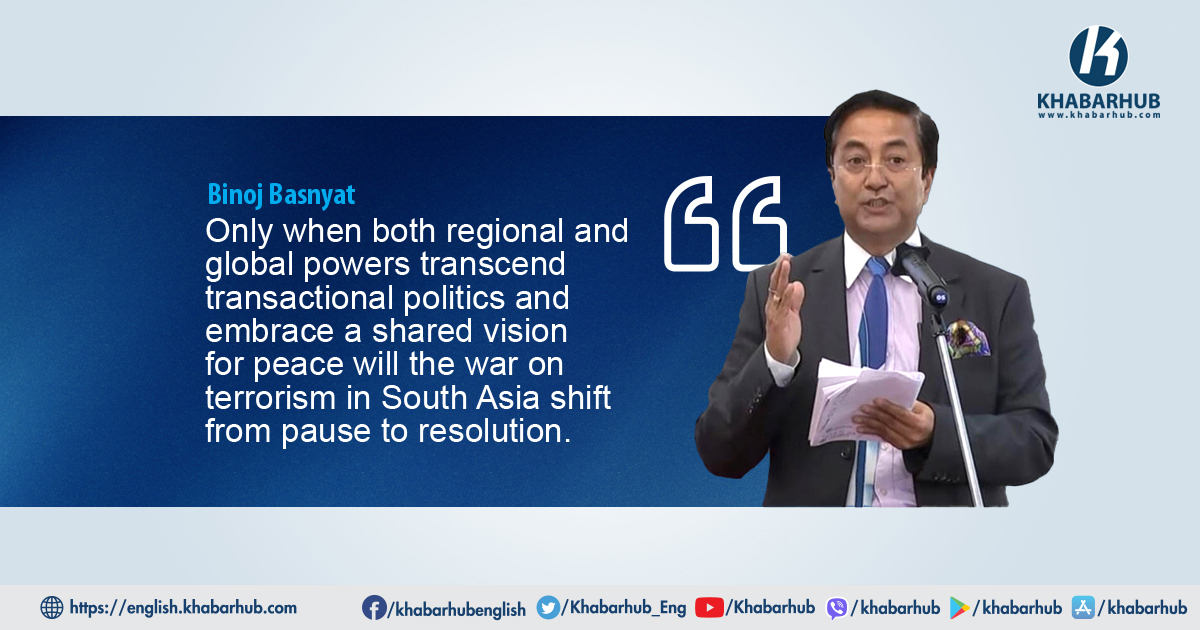
Only when both regional and global powers transcend transactional politics and embrace a shared vision for peace will the war on terrorism in South Asia shift from pause to resolution. Until then, diplomacy remains the battleground—and global opinion, the ultimate terrain of influence.
(The author is a Strategic Analyst, Major General (Retd) of the Nepali Army, and is associated with Rangsit University, Thailand.)
(Views expressed in this opinion are the writer’s and do not necessarily reflect the editorial stance of Khabarhub)




Comment