




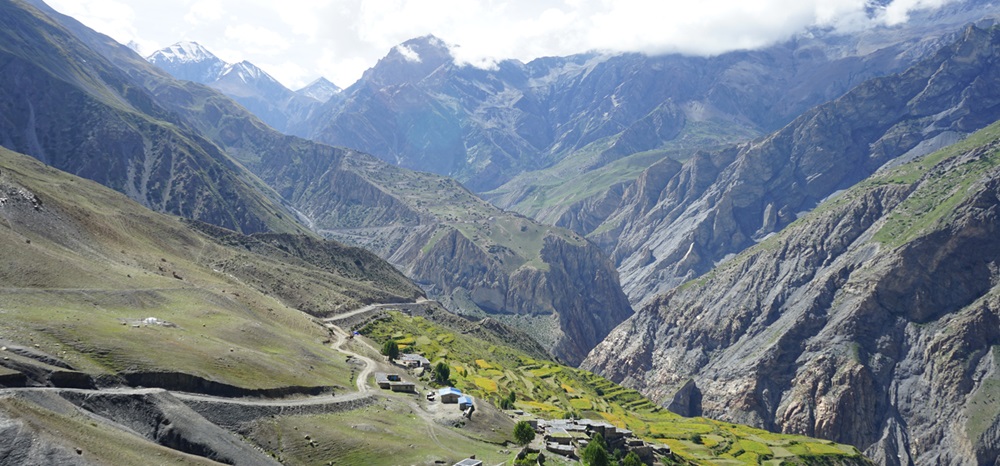
MUSTANG: Water sources in Mustang, a trans-Himalayan district in Gandaki Province, are gradually depleting, posing significant challenges for farmers who rely on water for both livestock and agriculture.
Locals attribute the diminishing water supply to rising temperatures in recent years, which they believe are a result of climate change. This shift has led to a noticeable decline in local water resources.
At recent meetings in Gharapjhong and Waragung Muktikshetra rural municipalities, residents expressed growing concerns over the dwindling water sources, which are adversely affecting agricultural practices and livestock farming.
Deepak Sherchan, a representative from the Local Water Consumers Committee in Jomsom, highlighted that the growing water shortage is directly tied to the depletion of natural water sources.
“On one hand, the natural water sources are vanishing, while on the other, the number of households in Jomsom is increasing. It has become increasingly difficult to meet the water demands for household use, animals, and farming,” Sherchan said, urging authorities to explore alternative solutions to address the crisis.
One farmer lamented, “Apple farming yields a good crop one year, but production drops drastically the next,” emphasizing the unpredictable nature of water scarcity’s impact.
A cattle farmer from Gharapjhong pointed out that the lack of snowfall in Mustang’s highlands has hindered vegetation growth, significantly impacting yak rearing. Furthermore, with vegetation in the highlands scarce, wildlife has begun descending into human settlements in search of food, raising additional concerns.
Although three glacial sources supply drinking water to Jomsom Bazaar, Sherchan noted that these sources are depleting due to the effects of climate change. Despite the water sources in Kungle Hill and Thini being sufficient to provide drinking water to Jomsom Market, there is still a shortage due to the drying up of snow-fed sources.
“The demand for drinking water is high, especially as Jomsom is a commercial hub,” he said, adding, “Since the water sources are depleting, it is crucial to explore long-term solutions and alternative possibilities.”
Rajendra Sherchan, a farmer from Gharapjhong-4, explained that snowfall, which traditionally occurs during the apple and other indigenous crop harvest seasons, has stopped. The lack of favorable weather and unseasonal snowfall has led to a decrease in crop production and quality. The rise in temperature has also caused various diseases to affect the crops, further diminishing yields.






Comment