




The announcement of an interim government in Nepal, filled with the challenges of restoring democratic legitimacy, marks a defining moment in the country’s democratic journey—toward either reform or regression. It comes amid clear warnings repeated time and again, with signals knocking at the doors of both party leaders and the government.
The unprecedented nationwide “natural unscripted uprising with a Nepali pulse” took place on 8th September, when the nation stood divided amid a widening trust deficit between citizens and political elites, the politicization of instruments and tools of the government, political instability, institutionalized corruption, inefficient governance, gaps in governance architecture, and the generational demands of a restless youth population.
National strategic challenges had long been raised by intellectuals, think tanks, and through repeated protests, but decrypting the message in the noise is essential—because Nepal today lies at a crossroads. The moment of reckoning, regional warnings, and the road to a democratic reset present an opportunity, but time is limited.
Nepal’s challenge is not only about managing the immediate political transition but also about reimagining governance to ensure legitimacy, accountability, and stability.
To be credible, the interim administration must deliver on four interlocking strategic objectives: ensuring free, fair, and inclusive elections that uphold the electoral rights of all Nepalis; amending the constitution to consider a directly elected head of government; launching an anti-corruption drive to address bad governance; and pursuing accountability through the commission already formed to investigate the excessive use of force during peaceful protests impacting human rights.
These goals are ambitious, but if navigated carefully, they can lay the foundation for a more resilient political order. To understand what lies ahead, Nepal can draw both warnings and inspiration from the experiences of Bangladesh and Sri Lanka.
The interim government’s task, therefore, is not just to maintain order until elections, but to build consensus and draft reforms that the next parliament cannot ignore. Consensus, inclusivity, and transparency will determine whether this moment is remembered as a bridge to renewal—or merely a pause in the cycle of crisis.
Yet Nepal’s biggest challenge lies in the constitutional dimension, because Parliament—legally required to amend the constitution—has been dissolved. Without a Parliament, even well-intentioned reform faces a legal impasse. Nepal must therefore chart a path by bridging the abyss in a way that combines legitimacy, consensus, and legal validity—symbolically and substantively.
Bangladesh: The Caretaker Dilemma
Bangladesh’s history offers a cautionary tale. The idea of an interim government—often referred to in local discourse as a caretaker government—has been central to the debate around fair elections and political stability.
The challenge in Bangladesh lies not just in addressing protest demands, but in creating an environment where peaceful assembly, negotiation, and dissent are respected. Without legal reforms, political tolerance, and institutional accountability, protests will continue to be seen as threats rather than expressions of democratic rights.
Constitutional legitimacy requires amendment or exceptional justification. Political polarization occurs with no consensus between major parties. The risk of military influence endangers the country with the threat of extra-constitutional takeover. Administrative neutrality is difficult to achieve with truly non-partisan officials. Public and international scrutiny increases the risk of unrest or diplomatic backlash. The limitations of time and mandate mean that deep reforms or complex demands may not be addressed, and managing expectations and unrest may fail to calm protesters or opposition.
From 1996 to 2008, caretaker administrations oversaw elections. Initially, they restored trust and allowed freer contests, but over time, political manipulation eroded neutrality. The caretaker government of 2006–2008, backed by the military, overreached its mandate, restricted dissent, and ultimately paved the way for authoritarian consolidation under a powerful executive.
For Nepal, the lesson is clear: an interim government must be transparent, time-bound, and resistant to partisan capture. Its legitimacy depends on avoiding the temptation of permanence or political overreach.
Unlike Bangladesh, where the caretaker model was abolished after accusations of politicization, Nepal must ensure its interim structure is insulated from partisan capture and designed solely to deliver on its defined objectives.
Sri Lanka: Crisis and Reform Fatigue
Sri Lanka’s 2022 crisis, triggered by economic collapse and massive public protests, resonates with Nepal’s current situation. Sri Lanka’s interim administration, which replaced the Rajapaksa regime, promised reform but soon fell into the trap of elite compromise.
While immediate political stability was restored, deeper structural reforms—particularly on corruption, accountability, and governance—remained elusive. As a result, the underlying discontent among citizens persists.
Nepal must not repeat this cycle of reform fatigue. A purely transitional arrangement without bold institutional action risks postponing, rather than resolving, systemic crises. Sri Lanka shows that interim governments may stabilize the streets but lose credibility if they fail to tackle root causes such as corruption, elite impunity, and constitutional flaws.
Nepal’s Four Strategic Objectives
Nepal lies at the edge—with interim leadership under scrutiny and the test of democratic commitment demanding direct and serious approaches. The interim government arrangement is an architecture for democratic stability. From crisis to constitution, reform measures now call on all stakeholders to reckon with accountability, reform, and the future.
- Elections with Full Electoral Rights
Free, fair, and timely elections are the cornerstone of legitimacy. The interim government must prioritize universal voter registration—including provisions for Nepalis abroad—and safeguard electoral processes from political interference. Technology-driven reforms such as digital voter rolls, transparent vote counting, and independent monitoring can help restore trust.
Elections, however, cannot simply be symbolic exercises. They must be perceived as credible by citizens, political parties, and external observers alike. Without this, the interim experiment risks deepening cynicism rather than healing it.
- Constitutional Amendments for a Directly Elected Executive
Nepal’s parliamentary model has delivered chronic instability—frequent government collapses, fragile coalitions, and decision-making gridlock. The growing demand for a directly elected head of government reflects public frustration with this dysfunction.
The interim government must therefore facilitate an inclusive debate on constitutional reform. A shift to a directly elected executive could bring stability, but it also carries risks of power centralization. Bangladesh’s authoritarian drift under a strong executive serves as a stark warning.
For Nepal, the path forward must include strong safeguards—strict term limits, judicial oversight, federal balance, and institutional checks—to prevent any slide toward personal rule.
- Governance and Anti-Corruption Drive
Corruption is perhaps the most corrosive factor in Nepal’s political system. It has weakened institutions, fueled public anger, and undermined both domestic and foreign investment confidence. The interim government has already formed a commission to investigate corruption and governance failures, but its credibility will depend on independence and enforcement power.
Unlike Sri Lanka, where anti-corruption efforts were diluted by elite resistance, Nepal must ensure that its commission is not merely symbolic. Key reforms could include:
Transparent procurement laws, particularly in infrastructure and energy;
Tracing illicit capital flight and offshore accounts;
Empowering watchdog agencies and ensuring judicial follow-through;
Encouraging whistleblower protections and citizen reporting mechanisms.
A high-profile case prosecuted swiftly could signal seriousness and shift public perception—much like Indonesia’s Anti-Corruption Commission (KPK) did in its early years.
- Accountability for Excessive Use of Force
Protesters have demanded justice for state violence—particularly the excessive use of force during peaceful demonstrations by Generation Z. The commission formed to investigate such incidents must deliver timely and transparent findings, and recommend prosecutions where appropriate. Anything less risks alienating the very youth whose trust the government seeks to restore.
Here, Bangladesh’s failure is instructive. Repeated protest crackdowns without credible investigation have left deep scars on its political legitimacy. Nepal must do better—by holding security forces accountable, institutionalizing rules of engagement, and ensuring security sector reforms that protect civil rights while maintaining order.
The Constitutional Challenge
The most difficult objective is constitutional reform. Parliament—the only body legally empowered to amend the constitution—has already been dissolved. This creates a paradox: the interim government’s mandate includes reform, yet it lacks the institutional channel to deliver it.
A New Approach to Strategy: Possible Ways Forward
As Nepal faces a deepening political impasse, driven by growing public unrest, electoral mistrust, and an increasingly polarized political climate, a new approach is urgently needed. Traditional confrontational tactics have yielded little lasting progress.
The country now stands at a critical crossroads. To break the cycle of crisis and mistrust, strategic alternatives must be explored—ones that balance immediate political needs with long-term democratic reforms.
- National Consensus Dialogue
Initiating a multi-party dialogue—including civil society and protest leaders—could produce a consensus document on reforms, binding the next parliament. - Interim Constitutional Assembly (ICA)
A temporary assembly or commission, formed by political consensus, could draft proposed amendments. These would not take immediate legal effect but could be introduced in the next parliament as its first legislative priority. This echoes Nepal’s past experience with constituent assemblies, which eventually produced the 2015 Constitution. - Limited Referendum
A bold nationwide vote on key constitutional reforms would give strong public legitimacy. This would directly engage citizens and give a clear mandate to the next parliament to implement the outcome. However, this approach risks oversimplifying complex constitutional questions and must rest on absolute political consensus to avoid further polarization. - Presidential Ordinance with Reconciliation Framework
Amid political gridlock, constitutional amendments could be advanced by government recommendations and formally endorsed as a presidential ordinance. While this mechanism allows urgent reforms without waiting for prolonged parliamentary consensus, it must be rooted in reconciliation—ensuring no major political or social force feels excluded.
A reconciliation-oriented ordinance framework could bridge divides, balance competing demands, and uphold the spirit of the constitution while enabling timely reforms essential for democratic stability.
The test for Nepal’s leaders is whether they will seize this moment to restore credibility and reimagine governance—or whether they will allow history to repeat itself. For a country at the crossroads with a constitutional dilemma, the choice is not just political—it is existential. Therefore, no parliament is no excuse: Nepal’s constitutional challenge and the imperative of reform remain.
While some approaches carry greater risk or complexity than others, perhaps the most pragmatic path is to prioritize clean elections, while simultaneously negotiating a post-election amendment pact. All stakeholders could sign a pre-election commitment to pursue agreed reforms immediately upon the new parliament’s formation. This ensures constitutional propriety while maintaining reform momentum. These various pathways offer hope for a more stable and inclusive political future.
A Unified Strategic Roadmap
Unlike Bangladesh and Sri Lanka, where interim arrangements faltered by treating reforms as piecemeal or postponable, Nepal’s interim government cannot afford incrementalism. Its credibility hinges on achieving all four objectives—elections, constitutional reform, anti-corruption, and accountability—simultaneously, through political consensus and constitutional mechanisms, such as roundtable discussions with all stakeholders.
Elections without reform risk recycling instability; reform without accountability risks empowering new elites without addressing past abuses.
The interim government’s task, therefore, is not just to maintain order until elections, but to build consensus and draft reforms that the next parliament cannot ignore. Consensus, inclusivity, and transparency will determine whether this moment is remembered as a bridge to renewal—or merely a pause in the cycle of crisis.
This means that elections, constitutional reform, governance, and accountability must advance together as interdependent pillars of renewal. Elections without reform may recycle instability; constitutional changes without accountability may empower new elites without addressing past abuses; an anti-corruption drive without political consensus risks becoming selective justice. Only a comprehensive approach can restore faith in the state.
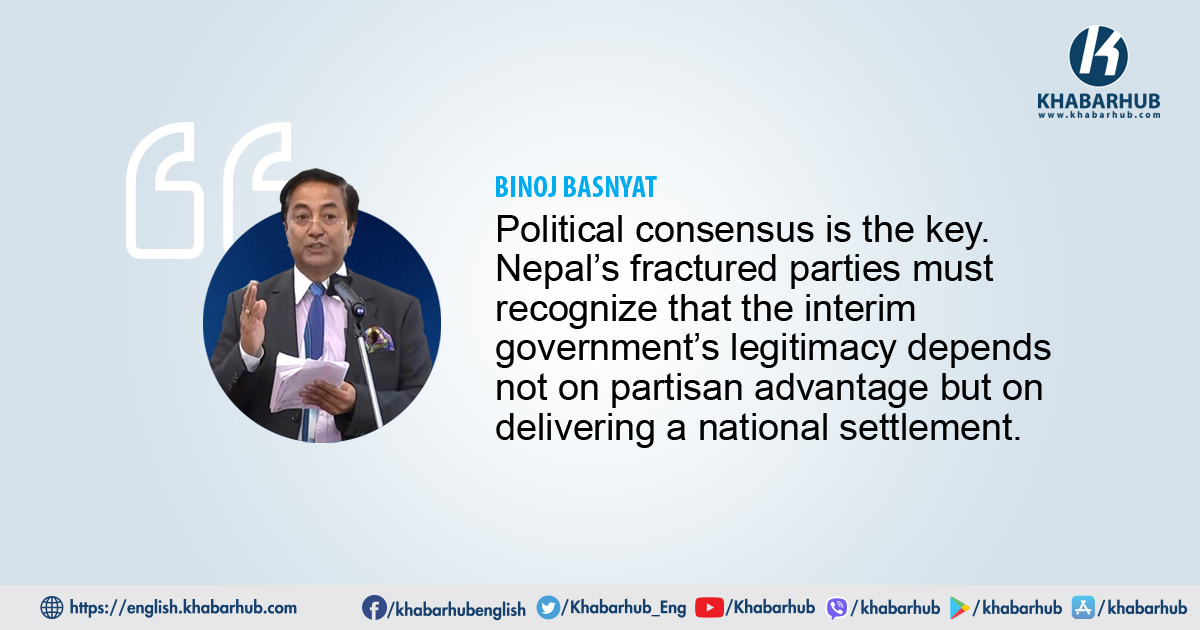
Political consensus is key. Nepal’s fractured parties must recognize that the interim government’s legitimacy depends not on partisan advantage but on delivering a national settlement. This requires compromise, inclusive dialogue, and even bold constitutional amendments to respond to citizens’ demands for direct representation, accountability, and cleaner governance.
Conclusion: A Bridge, Not a Bargain
Nepal’s interim government must avoid the strategic trap of being viewed as a political bargain among elites. Instead, it should act as a bridge to a more accountable democratic nation. The four objectives—elections, reform, governance, and accountability—are not sequential steps, but simultaneous imperatives that demand national harmony.
Bangladesh warns of politicized caretaker arrangements. Sri Lanka shows the perils of reform fatigue. Nepal now has a chance to chart its own path—one where an interim phase becomes the foundation for genuine transformation.
The greatest challenge will be resolving the constitutional dilemma: delivering reform without a parliament. If Nepal can use this interim period to forge consensus and bind future parliaments to act, it can turn crisis into opportunity. If not, the interim government risks becoming little more than a pause button in Nepal’s long struggle for stability.
The test for Nepal’s leaders is whether they will seize this moment to restore credibility and reimagine governance—or whether they will allow history to repeat itself. For a country at the crossroads with a constitutional dilemma, the choice is not just political—it is existential. Therefore, no parliament is no excuse: Nepal’s constitutional challenge and the imperative of reform remain.
(Basnyat, a Major General (Retd) of the Nepali Army, is a strategic analyst and is associated with Rangsit University, Thailand)





Comment