




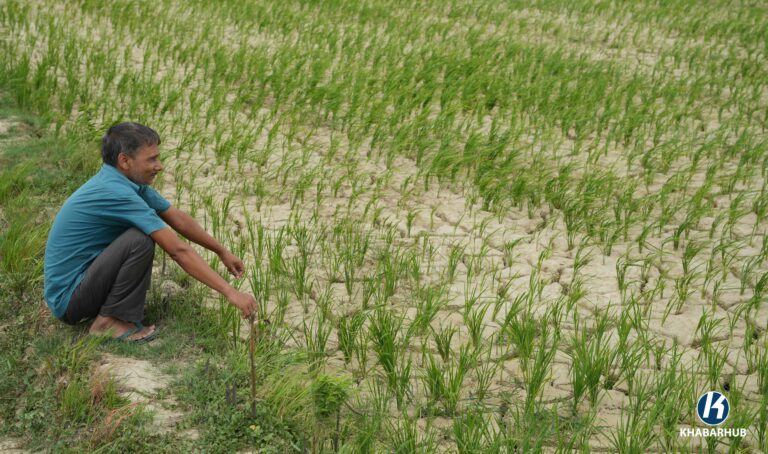
MAHOTTARI: The failure of monsoon rains to arrive on time has severely disrupted paddy transplantation in Nepal’s Madhesh Province, often referred to as the country’s “grain basket.”
According to the Ministry of Land Management, Agriculture and Cooperatives of Madhesh Province, only 47 percent of paddy planting has been completed so far this season, far below the normal levels expected by this time of year.
Mahottari district, one of the hardest-hit areas, has reported only 30 percent transplantation. Farmers are increasingly worried as dry fields, parched paddy seedbeds, and widening cracks in semi-transplanted plots indicate the scale of the damage.
Mahottari has approximately 71,570 hectares of cultivable land, with 64,977 hectares typically used for seasonal farming. While some farmers in the northwestern belt have managed to irrigate their fields using diesel pumps, river water, and tube wells—achieving up to 25 percent coverage—the overall progress is “unsatisfactory,” local officials say.
Due to prolonged dry spells, even the paddy nurseries are withering, and cracks have started appearing in transplanted fields. “The fields are dry, and even the taps are running empty this year,” said Islam Kawadi, a local farmer in Matihani Municipality. “This year, we might not be able to farm at all.”
Shanti Khatwa, another farmer from the same area, echoed similar concerns: “Only those who could afford diesel pumps were able to transplant paddy. We poor farmers have no choice but to rely on the skies.”
In response to the deepening crisis, the federal government, following a recommendation from the Madhes Province government, has declared the entire province a disaster-affected zone for the next three months.
On Friday, Prime Minister KP Sharma Oli conducted an aerial inspection of drought-affected regions in Madhes, including Mahottari and Bara districts. He is expected to meet with farmers and local officials during his visit.
As irrigation sources dry up and no significant rainfall is in sight, many farmers across the region are left praying for rain or awaiting urgent intervention from the government and local authorities.





Comment