




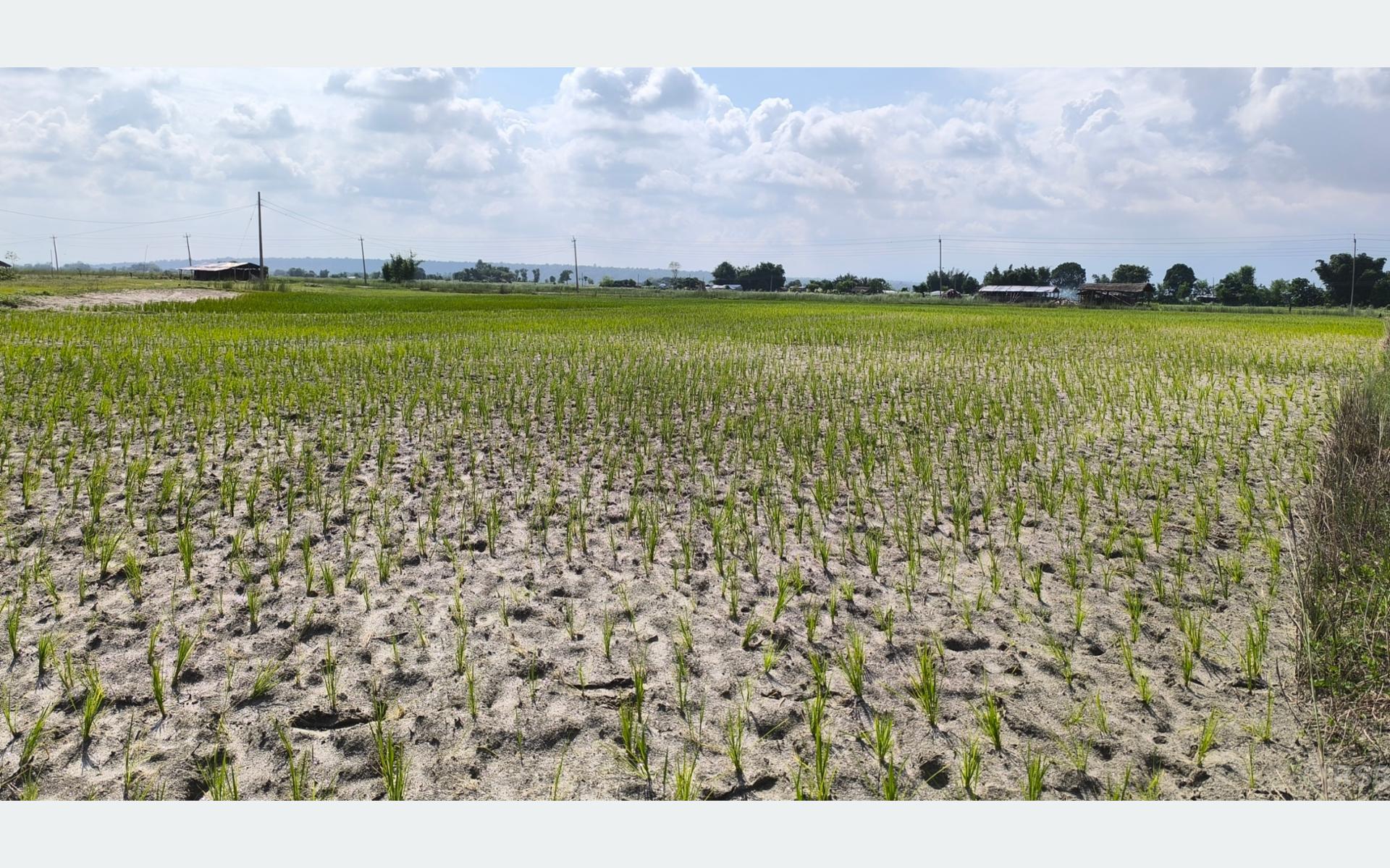
KAILALI: A delayed and weakened monsoon has triggered an emerging drought across parts of Sudurpaschim Province, particularly in Kailali and neighboring districts, posing a serious threat to paddy cultivation.
Farmers who had transplanted paddy seedlings in June using water drawn from boring pumps are now witnessing their fields crack under a dry spell that has lasted more than two weeks. With no significant rainfall since July, many fear the paddy crop may wither unless the monsoon intensifies soon.
“We transplanted paddy in June using water pumped from underground sources,” said local farmer Harilal Chaudhary. “But for the past two weeks, there’s been no sufficient rain. The drought is drying up the fields and damaging the crops.”
Although the monsoon arrived about 15 days earlier than average this year, it has failed to become fully active in the Far West. The Mahakali Basin Field Office of the Department of Hydrology and Meteorology in Attariya confirmed that the monsoon system remains weak in the region.
“Since recording 212.2 mm of rainfall in Dhangadhi on June 30, there hasn’t been any significant rain,” said office chief Sanjay Sah. He attributed the erratic behavior of the monsoon to the impacts of climate change.
According to agricultural technicians, the insufficient rainfall is not only stunting paddy growth but also increasing the risk of weed overgrowth and pest infestation in semi-irrigated fields. They warn that such climate-induced stresses could have long-term consequences on food security in the region.
The ongoing dry conditions have been accompanied by sweltering heat, making daily life increasingly difficult for residents across Kailali and surrounding districts. Locals report restless nights and frequent bathing just to cope with the oppressive humidity and rising temperatures.
“This sticky, suffocating heat has made it difficult to sleep at night. I’ve had to bathe multiple times a day just to feel some relief,” said Yagyaraj Bhatt, a resident of Dhangadhi.
While maximum temperatures have not been extreme, increased humidity and elevated minimum temperatures have made the heat feel more intense, meteorologists say. Vulnerable groups — including laborers, the elderly, and school children — are particularly affected.
Climate experts caution that the changing weather patterns — including irregular monsoon rains, unseasonal cyclones, and extreme heat — are becoming more frequent in Nepal, underscoring the urgent need for climate adaptation and resilient agricultural planning.






Comment