




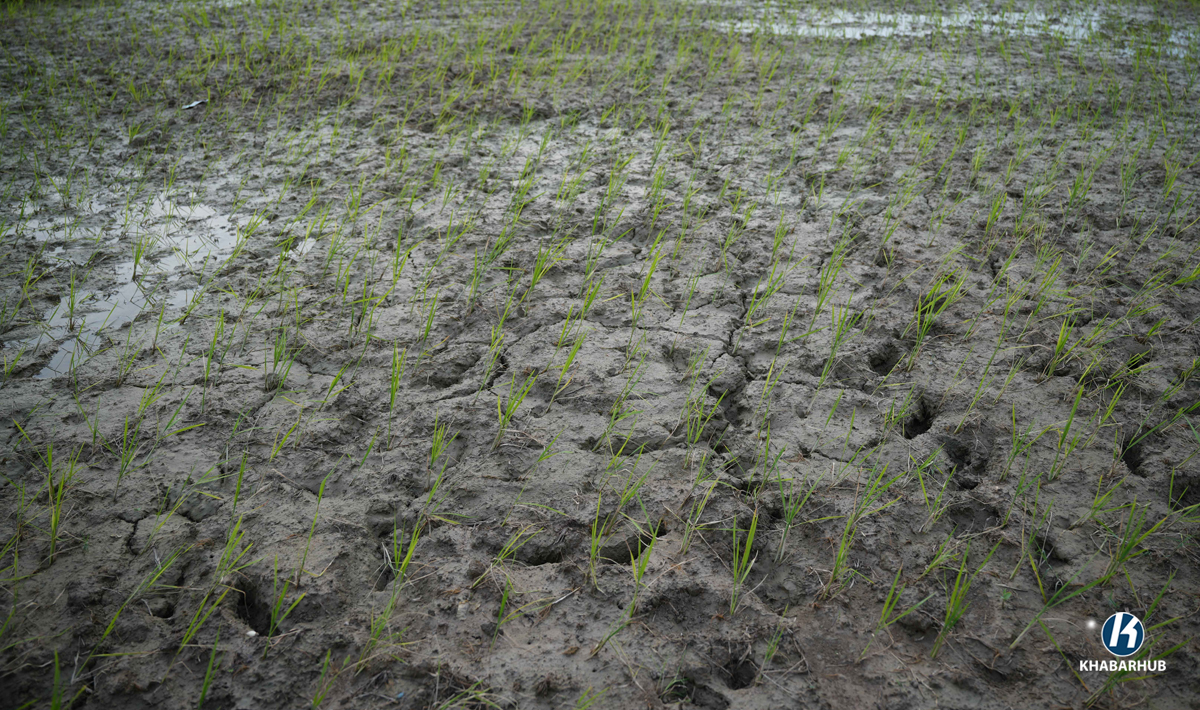
KAILALI: The paddy crop in several districts of Sudurpaschim Province, including Kailali, has begun to wither due to a prolonged dry spell, as the monsoon rains have yet to fully activate.
Local farmers report that paddy fields, which were irrigated using water from boreholes due to a lack of rainfall, are now cracking under the intense summer heat and continued dry weather.
Farmer Harilal Chaudhary expressed concern, saying the main food crop is at risk. “We planted paddy in the last week of June using water pumped from boreholes. Now, without sufficient rain for the past two weeks, the fields are drying up,” he said.
As of now, the monsoon has not been fully active in the region, particularly in Kailali and Kanchanpur districts. According to the Mahakali Basin Field Office of the Department of Hydrology and Meteorology in Attariya, although the monsoon arrived 15 days earlier than average this year, it has failed to maintain momentum.
Sanjay Sah, Chief of the Field Office, said, “On June 30, Dhangadhi received 212.2 mm of rainfall, but since then, there has been no significant precipitation.”
He further noted that the weakening monsoon is likely linked to the impacts of climate change. Agricultural technicians have warned that the lack of consistent rainfall is increasing the risk of weeds, diseases, and pests in paddy fields that were planted with minimal water availability.
Experts say climate change is leading to a growing pattern of unpredictable weather—rains failing to arrive on time, flash floods and inundation when it does rain, and unseasonal events like storms and cyclones.
These issues are becoming more frequent and are putting increasing pressure on the agricultural sector and food security in the region.






Comment