




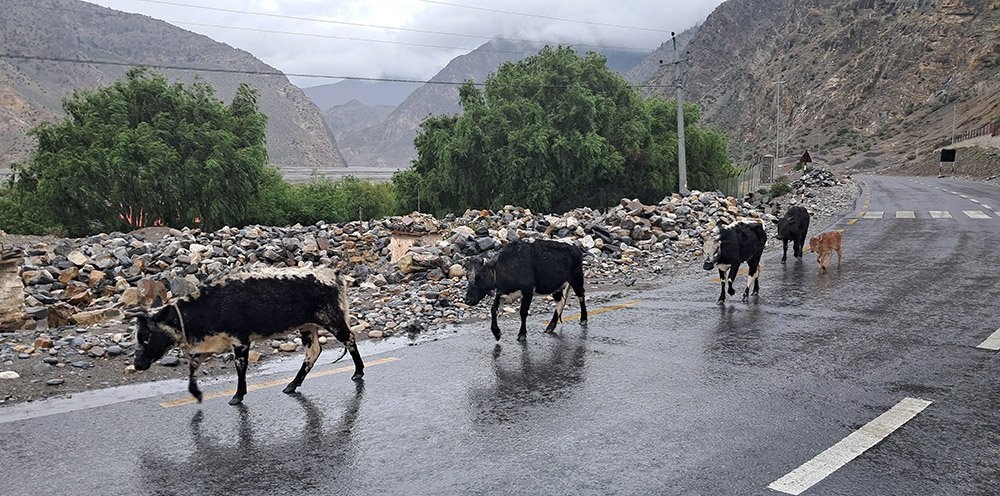
MUSTANG: Among various indigenous cow breeds raised by farmers in the Himalayan districts of Mustang, Manang, and Dolpa, the dwarf lulu cow has historically played a vital role in the region’s ecosystem.
However, this native breed is now facing the threat of extinction due to neglect, declining interest from farmers, and increasing modernization.
The Lulu cow is a small, hump-less local breed uniquely adapted to high-altitude Himalayan terrain. It thrives in elevations above 2,500 meters and has been raised for generations, particularly in Mustang, as part of local tradition and culture.
Dr. Lalmani Aryal, chief of the Veterinary Hospital and Livestock Expert Center, reported that the number of Lulu cows in Mustang has sharply declined—from over 10,000 a decade ago to around 6,000 today across five rural municipalities.
“Every year, the number of Lulu cows in Mustang is decreasing,” said Dr. Aryal. “Farmers are losing interest due to the breed’s low milk yield and the availability of more profitable alternatives. There has been little local concern or effort for their conservation.”
Lulu cows are primarily kept for manure, which is crucial for crop farming in the region, and for limited milk production. However, due to their low milk output—typically no more than one liter per day—farmers are turning away from this breed.
Aitlal Thakali, livestock officer of Gharapjhong Rural Municipality, noted that farmers now prioritize other income-generating activities, such as agriculture and tourism.
“Once, households used to keep 10–12 Lulu cows; now, it’s rare to find even one,” said local farmer Ajit Thakali. “People have started leaving these cows unattended as they focus more on running hotels or other businesses.”
Lulu cows are deeply embedded in the Himalayan cultural and ecological identity. Still, rising threats from climate change, including drying water sources and diminished grassland in high pastures, are further accelerating their decline. Conservationists warn that without urgent action, the breed could disappear entirely.
The challenge is compounded by natural predators—such as snow leopards and stray dogs—that prey on unprotected calves. Additionally, as pastures dry and feeding becomes more difficult, many Lulu cows are abandoned in villages and along roadsides, scavenging for discarded food and waste.
Despite having the natural ability to graze and manage their own feeding, Lulu cows are increasingly relying on human waste and leftover food for survival—a sign of both neglect and environmental stress.
Experts like Dr. Aryal and local authorities have called for structured conservation efforts and farmer incentives to protect this vital but vanishing breed. Without immediate intervention, the Lulu cow—once a symbol of Himalayan life and resilience—may soon become a relic of the past.






Comment