




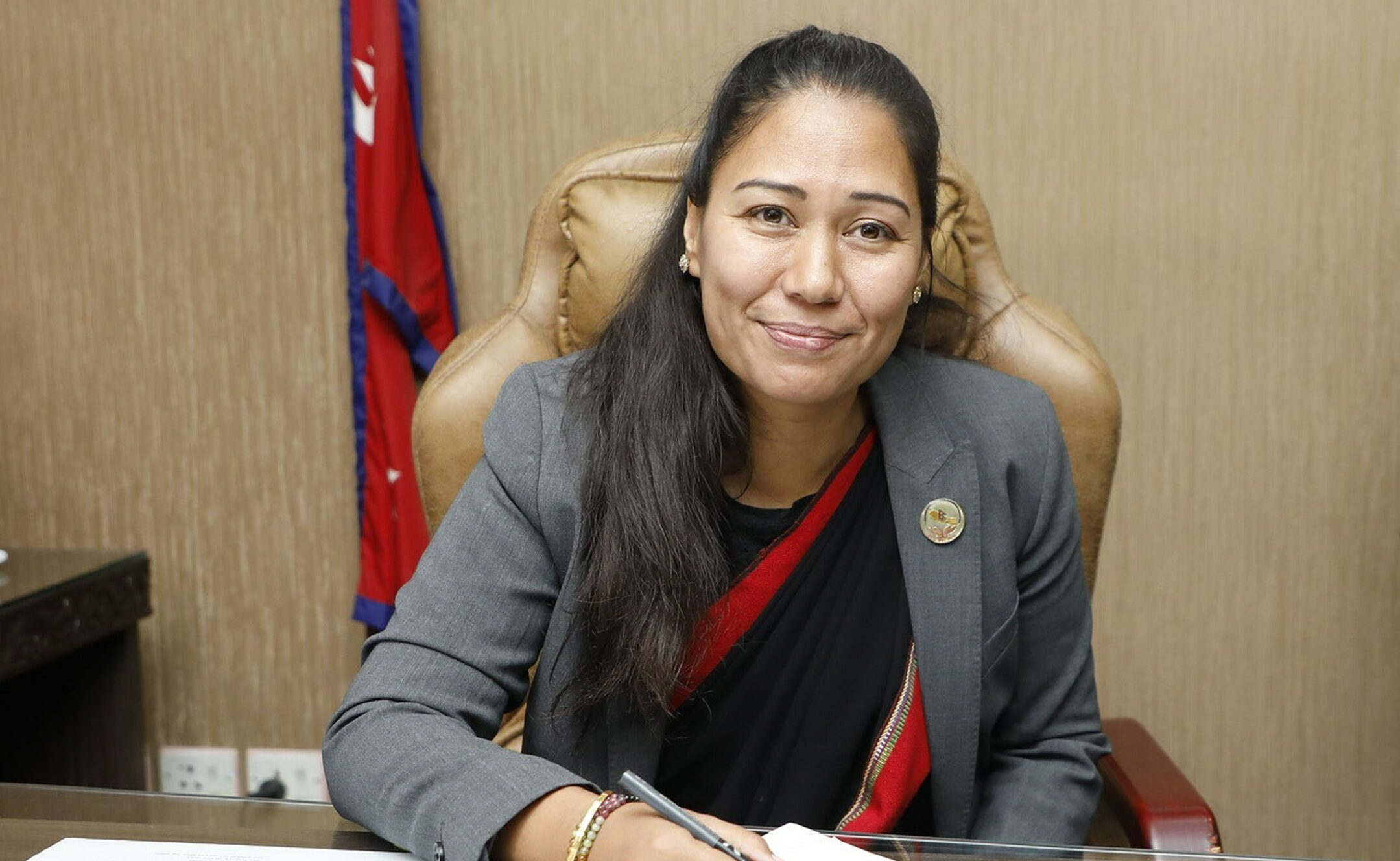
KATHMANDU: The School Education Bill, which has significant implications for millions of students and teachers across Nepal, has been endorsed by the Education, Health and Information Technology Committee of Parliament. However, it has moved forward with dissenting notes from several Members of Parliament and is now under consideration in the House of Representatives.
Despite the bill’s progression, it continues to face opposition from both public school teachers and private school administrators, many of whom have staged protests against it.
Among the dissenting voices is former Education Minister and Rastriya Swatantra Party (RSP) MP Sumana Shrestha, who has consistently advocated for an education policy that prioritizes students’ interests, ensures political neutrality in public schools, and mandates that private schools operate on a non-profit basis.
Ahead of the bill’s submission to the House, Shrestha registered a formal note of dissent. Below is an excerpt from a brief conversation with her, conducted by Khabarhub’s Narayan Aryal:
You and some other MPs have submitted a note of dissent on the School Education Bill. What are your main objections?
My note of dissent is focused on three main issues. Other parties have raised additional concerns—like the Maoist Centre’s broader five-point dissent and the RPP’s demand to make private schools non-profit—but my focus is on three specific areas:
Early Childhood Development (ECD): ECD is not just a program—it’s the foundational stage of a child’s education. Former minister Bimala Rai Paudyal even presented data showing how investing in ECD yields high returns in learning outcomes. Yet, the bill treats it superficially. We need to allocate sufficient investment to ECD, not just consider it as a play area for children. It must be formally recognized, and ECD facilitators should be given career development opportunities and re-designated as teachers. Without clear career paths, there’s no motivation for those working in this vital area.
Access to Compulsory and Free Education: The bill proposes 10% quota for free education, but that provision alone is not enough. For example, if a school has hostel facilities for 50 students, it should reserve at least 5 of those seats for students from extremely poor backgrounds.
Without support for accommodation and food, many students—especially those living on less than Rs 200 a day—cannot afford to study. Scholarships alone won’t help if students can’t afford basic living costs in places like Kathmandu.
Gender and Reproductive Health Rights: Article 38(5) of the Constitution calls for positive discrimination for women, but the bill doesn’t address this adequately. Maternity leave is provided, but it’s not sufficient in practice—especially for women who undergo abortions or require additional reproductive health care.
Repeated abortions are not listed as serious illnesses, meaning teachers are denied transfer priority and proper support. I’ve recommended that the bill include clear provisions addressing menstruation, childbirth, abortion, and overall reproductive health to ensure teachers, particularly women, are protected and supported.
The issues you raised were not agreed upon during discussions. Is that why you had to submit a note of dissent?
Yes, exactly. Many MPs supported the concerns I raised, especially on Early Childhood Development (ECD). However, the Ministry of Education consistently cited financial constraints. We had proposed joint investment from the federal, provincial, and local governments, with specific quotas for ECD, but the Finance Commission outright rejected it. Even though several lawmakers emphasized the importance of ECD, the ministry did not accommodate our suggestions.
On the second point, they refused even a small percentage increase, and on the third issue—related to reproductive health—they argued it is covered by a separate law, which in reality does not fully address the concerns.
How is it possible that the parties couldn’t form a unified stance on such a crucial issue affecting the future of the country?
I can’t speak for all parties, but our party (RSP) presented a clear and collective position. I personally gave a presentation to the committee, aligning with the views of other members. It was submitted in an organized and policy-driven way. But the broader political landscape remains fragmented on the issue.
Now that the Education Committee has passed the bill, do you think it will pass the House in its current form?
It should pass, in theory. Despite disagreements among stakeholders, ministers and committee leadership reached a consensus to move the bill forward. The current provisions—like the 2.5% or 3% allocation—came out of those understandings. If they now backtrack, it would be disappointing and hard to justify.
Unfortunately, various vested interests have heavily influenced the bill. We had cautioned that as long as it remained stuck in the committee, the bill would be vulnerable. That’s why we felt it was important to move forward—even if it meant submitting dissenting views.
What kind of impact do you expect this law to have on school education if passed?
If we truly want to transform school education, then political influence through party-affiliated organizations must end. No matter how much money is invested, if schools are run under parallel political systems, genuine reform is impossible. Teachers closely affiliated with political parties often prioritize partisan interests over professional responsibility. If 10% of teachers receive benefits without fulfilling their duties, while others have to cover for them, it creates an unequal and demoralizing environment. The presence of sister organizations weakens the system from within, and until they are removed, meaningful change will be hard to achieve.
So even if the bill becomes law, can we not expect a fresh start in Nepal’s schools?
That’s the biggest challenge—implementation. Even under the Education Act of 2028 BS, political party members were barred from holding executive roles in schools, and there were directives reiterating this. Yet, enforcement has been non-existent. Parties continue to embed their sister organizations and power centers into the education system for political leverage, especially during elections.
As long as teaching is seen as a 10-to-4 job and not a deeply committed profession, we will not see the results we hope for. There is dedication among educators—but we must not normalize mediocrity as the standard. That would be a disservice to the entire education system.
You worked hard to remove political influence from schools, but it hasn’t been possible, has it?
No, it hasn’t. The problem isn’t just political parties—Members of Parliament themselves are involved. One MP openly said that if we eliminate political influence from schools, it will be difficult to mobilize support during the next election.
This is the mindset: when elections dominate our thinking, everything—from policymaking to budget allocation—is influenced by that.
Political parties’ sister organizations in schools make things even more difficult. Instead of politically affiliated groups, we should form thematic teacher associations focused on professional development and peer support.
Teachers do need support networks—but under the current system, political proximity often dictates outcomes. Teachers aligned with party networks get protection even if they underperform, while competent teachers without political ties are overlooked.
Why has it been so difficult to set a time frame for making private schools non-profit and implement proper regulations?
That’s a major gap—we’ve failed to set a clear deadline. The private sector has significant influence, and we’ve even defined the concept of “non-profit” incorrectly. My stance has never been anti-private sector—it was always anti-profit-making in education.
Unfortunately, my position has been misrepresented. While some want to ban private schools outright, I wanted to prohibit profit-making, not private involvement itself.
There has also been no progress on equalizing teacher benefits in private and public schools. However, we have stated that local governments should regulate private schools through law, and that teacher salaries should align with the national minimum wage. But much more remains to be done.
The Teachers’ Federation and private school administrators have recently announced fresh protests. Why, despite their demands being addressed?
Many of their concerns have actually been addressed in the bill. However, the agreement they reached that undermines federalism cannot be implemented, and it will likely be challenged in court and struck down. I don’t fully understand the reason behind their continued protests.
Ironically, in the case of private schools, they’ve essentially won. The proposal to make private schools non-profit after 15 to 20 years has quietly disappeared from the bill. This, despite the Constitution clearly stating that education should serve the public interest, and the Supreme Court’s joint bench of Justices Hari Phuyal and Ishwar Khatiwada ruling that private schools should transition to non-profit models. How can anyone reject what both the Constitution and the judiciary have clearly interpreted?



Comment