




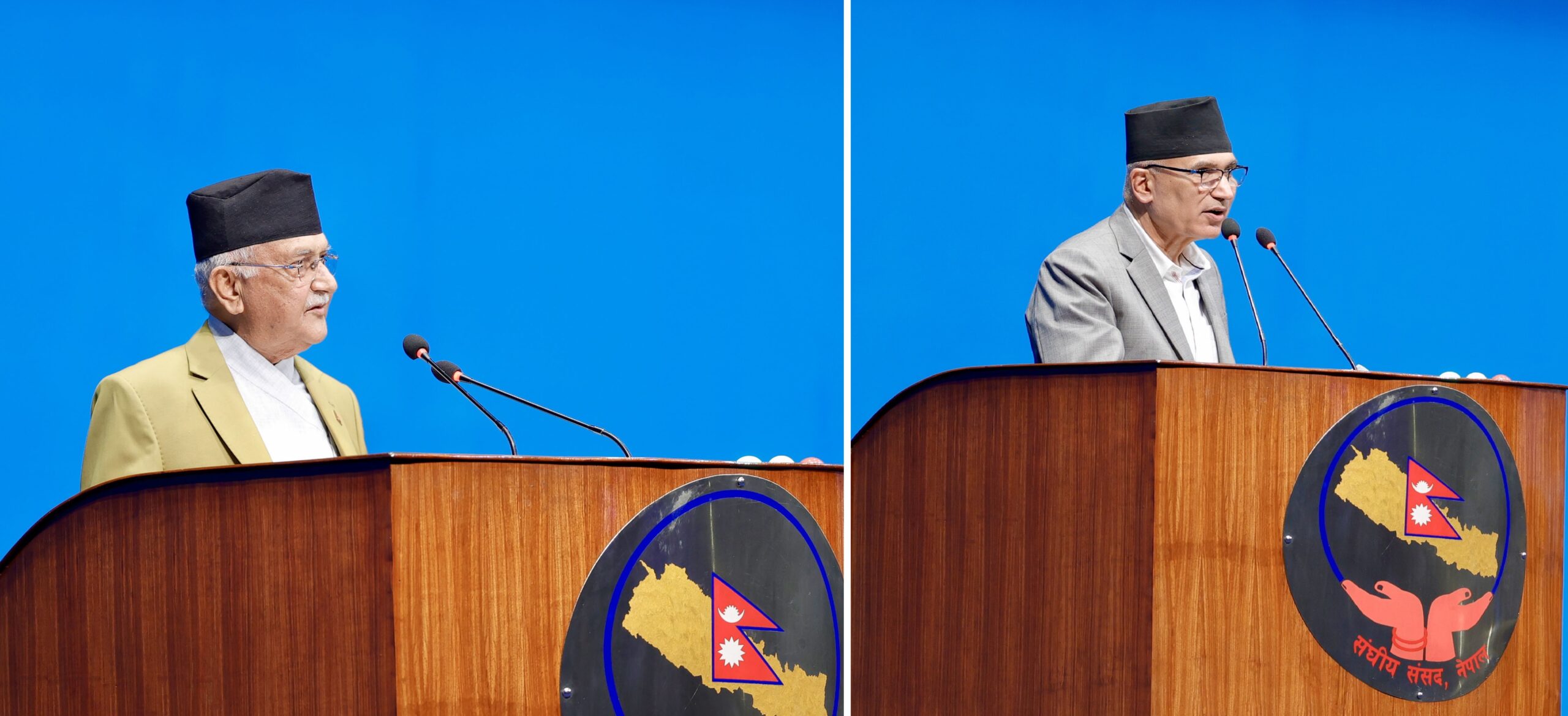
KATHMANDU: Prime Minister KP Sharma Oli and Deputy Prime Minister and Finance Minister Bishnu Prasad Paudel have defended the government’s decision to roll back the controversial ‘Take and Pay’ provision introduced in the budget speech for fiscal year 2083/84.
The provision, which had drawn criticism from energy producers, was removed following pressure from stakeholders and political parties.
Speaking during the ongoing House of Representatives meeting on Tuesday, where discussions on the Appropriation Bill and proposed expenditure cuts were underway, both leaders explained the rationale behind the policy shift.
Their responses came after lawmakers from the opposition CPN (Maoist Centre), including Aman Lal Modi and Ganga Karki, questioned why the government withdrew the provision.
Prime Minister Oli responded in his usual candid manner, saying, “It was introduced with good intentions, but since it seemed likely to do more harm than good, we decided to withdraw it.”
Finance Minister Paudel offered a more detailed explanation, referring to the government’s energy roadmap.
“According to our energy development roadmap, we have only 1,500 megawatts of space left for run-of-the-river (ROR) project PPAs until 2035. Clause 227 clarifies that power purchase will be limited to those projects with confirmed consumption or export plans and those that the Nepal Electricity Authority (NEA) can financially commit to,” he stated.
The ‘Take and Pay’ model had provoked backlash from power producers, who warned that more than Rs 66 billion in investments could be jeopardized and that the government’s 10-year target to generate 28,500 megawatts of electricity could collapse.
Critics argued that the ‘Take and Pay’ structure offered no purchase guarantee, unlike the existing ‘Take or Pay’ model under which NEA is obliged to buy all electricity generated. Without such assurance, financial institutions are unlikely to invest, and developers lack the incentive to proceed with hydropower projects.
The ruling Nepali Congress, a key coalition partner, also recommended removing the provision, leading to its eventual amendment in the budget.
Currently, NEA signs Power Purchase Agreements (PPAs) under the ‘Take or Pay’ system, which guarantees that all electricity generated by a project will be purchased regardless of demand.
Energy entrepreneurs have strongly advocated for this model to continue, citing its importance for investment and long-term energy planning.






Comment